



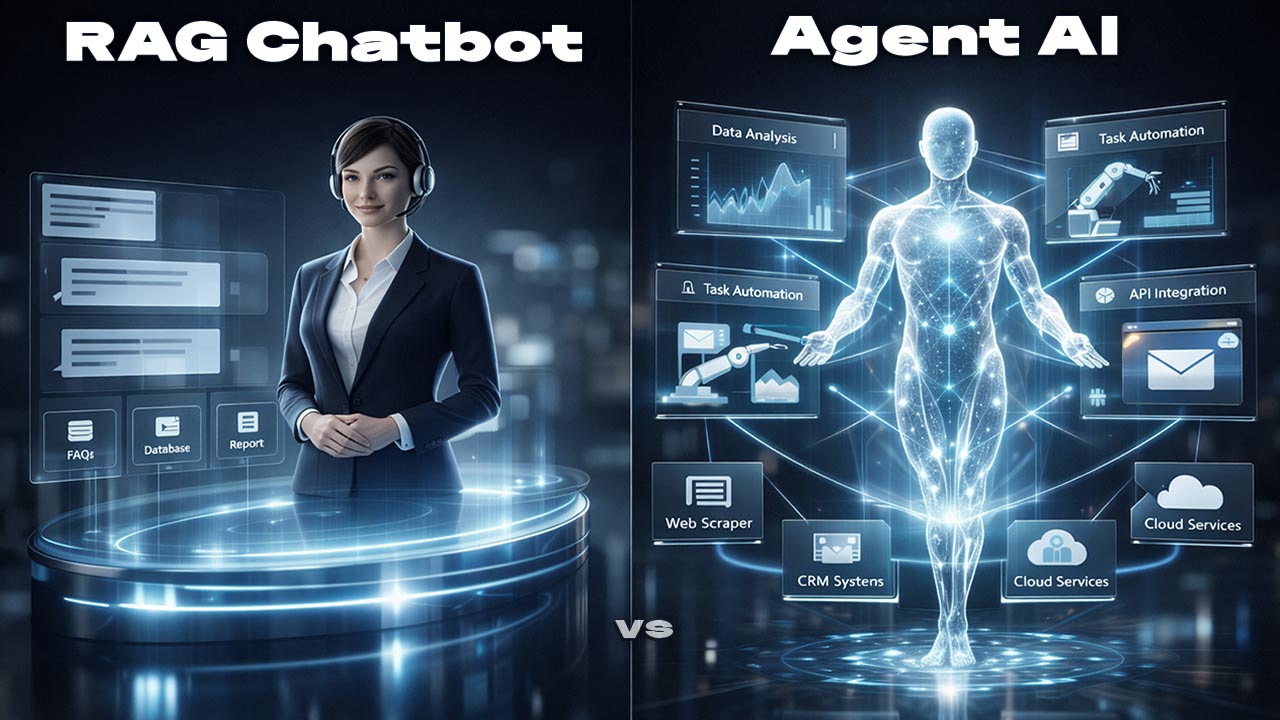
RAG Chatbot vs Agent AI: Key Differences, Use Cases, and Effectiveness
Artificial intelligence systems are rapidly evolving beyond simple conversational tools. Two architectures now dominate enterprise AI deployments: Retrieval-Augmented Generation (RAG) chatbots and Agent AI systems. While both aim to enhance decision-making and automation, they differ fundamentally in design, capability, and business impact. Todays article explains how each works, where each excels, and which is more effective depending on strategic objectives.
Table of Contents
- What Is a RAG Chatbot?
- What Is Agent AI?
- Architectural Differences
- Enterprise Use Cases
- Effectiveness Comparison
- Risk, Governance, and Control
- Future Outlook
- Top 5 Frequently Asked Questions
- Final Thoughts
- Resources
What Is a RAG Chatbot?
A Retrieval-Augmented Generation chatbot combines a large language model with an external knowledge retrieval layer. Instead of relying solely on pre-trained parameters, the system fetches relevant documents from structured or unstructured data sources at query time and uses them to ground its responses. From an innovation management standpoint, RAG systems reduce hallucination risk while preserving natural language fluency. They are especially effective in knowledge-intensive environments where accuracy, traceability, and compliance matter. RAG chatbots typically integrate vector databases, semantic search, and enterprise content repositories. This allows organizations to deploy AI without retraining models whenever internal knowledge changes, significantly lowering operational friction.
What Is Agent AI?
Agent AI systems go beyond answering questions. They are autonomous or semi-autonomous entities capable of planning, decision-making, tool usage, and goal execution across multiple steps. An AI agent can decompose objectives, call APIs, write and execute code, query databases, and adapt its behavior based on feedback. In effect, it acts less like a chatbot and more like a digital knowledge worker. From a technology management perspective, Agent AI introduces a new operational paradigm: AI as an active participant in workflows rather than a passive interface.
Architectural Differences
RAG chatbots follow a relatively linear architecture:
User query → Retrieval → Context injection → Response generation
Agent AI systems rely on a cyclical architecture:
Goal definition → Planning → Action execution → Observation → Reflection → Iteration
This distinction has major implications for system complexity. RAG systems are deterministic, auditable, and easier to govern. Agent systems are adaptive but introduce emergent behaviors that require stronger oversight.
Enterprise Use Cases
RAG chatbots dominate in:
- Customer support knowledge bases
- Legal and compliance advisory tools
- Internal policy and HR assistants
- Medical and scientific literature querying
Agent AI excels in:
- Automated data analysis and reporting
- Software development and DevOps workflows
- Business process automation
- Strategic research and competitive intelligence
Organizations pursuing incremental innovation typically adopt RAG first. Those pursuing transformational automation gravitate toward Agent AI.
Effectiveness Comparison
Effectiveness depends on the evaluation dimension. Accuracy: RAG chatbots outperform Agent AI in regulated or fact-sensitive domains because retrieved sources anchor responses. Autonomy: Agent AI is more effective when tasks require decision-making, iteration, or tool orchestration. Cost Efficiency: RAG systems are cheaper to deploy and maintain due to limited execution scope.
Scalability: Agent AI scales organizational capability rather than just information access, offering higher long-term strategic value. In quantitative terms, enterprise pilots report up to 40 percent reduction in knowledge worker time using RAG, while Agent AI deployments report productivity gains exceeding 60 percent in automation-heavy functions.
Risk, Governance, and Control
RAG chatbots are easier to govern. Every answer can be traced back to a source, enabling auditability and compliance.
Agent AI introduces risks including:
- Unintended actions
- Tool misuse
- Feedback loop amplification
- Security exposure through API access
Effective governance requires sandboxing, permission layers, human-in-the-loop controls, and real-time monitoring. From a risk-adjusted innovation lens, RAG represents low-risk, high-confidence value. Agent AI represents high-reward, high-governance complexity.
Future Outlook
The future is not RAG versus Agent AI, but convergence. Next-generation systems are already combining RAG grounding with agentic planning. This hybrid approach allows AI to reason, act, and verify against trusted data sources. As compute efficiency improves and governance frameworks mature, Agent AI adoption will accelerate. However, RAG chatbots will remain foundational infrastructure for enterprise knowledge systems.
Top 5 Frequently Asked Questions
Final Thoughts
The most important takeaway is this: effectiveness is contextual. RAG chatbots optimize knowledge accuracy and trust. Agent AI optimizes autonomy and operational leverage. Organizations that align the architecture with their innovation maturity and risk tolerance will outperform those chasing capability without strategy.
Resources
- Stanford HAI – Foundation Models Research
- Gartner – AI Architecture Trends and Agentic Systems
- OpenAI Technical Documentation
- McKinsey Global Institute – The Economic Potential of Generative AI


Leave A Comment