



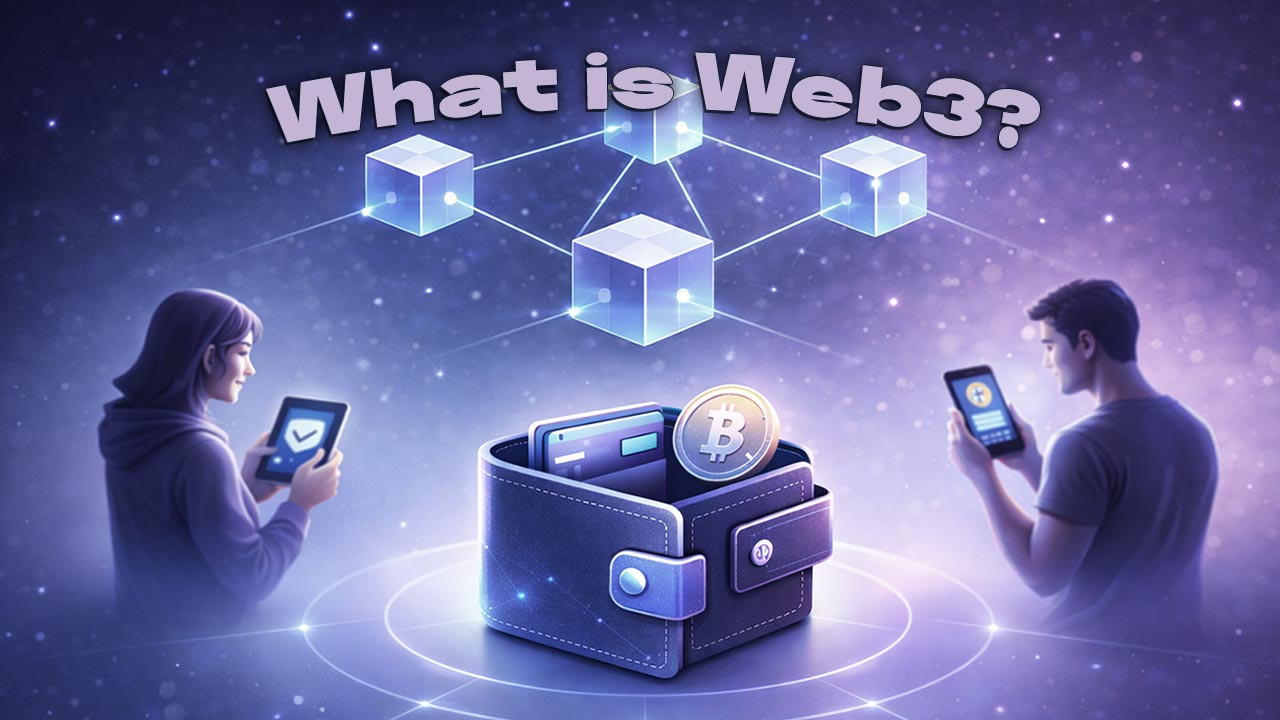
Web3 Explained: A Practical Guide to the Decentralized Internet
Web3 represents the next major shift in how the internet works—moving control from centralized platforms to users through decentralized networks, cryptography, and blockchain-based protocols. Instead of trusting intermediaries, Web3 enables peer-to-peer ownership, programmable value, and transparent digital coordination at internet scale.
Table of Contents
- The Evolution of the Web: Web1 to Web3
- What Exactly Is Web3?
- Core Technologies Powering Web3
- How Web3 Works in Practice
- Real-World Web3 Use Cases
- Key Benefits of Web3
- Challenges and Limitations
- Web3 vs Web2: A Strategic Comparison
- The Future of Web3
- Top 5 Frequently Asked Questions
- Final Thoughts
- Resources
The Evolution of the Web: Web1 to Web3
The internet has evolved in distinct phases driven by shifts in technology and power structures. Web1, emerging in the 1990s, was read-only. Users consumed static pages with little interaction. Ownership and publishing were limited to those with technical access. Web2, which dominates today, introduced social platforms, cloud computing, and mobile apps. Interaction exploded, but so did centralization. A small number of platforms control data, identity, and monetization. Users create value, but platforms capture most of it. Web3 proposes a structural correction. It re-architects the internet around decentralized ownership, where users control their data, digital assets, and online identity without relying on centralized gatekeepers.
What Exactly Is Web3?
Web3 is a decentralized internet model built on blockchain networks where trust is established through cryptography and consensus rather than institutions. Instead of logging in with an email and password controlled by a platform, users interact using cryptographic wallets that they own. At its core, Web3 enables three things simultaneously: digital ownership, programmable trust, and native value transfer. Assets, identity, and logic live on decentralized networks rather than private servers. From an innovation management perspective, Web3 is not a single technology. It is a coordination layer that reshapes incentives across ecosystems, enabling new business models that were not feasible under Web2.
Core Technologies Powering Web3
Blockchain is the foundational ledger technology that records transactions immutably across distributed nodes. It eliminates the need for a central authority to validate activity. Smart contracts are self-executing programs deployed on blockchains. They automate agreements, enforce rules, and reduce transaction costs. Once deployed, they operate exactly as coded. Cryptographic wallets act as identity, payment rail, and permission layer. Tools like MetaMask allow users to interact directly with applications while retaining custody of assets. Decentralized storage networks replace centralized cloud providers by distributing data across multiple nodes, improving resilience and censorship resistance.
How Web3 Works in Practice
In a typical Web3 interaction, a user connects a wallet to a decentralized application. The application’s logic is defined by smart contracts, not by a company’s backend server. When a transaction occurs, it is validated by the network and permanently recorded on the blockchain. Ownership changes instantly without intermediaries like banks, app stores, or payment processors. Governance is often handled through tokens that grant voting rights. Communities collectively decide protocol upgrades, funding allocation, and rule changes, creating digitally native organizations without traditional hierarchies.
Real-World Web3 Use Cases
Decentralized finance enables lending, borrowing, and trading without banks. Users retain custody while protocols manage liquidity algorithmically. Non-fungible tokens establish verifiable ownership of digital and physical assets. This has implications beyond art, including intellectual property, ticketing, and supply chains. Decentralized autonomous organizations coordinate capital and labor globally. They operate transparently through code rather than management layers. Identity systems allow users to prove attributes without revealing personal data, reducing fraud while enhancing privacy.
Key Benefits of Web3
Web3 shifts value capture from platforms to participants. Users can directly monetize their contributions and retain ownership of assets they create. Transparency increases trust. All transactions and rules are publicly verifiable, reducing information asymmetry. Interoperability allows applications to compose like building blocks. Innovation accelerates because developers can build on open protocols rather than closed APIs.
Challenges and Limitations
Scalability remains a technical hurdle. Many networks struggle to process large volumes of transactions efficiently. User experience is still complex. Key management, transaction fees, and onboarding present adoption barriers. Regulatory uncertainty creates strategic risk for enterprises and builders. Governance frameworks are still evolving globally. Security risks exist at the application layer. While blockchains are resilient, poorly written smart contracts can be exploited.
Web3 vs Web2: A Strategic Comparison
Web2 optimizes for convenience and scale but centralizes power. Web3 optimizes for resilience and ownership but trades off simplicity. From a technology management lens, Web2 favors platform dominance, while Web3 favors ecosystem coordination. The strategic question is not replacement, but integration—where decentralization adds measurable value.
The Future of Web3
Web3’s trajectory mirrors early internet adoption. Infrastructure matures first, followed by consumer-grade experiences. As scalability improves and abstractions simplify complexity, adoption barriers will fall. Institutions are already experimenting through foundations such as Ethereum Foundation, signaling long-term commitment to decentralized innovation. The most impactful Web3 applications will likely be invisible to users—embedded into everyday digital experiences while quietly shifting control back to individuals.
Top 5 Frequently Asked Questions
Final Thoughts
Web3 is not a trend—it is a structural evolution of the internet’s trust model. By embedding ownership, transparency, and programmable value directly into digital infrastructure, Web3 redefines how economic and social systems operate online. For innovators and technology leaders, the key insight is strategic selectivity: Web3 delivers the greatest impact where decentralization reduces friction, aligns incentives, and unlocks new forms of coordination.


Leave A Comment