



Mastering LangChain’s Prompt Templates: A Beginner’s Guide to Optimizing LLM Interactions
LangChain prompt templates are one of the most practical tools for improving how large language models behave in real-world applications. They introduce structure, consistency, and reusability into what would otherwise be unpredictable prompt engineering. For beginners, prompt templates are often the difference between a prototype that works occasionally and a system that performs reliably at scale.
Table of Contents
- Understanding LangChain and Prompt Templates
- Why Prompt Templates Matter for LLM Performance
- Core Components of a LangChain Prompt Template
- Building Your First Prompt Template
- Best Practices for Optimizing Prompt Templates
- Common Beginner Mistakes to Avoid
- Enterprise and Product Use Cases
- The Future of Prompt Engineering with LangChain
- Top 5 Frequently Asked Questions
- Final Thoughts
- Resources
Understanding LangChain and Prompt Templates
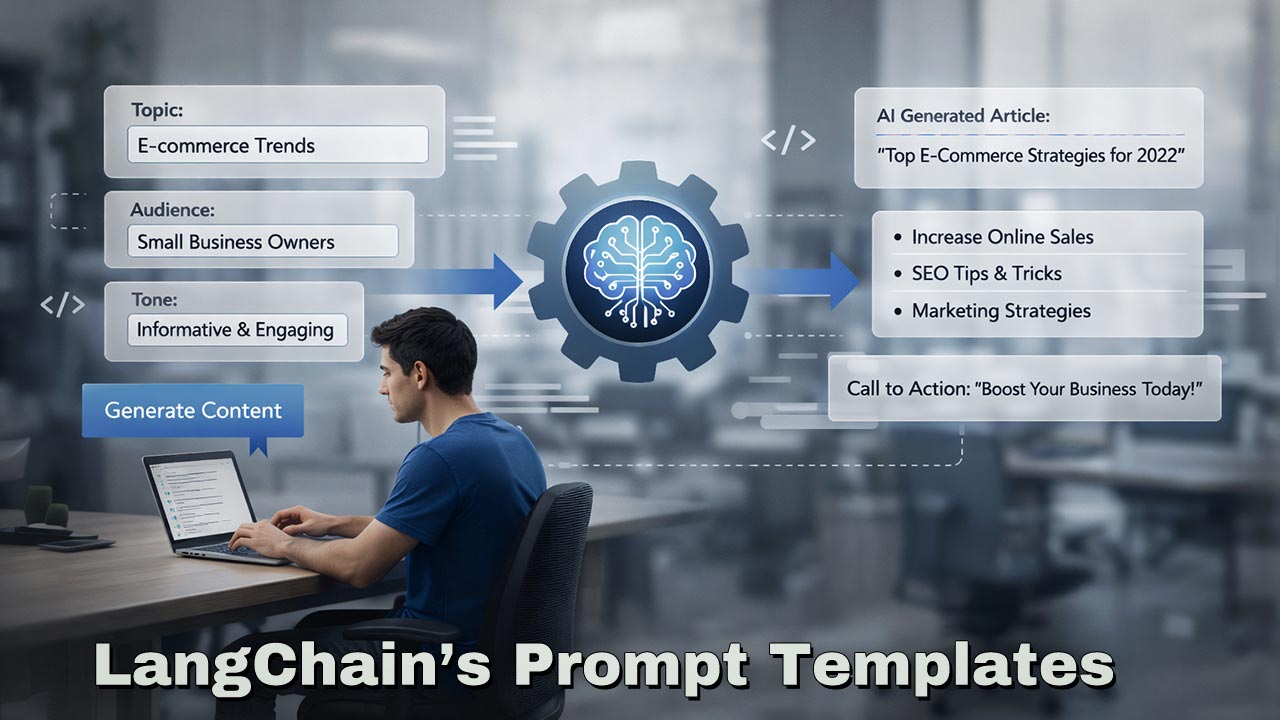
LangChain is an open-source framework designed to simplify the development of applications powered by large language models. Instead of treating prompts as one-off text strings, LangChain treats them as programmable assets that can be managed, tested, and reused. Prompt templates sit at the core of this approach. A prompt template is a structured prompt with placeholders for dynamic input. This allows developers to separate prompt logic from application logic, making systems easier to maintain and evolve. From an innovation management standpoint, this abstraction reduces technical debt. Teams can iterate on prompts without touching business logic, accelerating experimentation while preserving stability.
Why Prompt Templates Matter for LLM Performance
Large language models are probabilistic systems. Small variations in wording can lead to dramatically different outputs. Prompt templates reduce this variability by enforcing consistency. Research from OpenAI and Google DeepMind consistently shows that structured prompting improves task accuracy, especially for reasoning, summarization, and extraction tasks.
Prompt templates enable:
- Predictable output formats
- Improved response accuracy
- Reduced hallucinations
- Easier debugging and testing
For organizations deploying LLMs in production, prompt templates are not optional. They are a governance mechanism that ensures reliability and compliance.
Core Components of a LangChain Prompt Template
A LangChain prompt template typically consists of four elements. First is the instruction layer. This defines what the model is expected to do. Clear, explicit instructions outperform vague requests by a significant margin. Second is the input variables. These are placeholders that accept user or system-provided data. Variables allow a single template to handle thousands of interactions. Third is the context framing. This provides background, constraints, or role definitions. Assigning a role such as “You are a technical analyst” measurably improves output relevance. Fourth is the output expectation. Specifying format, tone, or structure reduces ambiguity and downstream processing costs.
Building Your First Prompt Template
Creating a prompt template in LangChain begins with identifying repetition. If you find yourself copying and pasting prompts with small changes, you need a template. A basic template includes variable placeholders wrapped in curly braces. These variables are injected at runtime, allowing the same prompt logic to be reused across contexts. From a beginner perspective, the key is restraint. Overloading a prompt with instructions reduces clarity. Start simple, validate outputs, then iterate. In innovation teams, prompt templates are often versioned like software artifacts. This allows teams to track performance improvements over time.
Best Practices for Optimizing Prompt Templates
The most effective prompt templates follow a few proven principles. Clarity always beats cleverness. Models respond better to explicit instructions than poetic phrasing. Constraints improve creativity. Defining boundaries reduces hallucination and increases usefulness. Test prompts systematically. Changing one variable at a time reveals what actually improves performance. Document intent. Treat prompt templates as knowledge assets that future team members must understand. Industry data suggests that teams using standardized prompt templates reduce prompt-related errors by over 30 percent compared to ad hoc prompting.
Common Beginner Mistakes to Avoid
One common mistake is treating prompt templates as static. Models evolve, and prompts must evolve with them. Another issue is excessive verbosity. Long prompts do not guarantee better results and often degrade performance. Beginners also underestimate the importance of output formatting. Poorly structured outputs increase downstream processing complexity. Finally, many developers fail to log prompt performance. Without metrics, optimization becomes guesswork.
Enterprise and Product Use Cases
Prompt templates are widely used in customer support automation, document analysis, and decision intelligence systems. In product development, they enable consistent UX across AI-powered features. In regulated industries, prompt templates support compliance by enforcing language constraints and auditability. From a technology management perspective, prompt templates function as operational controls, not just development tools.
The Future of Prompt Engineering with LangChain
Prompt engineering is moving toward modularity and automation. LangChain is already enabling prompt chaining, memory integration, and dynamic prompt selection. Future systems will likely generate and optimize prompts automatically based on feedback loops. For beginners, mastering prompt templates now provides a durable skill that will remain relevant as models advance.
Top 5 Frequently Asked Questions
Final Thoughts
Prompt templates are not a convenience feature. They are a foundational capability for anyone serious about building reliable LLM applications. For beginners, they provide structure. For enterprises, they provide control. Mastering LangChain’s prompt templates is one of the highest return-on-effort investments you can make in modern AI development.


Leave A Comment