



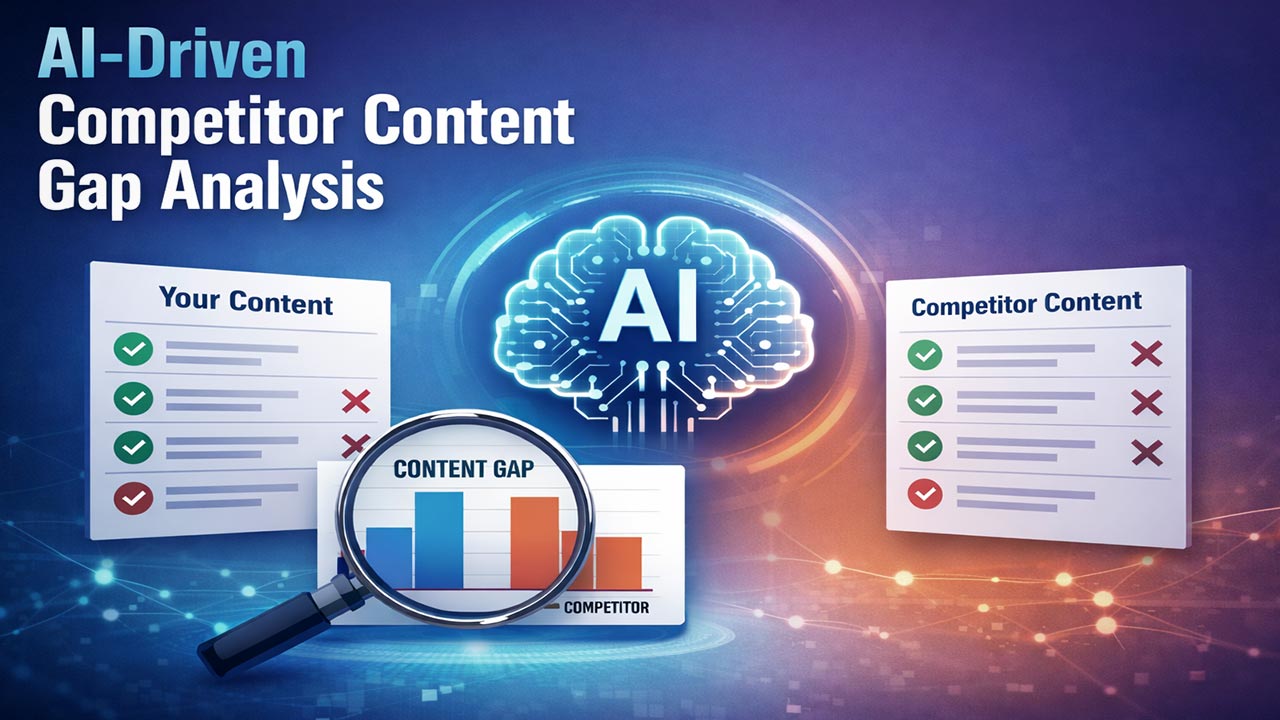
Competitor Content Gap Insights Using AI: The Guide for Businesses
Understanding what your competitors are saying is no longer enough. The real advantage lies in identifying what they are not saying. Competitor content gap analysis powered by artificial intelligence enables businesses to uncover unmet audience needs, missed keyword opportunities, and emerging topics at a scale and depth that manual analysis cannot achieve. This guide explains how AI-driven content gap insights work, why they matter, and how businesses can apply them to gain measurable competitive advantage.
Table of Contents
- What Is Competitor Content Gap Analysis?
- Why Traditional Content Gap Analysis Falls Short
- How AI Transforms Competitor Content Gap Insights
- Key Data Sources Used in AI Content Gap Analysis
- Step-by-Step AI-Driven Content Gap Process
- Business Use Cases and Strategic Impact
- Measuring Success and ROI
- Common Challenges and How to Avoid Them
- The Future of AI in Competitive Content Strategy
- Top 5 Frequently Asked Questions
- Final Thoughts
- Resources
What Is Competitor Content Gap Analysis?
Competitor content gap analysis is the systematic identification of topics, keywords, questions, and narratives that competitors either underutilize or completely ignore. These gaps represent opportunities to attract underserved audiences, rank for high-intent search terms, and establish thought leadership. When enhanced with AI, this process moves beyond keyword overlap comparisons. It analyzes semantic intent, topical authority, sentiment, content depth, and audience engagement patterns. The outcome is not simply a list of missing keywords but a strategic map of unmet information demand.
Why Traditional Content Gap Analysis Falls Short
Manual or rules-based content gap analysis relies heavily on static keyword tools and surface-level competitor comparisons. This approach has several limitations. First, it assumes search intent is fixed, when in reality intent evolves rapidly. Second, it treats all keywords equally, ignoring context, user motivation, and buyer journey stages. Third, it cannot process unstructured data such as long-form articles, customer reviews, or social discussions at scale. As markets become more saturated, these limitations lead to incremental gains rather than meaningful differentiation.
How AI Transforms Competitor Content Gap Insights
Artificial intelligence fundamentally changes how content gaps are identified and prioritized. Natural language processing allows AI systems to understand meaning rather than just matching words. Machine learning models detect patterns across thousands of competitor assets in minutes. AI-driven systems can cluster topics by intent, identify content freshness decay, and highlight narrative blind spots where competitors fail to address emerging concerns. For example, AI can reveal that competitors discuss product features extensively but neglect implementation challenges, compliance implications, or ROI justification. This depth of insight enables businesses to create content that is not only different, but strategically superior.
Key Data Sources Used in AI Content Gap Analysis
AI-powered content gap insights depend on diverse and high-quality data inputs. Search engine results pages provide visibility into ranking content and keyword intent. Competitor websites offer long-form content, landing pages, and metadata. Customer-generated content such as reviews, forums, and Q&A platforms reveal real-world pain points. Social media conversations highlight emerging trends and sentiment shifts. Sales enablement materials and analyst reports add industry context. By integrating these sources, AI models create a holistic view of the competitive content landscape.
Step-by-Step AI-Driven Content Gap Process
The process begins with competitor selection based on search visibility, market overlap, and audience similarity. AI systems then ingest competitor content at scale, converting unstructured text into machine-readable representations. Next, semantic analysis identifies core topics, subtopics, and intent categories. Gap detection algorithms compare these against audience demand signals such as search volume growth, question frequency, and engagement metrics. Finally, AI prioritizes gaps based on business relevance, competitive difficulty, and conversion potential. The output is a ranked content roadmap aligned with strategic objectives.
Business Use Cases and Strategic Impact
For marketing teams, AI-driven content gaps inform editorial calendars and SEO strategies with higher confidence. For product teams, insights reveal unmet informational needs that often correlate with feature gaps or onboarding challenges. Sales organizations benefit from content that addresses objections competitors ignore. Executive teams gain market intelligence that supports positioning and innovation decisions. According to McKinsey, organizations that leverage AI-driven insights are 23 percent more likely to outperform competitors in customer acquisition and retention.
Measuring Success and ROI
Success measurement must go beyond traffic growth. Key indicators include keyword coverage expansion, ranking velocity, engagement depth, and assisted conversion rates. AI also enables predictive measurement by estimating content impact before publication. By tracking how gap-driven content performs relative to baseline competitor benchmarks, businesses can quantify return on insight rather than intuition.
Common Challenges and How to Avoid Them
One common mistake is over-automation. AI insights require human interpretation to ensure brand alignment and accuracy. Another challenge is data bias, where incomplete competitor selection skews results. Businesses should combine AI outputs with expert review and continuously retrain models using updated market data. Governance and ethical AI practices are essential to maintain trust and reliability.
The Future of AI in Competitive Content Strategy
The next evolution of AI content gap analysis will be real-time and predictive. Systems will anticipate competitor moves and emerging topics before they appear in search results. Generative AI will increasingly work alongside analytical AI, enabling rapid creation of high-quality content tailored to identified gaps. This convergence will make content strategy a core component of competitive intelligence rather than a downstream marketing function.
Top 5 Frequently Asked Questions
Final Thoughts
Competitor content gap insights powered by AI represent a shift from reactive marketing to proactive market leadership. By revealing what competitors overlook and audiences actively seek, businesses can align content strategy with real demand. The most important takeaway is that AI does not replace strategic thinking; it amplifies it. Organizations that integrate AI-driven insights into decision-making frameworks will consistently outpace those relying on intuition alone.
Resources
- McKinsey & Company – The State of AI in Marketing
- Harvard Business Review – Competing in the Age of AI
- Gartner – Market Guide for Content Marketing Platforms
- Google Search Central – Understanding Search Intent


Leave A Comment