



How Much do Graphic Designers Make
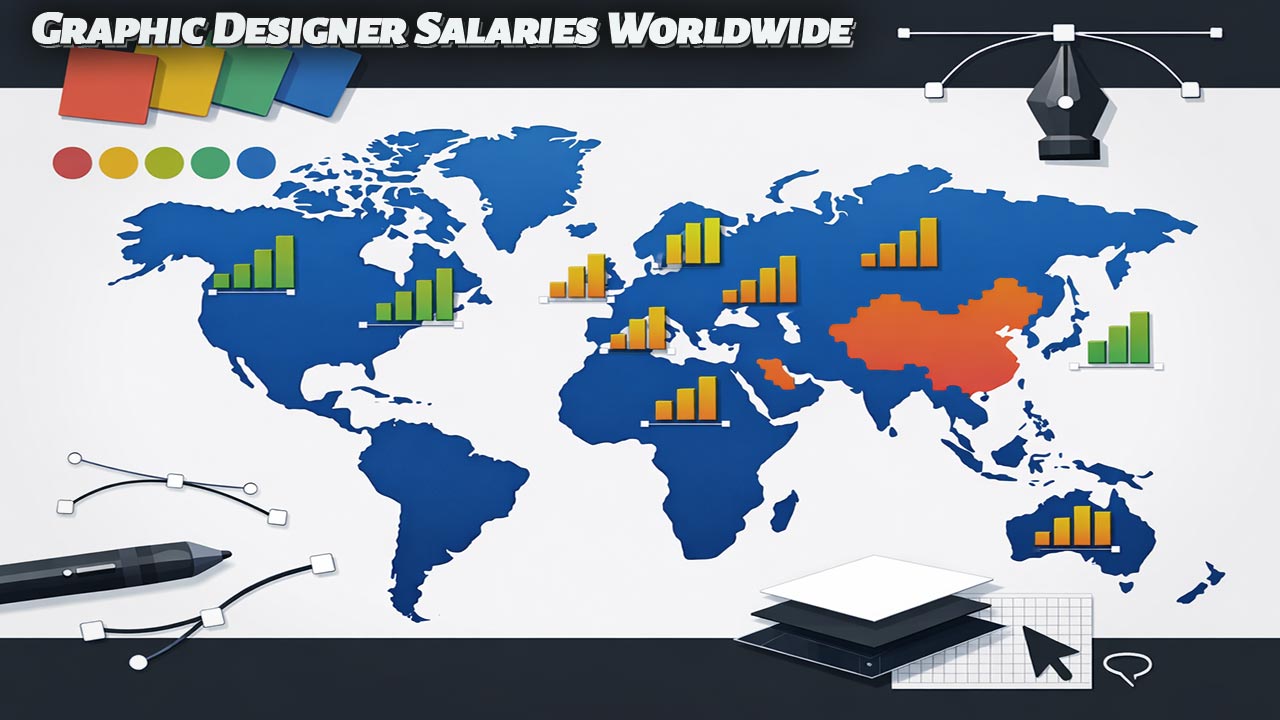
This guide breaks down graphic designer pay across 10 major markets, including an annual salary table, entry-level vs senior ranges, and a practical look at freelance vs in-house earnings—so you can benchmark your value and make smarter career moves.
Table of Contents
- What you can expect in 2026
- Annual salaries in the top 10 countries
- Freelance vs in-house earnings by country
- What drives graphic designer pay
- How to increase your earnings
- Top 5 Frequently Asked Questions
- Final Thoughts
- Resources
What you can expect in 2026
- Graphic design pay is no longer a single “average salary” story. In most countries, the market has split into multiple lanes: brand and print design, digital marketing design, product-adjacent design, and hybrid roles that blend design with motion, web, content systems, or AI-assisted production.
- That split matters because compensation follows business impact. Designers tied to revenue (product growth, conversion, lifecycle marketing) often out-earn designers tied mainly to output volume (asset production) even when the job titles look similar.
The real story behind the numbers
- Salary data is messy because the same title can mean different work. A “Graphic Designer” in one company may run a full brand system and manage agencies; in another, the role may be executing templates all day.
- That’s why you’ll see ranges and multiple sources: national labor statistics are conservative and stable, while job platforms often reflect current hiring signals and market pricing.
How to read the tables
- Annual salaries (in local currency) are the clearest way to compare within a country.
- Entry-level vs senior uses the best available “starter/experienced” or “1–3 years vs 8+ years” framing from sources. When a source provides hourly wages, the “annual equivalent” assumes a standard full-time schedule (about 40 hours/week).
- Freelance vs in-house is not a pure apples-to-apples comparison because freelancers pay their own taxes, tools, downtime, sales time, and benefits. In-house salaries usually come with paid leave and employer benefits; freelance income needs a margin to cover overhead and non-billable time.
Annual salaries in the top 10 countries
Annual salary table
| Country | Typical annual pay (local currency) | What the figure represents |
|---|---|---|
| United States | $61,300 USD (median); roughly $37,600–$103,030 across low/high ends | BLS median and distribution for Graphic Designers (May 2024) |
| Canada | About $20.00–$52.88 CAD per hour (often reported as a range) | Job Bank wage range for illustrator and graphic designer roles |
| United Kingdom | £25,000–£40,000 | Starter to experienced range (National Careers Service) |
| Australia | $70,000–$90,000 AUD | Typical annual range from SEEK salary guidance |
| Germany | ~€35,500 EUR average; ~€30,000 entry; up to ~€41,800 upper range | StepStone salary page (average + entry + upper end) |
| Sweden | ~462,866 kr SEK average | ERI SalaryExpert national average |
| Japan | ~¥5,812,918 JPY average | ERI SalaryExpert national average |
| China | ~¥211,380 CNY average | ERI SalaryExpert national average |
| Italy | ~€42,137 EUR average | ERI SalaryExpert national average |
| Spain | ~€40,435 EUR average | ERI SalaryExpert national average |
- Source notes: the U.S. figure uses the U.S. Bureau of Labor Statistics (BLS), which is highly reliable for baseline benchmarking. Canada uses Job Bank wage reporting. The U.K. uses National Careers Service starter/experienced ranges. Australia uses SEEK’s salary range. Several European/Asian country averages come from ERI SalaryExpert, which publishes survey-based estimates across countries.
Entry-level vs senior table
| Country | Entry-level benchmark | Senior benchmark | How to interpret |
|---|---|---|---|
| United States | ~$37,600 (low end in BLS distribution) | ~$103,030 (high end in BLS distribution) | Low/high ends are not strictly “junior vs senior,” but they are a useful proxy for early-career vs top earners |
| Canada | ~$20.00 CAD/hour (≈$41,600 CAD/year full-time equivalent) | ~$52.88 CAD/hour (≈$109,990 CAD/year full-time equivalent) | Job Bank reports hourly wages; annual equivalents assume full-time hours |
| United Kingdom | £25,000 | £40,000 | Direct “starter” vs “experienced” from a national career guide |
| Australia | ≈$70,000 AUD (lower end of SEEK range) | ≈$90,000 AUD (upper end of SEEK range) | SEEK is a hiring-market view; senior specialists can exceed this in some niches |
| Germany | ~€30,000 | ~€41,800 | StepStone includes entry and an upper bound for the role |
| Sweden | ~333,192 kr SEK (1–3 years) | ~569,439 kr SEK (8+ years) | Survey-based estimate with explicit experience bands |
| Japan | ~¥4,180,618 JPY (1–3 years) | ~¥7,144,842 JPY (8+ years) | Survey-based estimate with explicit experience bands |
| China | ~¥153,890 CNY (1–3 years) | ~¥263,004 CNY (8+ years) | Survey-based estimate with explicit experience bands |
| Italy | ~€30,323 EUR (1–3 years) | ~€51,824 EUR (8+ years) | Survey-based estimate with explicit experience bands |
| Spain | ~€29,071 EUR (1–3 years) | ~€49,685 EUR (8+ years) | Survey-based estimate with explicit experience bands |
- Key takeaway: the “experience premium” is real everywhere, but it compounds fastest when seniority also includes systems ownership (design ops, brand governance), business partnering (marketing/product), and specialization (motion, 3D, design systems).
Freelance vs in-house earnings by country
- When people ask “who makes more,” they usually compare a freelancer’s best month to an in-house salary averaged across the year. A better comparison is: annual take-home for the same level of skill, after accounting for overhead, downtime, and benefits.
- In-house pay is generally more stable. Freelance pay can be higher, but only if you consistently keep your pipeline full and price your work to cover non-billable time (sales, admin, revisions, tooling, taxes, and gaps).
Freelance rate benchmarks
- Platform benchmarks offer a useful baseline. Upwork’s public guidance shows many graphic designers on the platform falling around $15–$35/hour (median around $25).
- Upwork also notes that beginner freelancers often start at $10–$25/hour while building proof and repeat clients.
- Across the broader market, published guides commonly show a wider range (often $25–$150/hour depending on experience, niche, and deliverables).
Country-by-country comparison
- The table below is a practical way to think about it: in-house pay anchors to local employment markets, while freelance rates reflect what clients will pay for outcomes. Freelance “annual equivalent” depends on billable hours. If you bill 20 hours/week at $50/hour, that’s $52,000 gross; if you bill 30 hours/week, that’s $78,000 gross. Most freelancers do not bill 40 hours/week consistently because selling and operations consume time.
| Country | In-house anchor (from sources) | Freelance reality check | Who tends to win |
|---|---|---|---|
| United States | $61,300 median (BLS) | Many freelancers cluster around platform medians; strong specialists can command far more than baseline ranges | Freelance can win for specialists with steady demand; in-house wins for stability and benefits |
| Canada | Job Bank shows a wide hourly range (≈$20–$52.88 CAD/hour) | Freelance needs pricing that covers downtime; CAD rates often follow similar tiers as U.S. work when serving North American clients | Freelance wins when you sell strategy + execution; in-house wins early-career |
| United Kingdom | £25k–£40k (starter–experienced) | Freelance can outperform “experienced” salaries when you specialize (brand systems, motion, product marketing) | Freelance often wins mid/senior; in-house wins for predictable progression |
| Australia | $70k–$90k AUD (SEEK range) | Freelancers still need a strong client engine; higher rates are typically tied to niche capability and reputation | In-house is competitive; freelance wins with specialization and repeat retainers |
| Germany | ~€30k entry; ~€35.5k average; ~€41.8k upper range (StepStone) | Freelance can beat salary ceilings when you sell outcomes, not hours, but paperwork/tax complexity raises overhead | Freelance wins for senior designers with client networks; in-house wins for early-career |
| Sweden | ~333k kr entry; ~569k kr senior (SalaryExpert) | Freelance pricing must cover high cost-of-living and non-billable time; premium clients reward strong craft + systems | Often a tie: in-house stability vs freelance upside |
| Japan | ~¥4.18M entry; ~¥7.14M senior (SalaryExpert) | Freelance can win when designers work with global clients; local-only pricing can cap upside | In-house can be strong; freelance wins when internationalized |
| China | ~¥153,890 entry; ~¥263,004 senior (SalaryExpert) | Freelancing can scale quickly in fast-moving digital markets, but competition is intense and rates vary widely | Freelance can win with speed + niche; in-house wins for predictable growth |
| Italy | ~€30.3k entry; ~€51.8k senior (SalaryExpert) | Freelance often becomes the route to better economics when local salary bands are tight | Freelance often wins for experienced designers |
| Spain | ~€29.1k entry; ~€49.7k senior (SalaryExpert) | Freelance can outperform local salary ceilings when serving international clients and packaging offers | Freelance often wins mid/senior; in-house wins for stability |
- The best “freelance vs in-house” strategy is not choosing one forever. Many designers build career capital in-house (systems, mentorship, recognizable brands), then switch to freelance/consulting once they can sell outcomes. Platform rates and published pricing ranges are useful baselines, but long-term earnings come from positioning and repeatable offers.
What drives graphic designer pay
Specialization
- Generalists are valuable, but specialists capture pricing power. If you can own one high-demand lane end-to-end, you often unlock higher pay bands than “pure” production design.
- Specializations that commonly increase pay: brand identity systems, product marketing design, motion design, presentation design for executives, design systems for marketing teams, packaging, and 3D/visualization.
Industry and business model
- Designers in high-margin industries (software, finance, high-end consumer brands) tend to have more upside than designers in low-margin sectors (some print-heavy or cost-pressured markets).
- Agency roles can accelerate skills quickly, but in-house roles often offer steadier comp and clearer progression.
Location and labor market
- Within each country, pay can swing dramatically by city and by the density of tech and brand headquarters. Even when remote is allowed, “headquarters economics” often influence pay bands.
- Use national benchmarks as a starting point, then calibrate using job boards, recruiter conversations, and peer networks.
Portfolio signal and seniority
- Senior designers are paid for judgment and speed, not just aesthetics. The portfolio that raises your ceiling shows constraints: timelines, stakeholder tension, measurable results, and system thinking.
- If you can demonstrate that you reduce rework (clear briefs, reusable templates, asset systems, brand governance), you become a force multiplier—and compensation tends to follow.
Technology and AI
- AI hasn’t “killed” design salaries; it has shifted what companies value. The most defensible work is closer to decisions: creative direction, brand strategy, concepting, and building scalable content systems.
- If AI speeds up production, leaders will expect more throughput or broader ownership. Designers who treat AI as a production layer (while protecting quality) often become the person who can deliver more with less—and that strengthens negotiation leverage.
How to increase your earnings
Pricing and negotiation
- Stop negotiating only on “years of experience.” Negotiate on business outcomes: conversion lift, faster launches, fewer revisions, stronger consistency, better retention, stronger trust signals.
- Bring a pay narrative: the systems you built, the time you saved, the measurable results you influenced, and the risk you reduced.
- If you freelance, price for reality: your rate must cover non-billable time. A common failure mode is charging a “comfortable hourly” rate that collapses once you count sales/admin and downtime.
Skill stacks that move pay
- Design + motion: even light motion (short social animations, kinetic type) can lift campaign performance and perceived quality.
- Design + templates/systems: build libraries for social, paid ads, email, and sales decks so teams can ship faster without quality drift.
- Design + experimentation: if you can run A/B tests or collaborate tightly with growth teams, you become revenue-adjacent.
- Design + writing: clear messaging and microcopy improve the effectiveness of “good visuals.” Many teams pay more for designers who can tighten language and hierarchy.
Career paths that typically pay more
- Common paths that lift compensation without abandoning design: Brand Lead, Creative Strategist, Art Director, Marketing Design Lead, Design Ops for marketing systems, and hybrid Visual Designer roles that bridge product and marketing.
- If you want maximum upside, focus on roles that own a system (brand, lifecycle, growth creative) rather than only a queue of tasks.
Top 5 Frequently Asked Questions
The BLS reports a median annual wage of $61,300 for graphic designers (May 2024), with a low/high distribution that spans roughly $37,600 to $103,030.
The UK National Careers Service lists a starter salary around £25,000, with experienced designers around £40,000.
It can be, but only when you price to cover overhead and non-billable time. Public platform benchmarks show many designers clustered in $15–$35/hour ranges, while broader market guides show much wider possible ranges depending on experience and niche.
Among the sources used here, the U.S. has a high top-end distribution, and several markets show strong senior bands (for example Sweden and Japan in the SalaryExpert experience splits), but “highest” depends heavily on niche, city, and whether you serve international clients.
Specialization (brand systems, motion, product marketing), systems thinking (template libraries, governance), and revenue-adjacent collaboration (growth/lifecycle) are the most common levers that move compensation bands in both employment and freelance markets.
Final Thoughts
- The most important takeaway is this: graphic design pay rises fastest when your role shifts from “making assets” to “owning a system that moves the business.”
- The salary tables show big differences by country and seniority, but the pattern is consistent: designers who build reusable design systems, influence decisions, and tie their work to outcomes tend to escape the “title ceiling.”
- If you’re early-career, prioritize environments that grow your judgment and portfolio signal (real constraints, real stakeholders, real outcomes). If you’re mid-to-senior, your next pay jump usually comes from sharper positioning: a clearer niche, stronger proof, and an offer that clients or employers can immediately map to value.
- Use the country benchmarks to orient yourself, then compete on leverage: specialization, systems, speed with quality, and the ability to ship results repeatedly.
Resources
- U.S. Bureau of Labor Statistics (BLS) Occupational Outlook Handbook
- Canada Job Bank — Wages: Illustrator and graphic designer (hourly wage ranges)
- UK National Careers Service — Graphic designer (starter vs experienced)
- SEEK Australia — Graphic Designer salary range
- StepStone Germany — Grafik-Designer/in salary ranges
- ERI SalaryExpert — Sweden Graphic Designer (avg, entry, senior)
- ERI SalaryExpert — Japan Graphic Designer (avg, entry, senior)
- ERI SalaryExpert — China Graphic Designer (avg, entry, senior)
- ERI SalaryExpert — Italy Graphic Designer (avg, entry, senior)
- ERI SalaryExpert — Spain Graphic Designer (avg, entry, senior)
- Upwork cost guide — Graphic Designers hourly range
- Upwork resource — hourly rate guidance (beginner ranges and context)
- Todaymade — published market pricing range examples for graphic design


Leave A Comment