



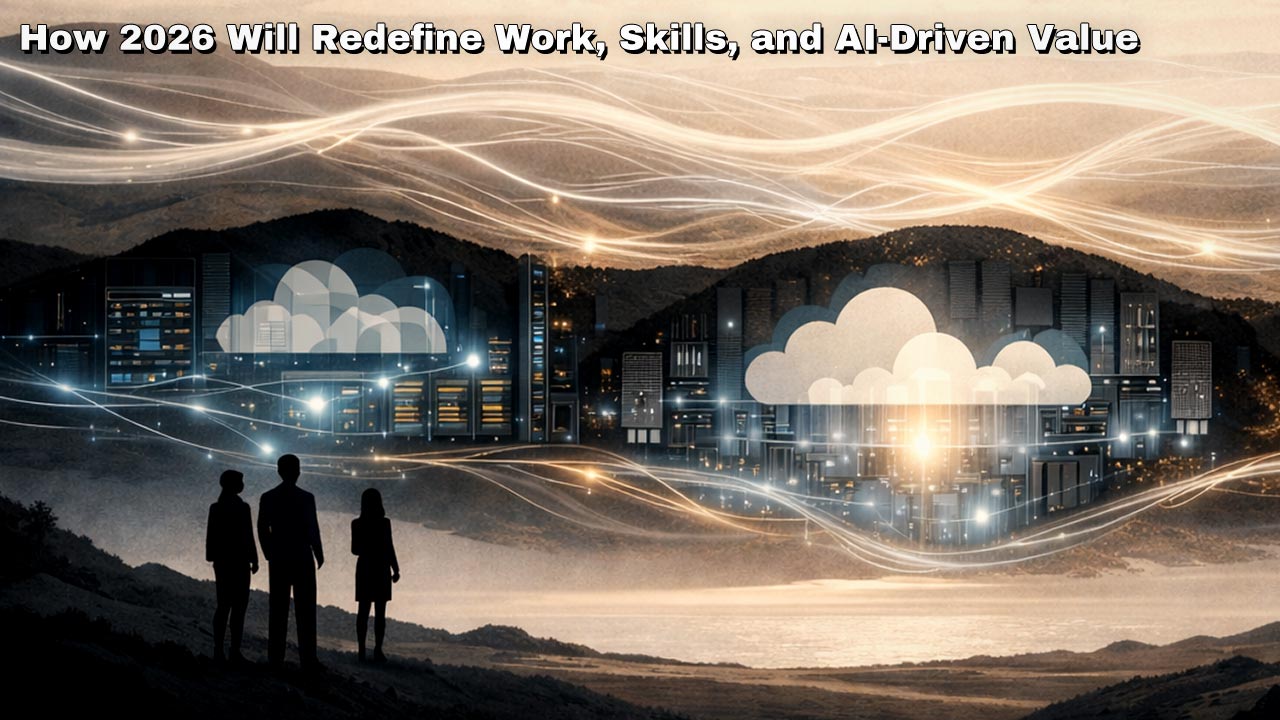
How 2026 Will Redefine Work, Skills, and AI-Driven Value
The global economy is entering a decisive talent inflection point. By 2026, demographic shifts, AI infrastructure expansion, and structural labor mismatches are converging into a once-in-a-generation opportunity to transform how talent is sourced, developed, and deployed worldwide. Organizations that understand this transformation will not merely survive disruption, they will define the next era of competitive advantage.
Table of Contents
- The Global Talent Context in 2026
- The Reality of the Worldwide Talent Pool
- The Skills Mismatch Driving Transformation
- The Incoming AI Infrastructure Wave
- Human and AI Collaboration as the New Baseline
- What This Means for Organizations
- The Role of Policy and Education Systems
- Why This Is a Historic Strategic Opportunity
- Top 5 Frequently Asked Questions
- Final Thoughts
- Resources
The Global Talent Context in 2026
By 2026, global talent markets are no longer defined by geography alone. Aging populations across OECD countries, declining birth rates, and prolonged workforce exits are creating acute talent shortages in healthcare, engineering, data, cybersecurity, and advanced manufacturing. At the same time, emerging markets are producing younger, digitally native workforces at unprecedented scale. According to the World Economic Forum, over 44 percent of workers’ core skills will be disrupted by 2027. This disruption is not cyclical. It is structural. The opportunity lies in how fast institutions and enterprises can realign talent with value creation.
The Reality of the Worldwide Talent Pool
The global talent pool is larger than ever, yet less efficiently utilized. India, Sub-Saharan Africa, Southeast Asia, and Latin America collectively add tens of millions of working-age individuals annually. However, underemployment, informal work, and skills underutilization remain systemic barriers. Digital connectivity has removed physical proximity as a gating factor, but capability alignment remains uneven. The future workforce is not constrained by scarcity of people, but by scarcity of job-ready, AI-literate, problem-solving talent. By 2026, remote-first and hybrid operating models have matured, enabling firms to tap into global expertise without relocation costs. Talent arbitrage is being replaced by talent optimization.
The Skills Mismatch Driving Transformation
The defining challenge of the talent economy is not unemployment, but mismatch. Traditional education pipelines were designed for static careers, while modern work requires continuous skill renewal.
High-growth skills include:
- AI model operations and prompt engineering
- Data governance and ethics
- Systems thinking and cross-domain problem solving
- Human-centered design
- Cyber resilience and cloud architecture
By 2026, companies that rely solely on degrees as hiring filters systematically exclude capable talent. Skills-based hiring, micro-credentials, and internal talent marketplaces are becoming core infrastructure, not HR experiments.
The Incoming AI Infrastructure Wave
The next phase of AI is not about experimentation, it is about infrastructure. Massive investments are being deployed into compute capacity, specialized AI chips, sovereign cloud platforms, and enterprise AI stacks. Generative AI, autonomous agents, and domain-specific models are becoming embedded into daily workflows. This fundamentally alters talent productivity curves. One skilled individual, augmented by AI, can now perform work that previously required entire teams. This does not eliminate jobs. It redefines them. Talent value shifts from execution to judgment, orchestration, and strategic oversight.
Human and AI Collaboration as the New Baseline
By 2026, AI is no longer a differentiator. It is a baseline capability. Competitive advantage comes from how effectively humans and AI systems collaborate.
High-performing organizations train talent to:
- Frame better questions for AI systems
- Validate and contextualize AI outputs
- Make ethical and accountable decisions
- Translate insights into business action
This hybrid intelligence model elevates cognitive skills, emotional intelligence, and leadership capacity. The most valuable talent is not the most technical, but the most adaptable.
What This Means for Organizations
Talent transformation is now a board-level issue. Organizations that succeed in 2026 adopt three structural shifts. First, they invest in internal reskilling at scale, treating learning as a continuous operating system rather than a benefit. Second, they redesign roles around outcomes, not tasks, allowing AI to absorb low-value execution. Third, they build global talent ecosystems, partnering with education providers, startups, and platforms to access distributed capability. Firms that fail to act face declining productivity, rising labor costs, and strategic irrelevance.
The Role of Policy and Education Systems
Governments and education systems are under pressure to modernize. Static curricula and slow accreditation cycles cannot keep pace with AI-driven change.
Leading economies are piloting:
- National skills taxonomies
- Public-private reskilling funds
- AI literacy mandates
- Portable credential frameworks
Policy alignment is critical to unlocking global talent mobility while ensuring ethical AI deployment and workforce inclusion.
Why This Is a Historic Strategic Opportunity
The global talent transformation opportunity is rare because it aligns economic necessity with technological capability. AI infrastructure amplifies human potential, while demographic shifts force innovation. Organizations, nations, and individuals that embrace this moment will unlock productivity gains not seen since the industrial revolution. Those that resist will be constrained by outdated models of work. The defining question of 2026 is not whether AI will change talent, but who will lead that change.
Top 5 Frequently Asked Questions
Final Thoughts
The global talent transformation opportunity is not a future concept, it is unfolding now. By 2026, talent advantage will define economic leadership. The most resilient systems will be those that integrate human creativity with AI scale, unlocking value across borders, industries, and generations.
Resourses
- World Economic Forum – Future of Jobs Report
- OECD – Global Skills Outlook
- McKinsey Global Institute – AI and the Future of Work
- ILO – Global Employment Trends


Leave A Comment