



Best Marketing Strategy for 2026: AI, Trust, and Growth
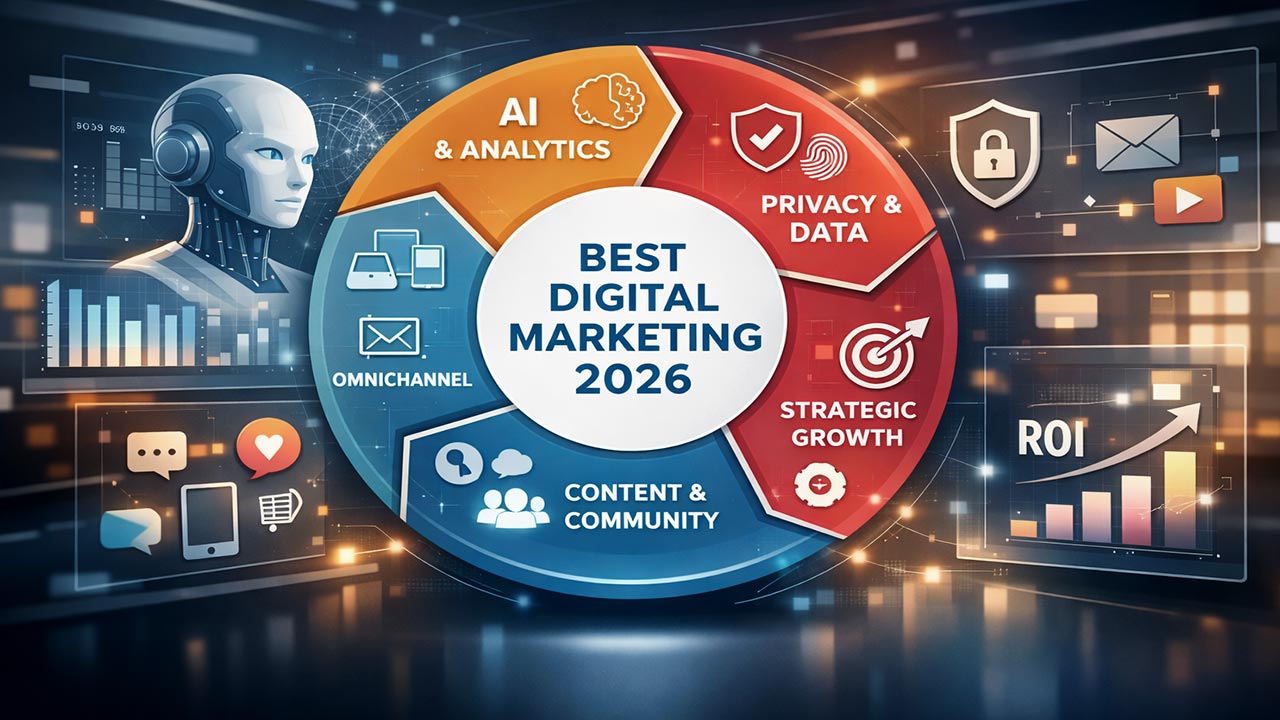
Marketing in 2026 is defined by intelligence, trust, and adaptability. Traditional funnel-based marketing has been replaced by AI-driven ecosystems where brands must earn attention, personalize at scale, and deliver real value across fragmented digital touchpoints. The most effective marketing approach in 2026 blends artificial intelligence, human creativity, ethical data use, and community-led growth into a unified operating model.
Table of Contents
- AI-Driven Marketing as the Core Engine
- Privacy-First and Zero-Party Data Strategies
- Content Authority Over Content Volume
- Community-Led and Creator-Powered Growth
- Unified Omnichannel Experience Design
- Outcome-Based Measurement and Marketing ROI
- Top 5 Frequently Asked Questions
- Final Thoughts
- Resources
AI-Driven Marketing as the Core Engine
The most successful marketing strategies in 2026 are built on artificial intelligence, not as a tool, but as infrastructure. AI now powers customer segmentation, predictive analytics, dynamic pricing, content personalization, and real-time optimization.
Generative AI enables marketers to test hundreds of creative variations instantly, while machine learning models predict intent before customers explicitly express it. According to McKinsey, companies using AI-driven personalization achieve up to 40% higher revenue growth than competitors.
However, competitive advantage does not come from AI adoption alone. It comes from proprietary data, high-quality prompts, and human oversight that ensures brand consistency and ethical decision-making.
Privacy-First and Zero-Party Data Strategies
With the complete deprecation of third-party cookies and stricter global regulations, 2026 marketing is fundamentally privacy-first. Consumers now expect transparency, control, and value in exchange for their data.
The best-performing brands prioritize zero-party data, information that customers intentionally share through preference centers, quizzes, loyalty programs, and interactive content. This data is more accurate, compliant, and trust-building than inferred behavioral tracking.
Privacy is no longer a legal constraint. It is a brand differentiator.
Content Authority Over Content Volume
In 2026, content saturation has reached its peak. AI-generated content is abundant, making authority, originality, and expertise the primary ranking and trust signals.
Search engines prioritize Experience, Expertise, Authority, and Trust (E-E-A-T). Brands that win focus on deep explanatory content, proprietary insights, expert-led narratives, and real-world proof.
The goal is not to publish more content, but to publish content that decisively answers questions better than anyone else.
Community-Led and Creator-Powered Growth
Communities outperform campaigns in 2026. Private groups, brand ecosystems, and creator partnerships generate higher lifetime value and stronger advocacy than paid media alone.
Influencer marketing has evolved into creator collaboration, where trusted individuals co-create products, content, and experiences. Micro-creators with niche credibility consistently outperform large influencers in engagement and conversion.
Community-led growth reduces acquisition costs while increasing retention and trust.
Unified Omnichannel Experience Design
Customers in 2026 move fluidly across platforms, devices, and physical-digital boundaries. The best marketing strategies are experience-driven, not channel-driven.
This means consistent messaging, adaptive personalization, and seamless transitions between search, social, email, voice, in-app, and offline touchpoints.
Brands that design marketing as an integrated system, rather than isolated tactics, achieve stronger emotional connection and higher conversion efficiency.
Outcome-Based Measurement and Marketing ROI
Vanity metrics no longer justify budgets. In 2026, marketing performance is measured by outcomes: revenue contribution, customer lifetime value, retention, and brand equity.
Advanced attribution models powered by AI now connect marketing activity to financial impact with greater accuracy. Marketing leaders operate as growth strategists, not campaign managers.
The best approach to marketing in 2026 aligns marketing metrics directly with business strategy.
Top 5 Frequently Asked Questions
Final Thoughts
The best approach to marketing in 2026 is not tactical. It is systemic. Winning brands combine AI intelligence, ethical data practices, authoritative content, community trust, and measurable business impact into a cohesive growth engine. Marketing is no longer about attention alone. It is about relevance, value, and long-term relationships.
Resources
- McKinsey & Company – The State of AI in Marketing
- Gartner – Future of Marketing Strategy
- HubSpot – Marketing Trends Report 2026
- Google – E-E-A-T and Search Quality Guidelines


Leave A Comment