



What Does MQL Mean in Marketing?
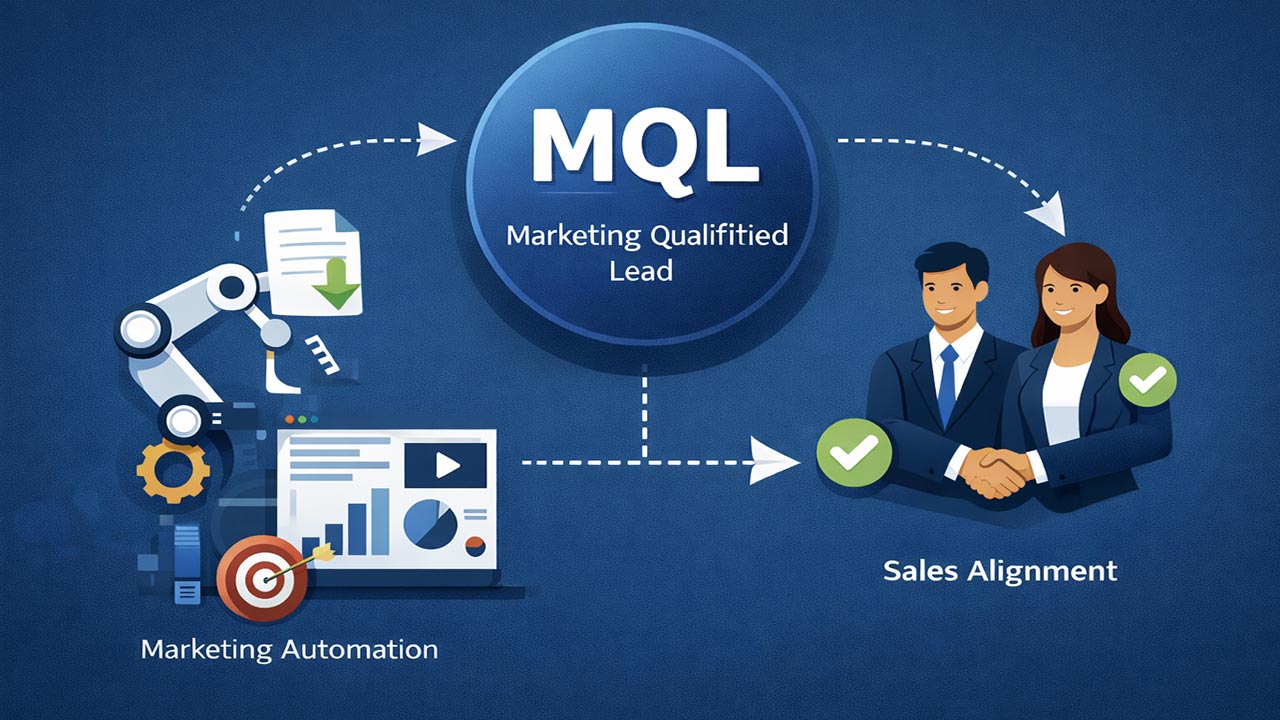
A Marketing Qualified Lead, commonly known as an MQL, is one of the most critical concepts in modern digital marketing. It represents the moment when raw audience interest turns into measurable buying intent, helping marketing and sales teams align, prioritize, and drive revenue more efficiently.
Table of Contents
- Definition of MQL in Marketing
- Why MQLs Matter in Modern Marketing
- MQL vs Other Lead Types
- How Marketing Qualified Leads Are Created
- Lead Scoring and MQL Qualification
- MQL to Sales Handoff Process
- Key Metrics Used to Measure MQL Success
- Common MQL Mistakes to Avoid
- The Future of MQLs in Marketing
- Top 5 Frequently Asked Questions
- Final Thoughts
- Resources
Definition of MQL in Marketing
MQL stands for Marketing Qualified Lead. It describes a potential customer who has interacted with a brand’s marketing efforts and demonstrated a higher likelihood of becoming a paying customer compared to a general lead.
An MQL is not just someone who visited a website. It is someone who has taken meaningful actions such as downloading gated content, attending webinars, requesting demos, or repeatedly engaging with emails. These actions signal intent rather than curiosity.
Why MQLs Matter in Modern Marketing
Marketing Qualified Leads act as the bridge between marketing activity and revenue generation. Without this classification, sales teams waste time chasing low-quality leads, while high-intent prospects slip through the cracks.
Organizations that use MQL frameworks report higher conversion rates and better alignment between sales and marketing. According to industry research, companies with strong lead qualification processes generate up to 50 percent more sales-ready leads at a 33 percent lower cost.
MQLs also create accountability. Marketing teams can no longer rely on vanity metrics like traffic alone. Instead, they are measured on lead quality and contribution to pipeline growth.
MQL vs Other Lead Types
Understanding MQLs requires understanding how they differ from other lead categories.
A lead is anyone who provides contact information, often in exchange for content. This could be a newsletter signup or a basic form submission.
A Marketing Qualified Lead goes further. It meets predefined behavioral or demographic criteria indicating purchase intent.
A Sales Qualified Lead, or SQL, is an MQL that sales teams have validated and accepted as ready for direct sales engagement.
The difference lies in intent, readiness, and qualification depth. MQLs sit in the middle of the funnel, where education turns into evaluation.
How Marketing Qualified Leads Are Created
MQLs are created through a combination of inbound marketing, data tracking, and behavioral analysis.
Common MQL-generating activities include content downloads, product comparison views, pricing page visits, webinar attendance, and free trial signups.
These actions are tracked through marketing automation platforms and customer relationship management systems. Once a lead crosses a predefined engagement threshold, it is flagged as an MQL.
The process is systematic, not subjective. Strong MQL frameworks rely on data, not guesswork.
Lead Scoring and MQL Qualification
Lead scoring is the engine behind MQL identification. Each action a lead takes is assigned a numerical value based on its relevance to buying intent.
For example, reading a blog post may earn a small score, while requesting a demo earns a much higher score. Demographic factors such as job title, company size, and industry also influence scoring.
When a lead reaches a predetermined score threshold, it becomes an MQL.
Effective lead scoring models are reviewed and refined continuously to reflect real-world sales outcomes.
MQL to Sales Handoff Process
The handoff from marketing to sales is one of the most critical moments in the customer journey.
Once a lead becomes an MQL, it is routed to sales development or inside sales teams for follow-up. Speed matters. Research shows that contacting an MQL within five minutes significantly increases conversion probability.
Clear service-level agreements between marketing and sales ensure MQLs are followed up consistently and feedback flows back to marketing for optimization.
Without alignment, MQLs lose value quickly.
Key Metrics Used to Measure MQL Success
MQL performance is measured through several key metrics.
MQL to SQL conversion rate shows how many qualified leads sales accepts.
Cost per MQL measures marketing efficiency.
Pipeline contribution tracks revenue influenced by MQLs.
Time to conversion highlights funnel velocity.
Together, these metrics help organizations evaluate whether their MQL definition aligns with actual revenue outcomes.
Common MQL Mistakes to Avoid
One common mistake is defining MQLs too loosely, flooding sales with unqualified leads.
Another is making criteria too strict, starving sales of opportunities.
Many companies also fail to update MQL definitions as markets evolve, leading to misalignment.
The most damaging mistake is treating MQLs as a marketing-only metric rather than a shared revenue responsibility.
The Future of MQLs in Marketing
The role of MQLs is evolving. With AI-driven analytics and intent data, qualification is becoming more predictive and less reactive.
Account-based marketing models are shifting focus from individual MQLs to account-level qualification.
Despite these changes, the core principle remains the same: MQLs exist to improve relevance, efficiency, and revenue alignment.
Top 5 Frequently Asked Questions
Final Thoughts
Marketing Qualified Leads represent the tipping point where attention becomes opportunity. They are not just a label but a system that forces marketing and sales to operate with shared accountability. When defined correctly, MQLs reduce waste, accelerate growth, and create predictable revenue pipelines. The most successful organizations treat MQLs not as a metric, but as a strategic discipline.


Leave A Comment