



What Is Closed Loop Marketing?
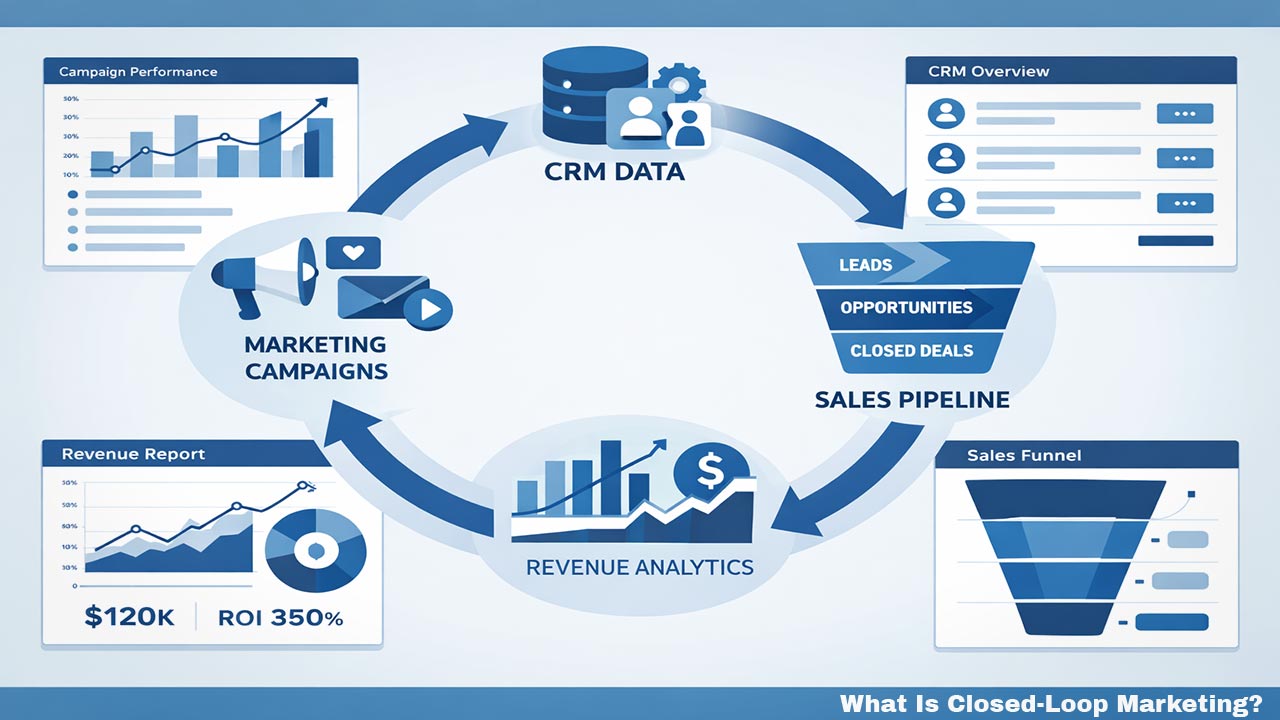
A closed loop marketing system connects marketing activities directly to sales outcomes, creating a continuous feedback cycle where performance data informs future decisions. Instead of guessing which campaigns work, organizations track each lead from first interaction through conversion and revenue. This approach aligns marketing and sales around shared data, measurable impact, and continuous improvement.
Table of Contents
- Definition and Core Concept
- How Closed-Loop Marketing Works
- Key Components of Closed-Loop Marketing
- Business Benefits and Strategic Value
- Technology Stack and Tools
- How to Implement Closed-Loop Marketing
- Common Challenges and How to Overcome Them
- Real-World Examples
- The Future of Closed-Loop Marketing
- Top 5 Frequently Asked Questions
- Final Thoughts
- Resources
Definition and Core Concept
Closed-loop marketing is a data-driven strategy where marketing performance is evaluated based on actual revenue outcomes rather than surface-level metrics like clicks or impressions. The “loop” closes when sales data flows back to marketing, enabling teams to see which campaigns, channels, and messages generate qualified leads and customers.
At its core, closed-loop marketing answers one critical question: which marketing activities drive real business results? This model replaces intuition with evidence and transforms marketing from a cost center into a measurable growth engine.
How Closed-Loop Marketing Works
Closed-loop marketing operates as a continuous cycle. First, marketing campaigns attract prospects through channels such as search, email, or social media. Each interaction is tracked and associated with a unique lead record. When the lead engages further, the data moves into a customer relationship management system where sales activity is recorded.
Once a deal is closed or lost, that outcome is sent back to marketing systems. Marketers then analyze which campaigns influenced the result, refine targeting, adjust messaging, and launch improved initiatives. Over time, this loop compounds learning and efficiency.
Key Components of Closed-Loop Marketing
A functioning closed-loop marketing system relies on several interconnected components.
Marketing automation platforms capture lead behavior, campaign engagement, and attribution data. CRM systems record sales interactions, deal stages, and revenue outcomes. Analytics and reporting layers unify this information into dashboards that support decision-making.
Equally important is organizational alignment. Marketing and sales must agree on lead definitions, qualification criteria, and success metrics. Without shared standards, data loses meaning.
Business Benefits and Strategic Value
Closed-loop marketing delivers clear strategic advantages. It improves return on investment by directing spend toward proven channels. Research from industry analysts consistently shows that organizations using revenue attribution models outperform peers in budget efficiency.
It also strengthens marketing and sales alignment. When both teams work from the same data, friction decreases and accountability increases. Marketing gains credibility by demonstrating revenue impact, while sales benefits from higher-quality leads.
Finally, closed-loop marketing accelerates learning. Every campaign becomes an experiment with measurable outcomes, enabling faster optimization and innovation.
Technology Stack and Tools
Technology is the backbone of closed-loop marketing. Common stacks integrate marketing automation platforms with CRM systems and analytics tools.
Well-known examples include integrations between marketing platforms and CRM solutions such as Salesforce and HubSpot. These systems enable end-to-end visibility from first touch to closed deal.
Advanced organizations layer in business intelligence tools and customer data platforms to unify datasets and support multi-touch attribution models.
How to Implement Closed-Loop Marketing
Implementation begins with clear objectives. Organizations must define what success looks like, typically in terms of revenue contribution or customer lifetime value.
Next, teams align on data standards, including lead stages, scoring models, and attribution rules. Technology integration follows, ensuring marketing and sales systems share data seamlessly.
Finally, organizations establish reporting cadences. Dashboards should be reviewed regularly, with insights translated into campaign adjustments and strategic decisions.
Common Challenges and How to Overcome Them
Data quality remains the most common obstacle. Incomplete or inconsistent records undermine trust in reporting. Addressing this requires disciplined data governance and automation wherever possible.
Another challenge is cultural resistance. Teams accustomed to operating in silos may resist transparency. Leadership support and shared incentives help reinforce collaboration.
Attribution complexity also increases as channels multiply. Organizations should start with simple models and evolve sophistication over time.
Real-World Examples
Business-to-business companies often use closed-loop marketing to connect content marketing and lead nurturing programs directly to pipeline growth. By analyzing which assets influence deal velocity, marketers prioritize high-impact content.
In digital commerce, closed-loop principles link advertising spend to purchase behavior, enabling rapid optimization of campaigns and offers.
The Future of Closed-Loop Marketing
The future of closed-loop marketing lies in deeper automation and predictive analytics. Artificial intelligence will increasingly identify patterns across datasets, recommend actions, and forecast revenue impact.
Privacy regulations and data ethics will also shape implementation. Organizations must balance personalization with responsible data use, ensuring transparency and consent.
Closed-loop marketing will continue evolving from a tactical reporting method into a strategic management discipline.
Top 5 Frequently Asked Questions
Final Thoughts
Closed-loop marketing represents a shift from assumption-based promotion to evidence-based growth management. By connecting actions to outcomes, organizations gain clarity, accountability, and competitive advantage. The most important takeaway is that closed-loop marketing is not merely a technology initiative but an organizational mindset focused on learning, alignment, and continuous improvement.


Leave A Comment