



Why Was My Organic Website Traffic Down During 2025?
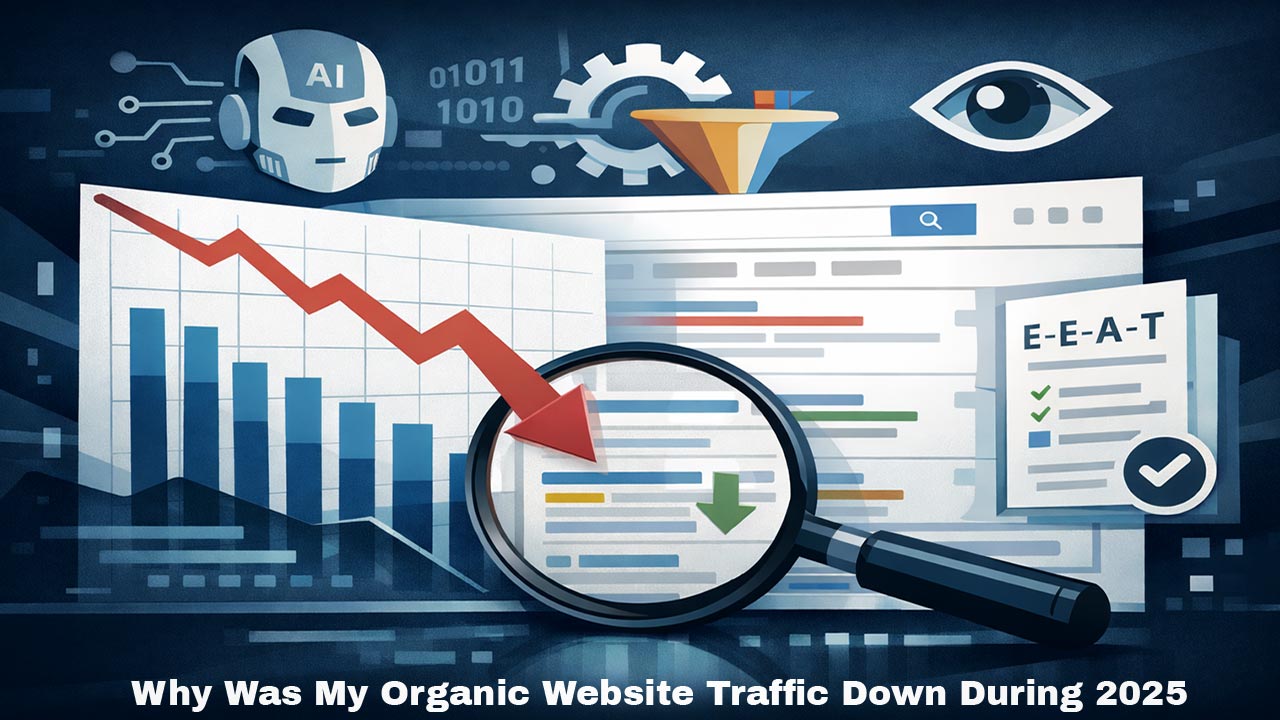
A drop in organic traffic during 2025 was not random or unique to your website. It was the result of multiple converging forces: aggressive search engine algorithm updates, accelerated AI-generated content saturation, changing user behavior, and rising technical expectations for websites. Understanding what actually changed in 2025 is the key to diagnosing what happened to your traffic—and fixing it.
Table of Contents
- Major Search Algorithm Shifts in 2025
- AI Content Saturation and Trust Decay
- User Behavior Changes Reduced Clicks
- Rising Technical SEO Standards
- Authority, Brand, and E-E-A-T Pressure
- How to Diagnose Your Traffic Drop
- How to Recover Organic Traffic in 2026
- Top 5 Frequently Asked Questions
- Final Thoughts
- Resources
Major Search Algorithm Shifts in 2025
The single biggest reason organic traffic declined in 2025 was the cumulative impact of search algorithm updates from Google. Unlike prior years with isolated core updates, 2025 introduced continuous ranking recalibration.
Google’s ranking systems increasingly prioritized:
- First-hand experience over recompiled information
- Brand recognition and entity authority
- Content depth relative to competing pages
- User satisfaction signals rather than keyword usage
Sites that relied on templated SEO pages, thin affiliate content, or lightly edited AI articles experienced gradual erosion rather than sudden drops. This made traffic losses harder to notice until they became severe.
AI Content Saturation and Trust Decay
By mid-2025, AI-generated content flooded search results at an unprecedented scale. As a defensive response, Google tightened quality thresholds across nearly all informational queries.
The problem was not using AI—it was publishing content without:
- Original insights
- Unique data or lived experience
- Clear author accountability
- Demonstrated subject matter expertise
Sites publishing high volumes of “good enough” content saw rankings decay even if their on-page SEO was technically correct. Google’s systems learned to devalue sameness.
If your content closely resembled what already existed in the SERPs, it likely lost visibility—even if it ranked well in previous years.
User Behavior Changes Reduced Clicks
Many websites misdiagnosed ranking losses when the real issue was reduced click-through rates.
In 2025, search behavior changed dramatically due to:
- AI Overviews and instant answers
- Featured snippets expanding in size
- Zero-click searches becoming dominant
Even when rankings remained stable, fewer users clicked through. Informational queries were increasingly resolved directly on the results page.
If your traffic drop came without major ranking changes, your site was likely affected by SERP feature cannibalization rather than penalties or SEO errors.
Rising Technical SEO Standards
Technical SEO expectations rose sharply in 2025. Sites that were merely “acceptable” in prior years began to underperform.
Key problem areas included:
- Slow interaction times on mobile
- Poor Core Web Vitals under real-world conditions
- Bloated JavaScript frameworks
- Weak internal linking structures
Google increasingly evaluated performance based on real user data, not lab scores. If your site loaded well in testing tools but felt slow to users, rankings suffered.
Authority, Brand, and E-E-A-T Pressure
In 2025, Google leaned harder into E-E-A-T signals: Experience, Expertise, Authoritativeness, and Trust.
Sites without:
- Recognizable authors
- Clear editorial standards
- Brand mentions outside their own website
- Consistent topical focus
were increasingly outranked by known brands—even when the smaller site’s content was objectively better.
This shift disproportionately impacted niche publishers, affiliate sites, and anonymous blogs.
How to Diagnose Your Traffic Drop
To accurately diagnose a 2025 traffic decline, separate symptoms from causes.
Start by answering:
- Did rankings drop or did CTR drop?
- Did losses affect specific content types or the entire site?
- Did traffic decline align with known algorithm updates?
- Are competitors now publishing deeper or more authoritative content?
Use Search Console data to compare impressions versus clicks. If impressions remained stable while clicks fell, SERP changes—not SEO failures—were likely responsible.
How to Recover Organic Traffic in 2026
Recovery in 2026 requires adaptation, not reversal.
Winning sites are:
- Publishing fewer but higher-impact pages
- Building real author profiles with credentials
- Targeting problems, not keywords
- Demonstrating real-world experience
Content must now earn its ranking by offering something competitors cannot replicate easily—insight, data, opinion, or experience.
SEO is no longer about optimization alone. It is about differentiation.
Top 5 Frequently Asked Questions
Final Thoughts
Organic traffic declined in 2025 because search engines fundamentally changed what they reward. Visibility now depends less on optimization tricks and more on credibility, usefulness, and differentiation. Websites that evolve into trusted resources will recover—and outperform—those that cling to outdated SEO playbooks.


Leave A Comment