



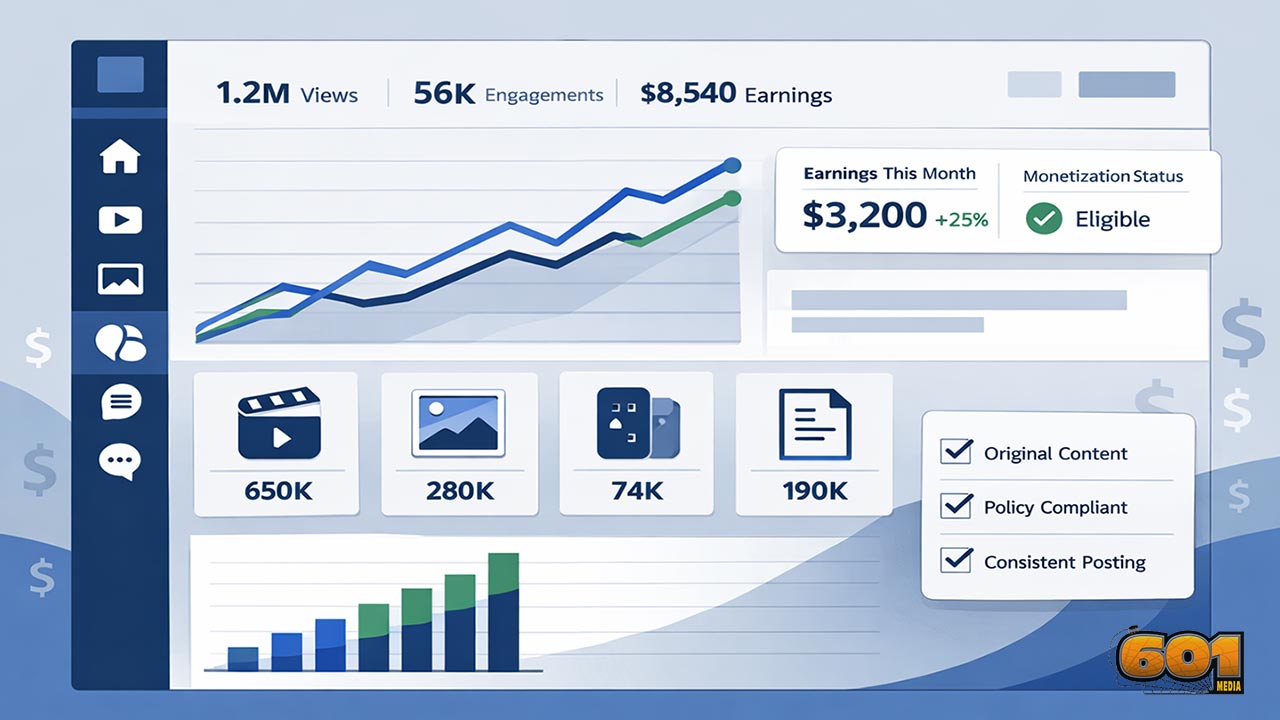
Facebook Content Monetization (FCM): How It Works, What Meta Actually Rewards, and How to Build a Durable Earnings System
Facebook Content Monetization (FCM) is Meta’s streamlined approach to paying creators across multiple content formats—especially where performance, originality, and policy compliance intersect. This guide breaks down what FCM is, how eligibility and policies work, how to set up payouts, and how to run your content operation like a product: instrumented, test-driven, and resilient to policy and algorithm shifts.
Table of Contents
- What Facebook Content Monetization (FCM) Is
- How FCM Earnings Work in Practice
- Eligibility and Policies: The Non-Negotiables
- Setup, Payouts, and Operating Your Monetization Stack
- Strategy: Building a Repeatable FCM Content System
- Measurement: KPIs That Matter More Than Vanity Metrics
- Top 5 Frequently Asked Questions
- Final Thoughts
- Resources
What Facebook Content Monetization (FCM) Is
- FCM is a monetization program that lets creators earn money based on the performance of eligible content across multiple formats.
- Meta positions FCM as a simpler, more unified monetization experience compared with a patchwork of separate tools.
- FCM is best understood as a system: policy gates + content eligibility + distribution + advertiser demand + viewer engagement.
Why Meta Built FCM (and Why It Matters to Creators)
- Meta’s incentive design is straightforward: maximize user time, improve feed quality, reduce spam, and keep creators producing original content that retains audiences.
- For creators, the practical impact is operational: you’re no longer just “posting,” you’re managing a revenue pipeline where policy compliance and content quality are the price of admission.
- As Meta pushes more automation into distribution and enforcement, creators who run disciplined content operations (consistent production, originality controls, and clear measurement) typically become more resilient.
- Innovation-and-technology-management lens: treat FCM like a platform dependency. Platforms reward behaviors that improve the platform’s economics. Your job is to align your content “product” with the platform’s value function while keeping your business diversified enough to survive policy shifts.
What Formats FCM Can Apply To
- Meta’s official materials describe FCM as enabling earnings tied to performance across multiple eligible formats, including formats like reels and other content types surfaced in their onboarding content.
- Key takeaway: don’t assume only one format will pay well for you. The highest-performing creators often build a portfolio: short-form for reach, “evergreen” for long-tail views, and community posts for loyalty.
How FCM Earnings Work in Practice
- FCM monetization is performance-based: earnings are driven by how eligible content performs with real audiences, under real advertiser demand.
- Meta does not publicly publish a universal “rate card” for creator payouts under FCM because monetization is influenced by variables like geography, audience makeup, advertiser demand, content type, seasonality, and compliance signals.
- This means your job is not to chase a mythical fixed CPM. Your job is to build a repeatable system that produces eligible content with compounding audience value.
Performance Signals That Typically Correlate With Earnings
- Watch time and retention: content that holds attention tends to be distributed more, which can increase monetization opportunities.
- Meaningful engagement: comments, shares, saves, and repeat viewers can indicate audience resonance more than likes alone.
- Session contribution: content that keeps people on-platform (watching more, clicking through your profile, following) tends to align with platform incentives.
- Authenticity signals: natural engagement patterns matter because Meta’s monetization policies emphasize authentic audiences and prohibit manipulative behaviors.
Why Revenue Is Variable (and What You Can Control)
- Advertiser demand fluctuates: ad spend changes by season and macro conditions, and demand differs by audience and region.
- Distribution is dynamic: recommendation systems adjust continuously based on user behavior and integrity controls.
- What you can control:
- Originality and rights (no stolen content, no unlicensed material, no lazy reposting)
- Audience targeting (who you attract affects advertiser value)
- Consistency (stable output improves learning and repeat-viewer momentum)
- Quality-of-experience (clear audio, strong hook, readable captions, tight pacing)
- Governance (review processes that reduce policy violations)
Eligibility and Policies: The Non-Negotiables
- FCM sits on top of Meta’s broader monetization policy stack.
- Meta’s documentation emphasizes that creators and their content must comply with policy requirements to monetize, including Partner Monetization Policies and additional content monetization policies.
- In operational terms: you can do everything “right” creatively and still lose revenue if you violate policies, trigger integrity enforcement, or repeatedly post unoriginal content.
Partner Monetization Policies and Content Monetization Policies
- Partner Monetization Policies (formerly referred to as monetization eligibility standards in older materials) describe the baseline rules for who and what can monetize—think of this as the gate that determines whether an account is eligible to earn at all.
- Content Monetization Policies focus on what specific types of content are allowed to earn (even if your account is eligible overall).
- Practical governance rule: assume every post is an “asset” that must be rights-cleared, original (or meaningfully transformed), and aligned with both community and monetization rules. If your process can’t guarantee that, you are building on sand.
Originality, Reuse, and the Rising Enforcement Trend
- Meta has signaled stricter enforcement against repeated reposting and unoriginal content. Public reporting has highlighted Meta’s efforts to reduce spam and penalize accounts that repeatedly reuse others’ content, including monetization restrictions and reduced distribution for duplicates.
- Implication for creators: “curation accounts” that rely on copying viral clips are structurally risky. Even if they temporarily perform, they can face monetization and reach constraints.
- Safer reuse pattern: meaningful transformation—commentary, analysis, original editing, and context that changes the value of the content—combined with rights compliance.
Setup, Payouts, and Operating Your Monetization Stack
- Monetization is not just creative; it is operational. Many creators leak revenue through incomplete setup (payouts not configured), poor asset governance (rights issues), or inconsistent measurement.
- FCM success looks like a lightweight business system: documentation, checklists, quality controls, and a stable publishing cadence.
Setting Up Payouts the Right Way
- Meta’s guidance on payouts emphasizes setting up a payout account so you can actually receive earnings once you are eligible and accepted into a monetization tool.
- Operational best practices:
- Use a consistent legal name and tax information across Meta tools.
- Separate creator finances: dedicated bank account or payout destination where possible.
- Document access control: who can change payout settings, who can approve monetization terms.
- Build a monthly reconciliation habit: compare expected vs. actual payouts; look for anomalies that could indicate policy issues, audience quality issues, or content removals.
Checking Eligibility Status and Diagnosing Issues
- Meta provides guidance on checking monetization eligibility status in Meta Business Suite and related creator tools.
- Diagnosis framework when earnings drop:
- Step 1: Confirm you’re still eligible and no policy flags exist.
- Step 2: Check whether content is marked ineligible (rights, restricted topics, low originality, or other policy triggers).
- Step 3: Inspect distribution: are reach and watch time down, or only monetization?
- Step 4: Inspect audience quality: sudden spikes from suspicious sources can correlate with integrity actions.
- Step 5: Run controlled experiments: adjust one variable at a time (hook, length, topic cluster, posting time).
Strategy: Building a Repeatable FCM Content System
- Most creators approach monetization as a “viral lottery.” A better approach is a portfolio strategy + experimentation + governance.
- Think like a product manager: define a target audience, deliver repeated value, measure retention, and iterate.
Design a Content Portfolio (Not a Single Format Bet)
- Portfolio logic: different formats can serve different business objectives. A balanced system can stabilize revenue even when a format’s distribution changes.
- Example portfolio:
- Reels: top-of-funnel discovery (reach new viewers, grow followers)
- Evergreen videos or series: long-tail watch time and repeat traffic
- Photos and text posts: community engagement and identity-building
- Stories: trust-building and lightweight audience feedback
- Innovation management principle: manage format risk like product risk. Don’t let one distribution surface become your single point of failure.
Use an Experimentation Loop Like a Product Team
- FCM is a performance system, so you need a performance process.
- Adopt a weekly experimentation loop:
- Hypothesis: “If I shorten the opening by 2 seconds and show the outcome first, retention will rise.”
- Test design: publish 5–10 posts using the new pattern while holding topic constant.
- Measure: retention curve, average watch time, shares per 1,000 views, follow conversion.
- Decide: keep, discard, or refine.
- Important nuance: A single post is noisy. Treat each post as a data point in a controlled series. FCM rewards creators who produce enough volume to let the system learn and enough quality to keep real humans watching.
Quality Operations: Governance, QA, and Risk Controls
- As enforcement increases, content governance becomes a competitive advantage.
- Build a simple pre-publish checklist:
- Do you own the footage/music, or is it licensed for monetized use?
- Is this original, or meaningfully transformed with your commentary and editing?
- Does the content avoid restricted categories that commonly trigger monetization limits?
- Is there any visible watermark from another platform?
- Is the content accurate and non-deceptive (especially for health, finance, or news-like claims)?
- Operational safeguard: maintain a “rights and sources” log for recurring assets (templates, music libraries, stock footage). This reduces scramble when content is flagged.
Measurement: KPIs That Matter More Than Vanity Metrics
- Creators often optimize for views, but a monetization system is influenced by deeper signals: retention, audience quality, and repeat consumption.
- Because Meta does not publish universal payout rates, the safest metric strategy is to measure what you can directly influence, then correlate that to revenue over time.
A Practical North Star Metric for Creators
- Recommended north star metric: “Eligible Watch Minutes per Week” (or an equivalent engagement measure that reflects sustained attention).
- Why it works: it aligns with platform incentives (time and satisfaction), it’s harder to fake than raw views, and it predicts whether your audience is actually sticking around.
- Pair it with two guardrails:
- Originality rate: percentage of posts created from your own assets or truly transformed content
- Policy incident rate: monetization restrictions or removals per 100 posts
Cohorts and Retention: The Creator Advantage
- Many creators never run cohort analysis. You should.
- Cohort concept: group viewers by the week they first followed you, then track how many keep watching in weeks 2, 4, and 8.
- Why it matters for FCM: durable revenue usually comes from repeat viewers, not one-time virality. Retention creates compounding distribution, which increases the number of monetizable opportunities over time.
- Expert-level operating insight: treat your content like a product with a roadmap. You’re not just making posts; you’re shipping weekly “releases” that evolve your audience’s relationship with you.
Top 5 Frequently Asked Questions
Final Thoughts
The most important takeaway: Facebook Content Monetization rewards creators who operate like disciplined builders—original content, authentic audiences, and a measurable system—more than creators who chase short-term hacks.
From an innovation and technology management perspective, FCM is a classic platform-economy environment: the platform defines the rules, refines enforcement, and optimizes the feed for user satisfaction and advertiser value.
Your durable advantage is not guessing the algorithm. Your durable advantage is running a creator operation with:
Governance: policy compliance and rights clearance baked into your workflow
Instrumentation: metrics that reflect real audience value (retention and repeat viewing)
Experimentation: controlled tests that turn creativity into a learning engine
Portfolio strategy: diversified formats and content pillars so you are not dependent on one surface
If you build those capabilities, you become harder to disrupt by policy updates, trend shifts, or distribution volatility. You’re not just monetizing posts—you’re building a resilient content business inside a fast-changing platform ecosystem.
Resources
- Meta Business Help Center: Get Started with Facebook Content Monetization
- Meta for Creators: Introducing Facebook Content Monetization
- Meta Business Help Center: Partner Monetization Policies
- Meta Business Help Center: Content Monetization Policies
- Meta Business Help Center: How to Set Up Payouts on Facebook
- Meta for Business: Check and maintain your monetization eligibility status
- Meta Newsroom: Monetize More Content with Facebook’s New Streamlined Program
- The Verge: Facebook creators who steal and repost content could lose their monetization


Leave A Comment