



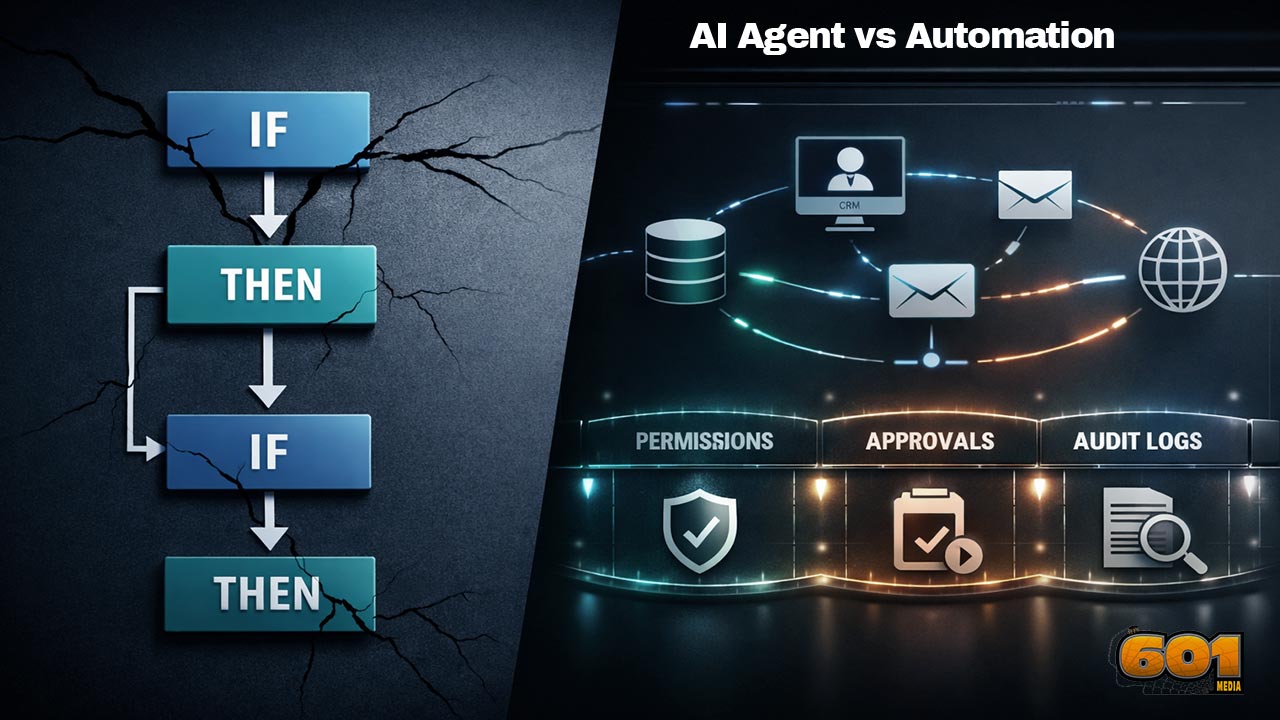
AI Agent vs Automation: Where “If-This-Then-That” Breaks Down
AI automation used to be a story about rules: if a trigger happens, do a predefined action. That approach still wins for stable, repeatable workflows. But the moment work becomes ambiguous, multi-step, cross-tool, or dependent on changing context, classic “If-This-Then-That” logic starts to crack. This article explains why AI agents are not just “automation with a chatbot,” how they differ architecturally from rule-based systems, and what innovation leaders should do to deploy agents safely, measurably, and at scale.
Table of Contents
- What Changed: From Rules to Reasoning
- Definitions That Prevent Confusion
- AI Agents vs Automation: A Practical Comparison
- Where “If-This-Then-That” Breaks Down in Real Organizations
- Design Patterns for Safe, High-ROI Agentic Work
- An Innovation Roadmap: When to Use What
- Top 5 Frequently Asked Questions
- Final Thoughts
- Resources
What Changed: From Rules to Reasoning
Automation has always been about reducing variance. If a process is stable and its decision points are explicit, rules and scripts excel. The break happens when the “decision” is not a boolean choice but a judgment call that depends on messy inputs: a customer email, a policy document, a partial dataset, or a shifting business goal.
A simple mental model:
- Rule-based automation optimizes for predictability.
- AI agents optimize for adaptability.
Adaptability is powerful, but it introduces a new management challenge: you are no longer deploying only “logic,” you are delegating discretion.
Why IFTTT-Style Automation Still Matters
“If This Then That” is not outdated. It is a strong fit for:
- High-frequency, low-ambiguity tasks (routing notifications, syncing records).
- Stable triggers and deterministic actions (webhooks, scheduled jobs, simple approvals).
- Workflows where correctness matters more than creativity (compliance reminders, data backups).
IFTTT itself describes its model as connecting apps and services through triggers (the “If”) and actions (the “Then”).
The Exact Places “If-This-Then-That” Breaks Down
Classic automation breaks down when one or more of these are true:
- The trigger is fuzzy: “When a customer sounds frustrated” is not a clean event.
- The action is conditional on interpretation: “Respond appropriately” depends on tone, intent, and policy.
- The workflow is multi-step and stateful: It requires planning, memory, and re-planning.
- The environment changes mid-run: New data arrives, systems fail, or constraints shift.
- Exceptions dominate: The long tail of edge cases becomes the majority of engineering effort.
In innovation terms, rule-based automation struggles in high-variance domains where the process is not fully knowable in advance.
Definitions That Prevent Confusion
A lot of failed “agent” programs are actually vocabulary problems. Teams buy an “AI agent” expecting autonomy, then deploy a scripted workflow with a chat UI. Or they give a model too much freedom and call the resulting incidents “AI mistakes” rather than “unsafe delegation.”
Automation and RPA in Plain Terms
Robotic Process Automation (RPA) is typically software that automates tasks by emulating human interaction with applications through UI-driven scripts and low/no-code tooling. Gartner’s definition emphasizes scripts that emulate human interaction with the application UI.
This is still “If-This-Then-That” at heart:
- A known interface
- A defined sequence
- Expected screens, fields, and outcomes
Hyperautomation expands the toolbox by orchestrating multiple technologies, including AI and machine learning, to identify and automate more processes end-to-end. Gartner frames hyperautomation as an orchestrated, disciplined approach using multiple technologies.
What an AI Agent Is (and Is Not)
An AI agent is a system that can interpret a goal, plan steps, use tools, observe outcomes, and adjust behavior based on context. Unlike deterministic automation, an agent may decide which tool to use next, what information to request, and when to escalate to a human.
An agent is not automatically “fully autonomous.”
- An agent can be assistive (suggesting next actions) or autonomous (executing them).
- Autonomy is a product decision, not a default.
Security and risk guidance increasingly calls out “autonomous agents” as a distinct concern because delegated authority changes the risk surface.
The Agentic Spectrum: Assistive to Autonomous
Think of agentic capability as a spectrum:
- Copilot: drafts, summarizes, recommends; humans execute.
- Guided agent: executes with approvals at key checkpoints.
- Bounded autonomous agent: executes within strict permissions and policies.
- Open-ended autonomous agent: broad tool access; minimal oversight (rarely appropriate in enterprises).
McKinsey’s recent work highlights growing use of “agentic AI” in organizations, while noting that scaling to consistent impact remains hard.
AI Agents vs Automation: A Practical Comparison
The simplest difference is not “AI vs no AI.” It is planning under uncertainty.
Decision-Making Model
- Automation: decision points are encoded upfront (rules, flowcharts, scripts).
- Agents: decision points can be generated at runtime (planning, reasoning, tool selection).
That runtime decision-making is what makes agents useful for ambiguous work and dangerous for poorly governed work.
Workflow Shape: Linear vs Branching vs Exploratory
Automation excels when the “shape” of the workflow is mostly linear or predictably branching:
- Step 1 → Step 2 → Step 3
- If A, do X; if B, do Y
Agents excel when the shape is exploratory:
- Search for information
- Compare options
- Ask clarifying questions
- Retry with alternate tools
This is exactly where IFTTT-style tooling struggles: it assumes the workflow is known, not discovered.
Data Dependency and Context Windows
Rule-based automation is brittle when inputs become unstructured:
- emails
- PDFs and contracts
- chat transcripts
- free-form customer requests
Agents can interpret these inputs, but now your risk is not only “did the workflow run?” It is “did the agent interpret correctly?” NIST’s AI Risk Management Framework exists because interpretation systems introduce trustworthiness concerns that standard software risk models don’t fully cover.
Failure Modes You Must Expect
Automation failure modes are usually obvious:
- UI changed, script broke
- API timeout, job failed
- Missing field, exception thrown
Agent failure modes are often subtle:
- Confident wrong action: plausible output that violates policy.
- Tool misuse: calling the right tool the wrong way.
- Goal drift: optimizing for local success while missing the true intent.
- Security and privilege abuse: unintended access paths when agents have broad credentials.
This is why “agentic AI security” is being treated as a specialized governance problem, not just standard app security.
Where “If-This-Then-That” Breaks Down in Real Organizations
The most expensive failures in automation programs tend to happen in the gap between “what we can specify” and “what we need to accomplish.”
Exception Handling and Long Tails
In many business processes, the “happy path” is only 60–80% of reality. The rest is a long tail:
- missing information
- conflicting systems of record
- edge-case contract language
- special customer segments
Rule-based automation pushes this long tail back onto humans, which can erase ROI. Agents can reduce the long tail by interpreting context and choosing next steps, but only if you bound their authority and define escalation.
Strategically, this is where agents can unlock value: they convert exception handling from a manual “triage queue” into a guided resolution flow.
Cross-System Handoffs and Unstructured Inputs
Many workflows are not “one system.” They are a relay race across SaaS tools, legacy systems, spreadsheets, and inboxes. RPA helped by mimicking UI clicks, but the underlying fragility remained: a small UI change can break the chain.
Agents help in cross-system handoffs when:
- the next system depends on interpreting the request
- the data mapping is incomplete or inconsistent
- the handoff requires judgment (what category is this ticket, really?)
But the moment an agent is allowed to “decide,” it becomes a governance question: what is allowed, what requires approval, and what is prohibited.
Policy, Compliance, and “Interpretation Work”
Policy-heavy work is often misunderstood. The challenge is not typing; it is interpretation:
- Does this expense comply with policy given the context?
- Is this vendor risk acceptable under current controls?
- Which clause applies to this customer request?
NIST’s AI RMF stresses managing AI risks so systems remain trustworthy in real contexts, not only in test environments.
A practical takeaway for technology management: treat compliance workflows as “bounded decision systems.” You can use agents to interpret and propose actions, but you should require approvals on decisions with regulatory or financial impact.
Customer Conversations and Negotiation
Rules struggle with conversation because conversations are not a flowchart. Customers contradict themselves, change requirements, and ask for exceptions.
Agents can:
- detect intent and sentiment
- retrieve relevant policies and past cases
- draft responses aligned to brand voice
- propose next best actions
But autonomy here can backfire. If an agent offers a refund or a contract term incorrectly, the cost is real. The right design is typically: agent drafts + human approves, then gradually expand autonomy for low-risk outcomes.
Design Patterns for Safe, High-ROI Agentic Work
Agent programs fail when they skip product discipline. The goal is not “deploy agents.” The goal is “reduce cycle time, improve quality, and control risk.”
Bounded Agency and Tool Permissions
Bounded agency means the agent can only do what you explicitly allow:
- tool allowlists (which systems it can call)
- permission scopes (read vs write, which records, which actions)
- policy constraints (what it must never do)
This aligns with modern risk guidance that highlights “autonomous agents” and security considerations as a distinct concern.
A strong pattern is “read-wide, write-narrow”:
- Let agents read broadly to build context.
- Restrict writes to narrow, auditable actions.
Human-in-the-Loop as a Product Feature
Human oversight is not a weakness. It is a design choice that lets you:
- capture expert feedback
- reduce high-impact errors
- create training data for continuous improvement
The mistake is using humans as an unstructured “catch-all.” Instead, define explicit approval gates:
- money movement
- contract changes
- customer commitments
- security permissions
Observability: Logs, Traces, and Replay
Traditional automation logs “step succeeded” or “step failed.” Agents need richer observability:
- what goal the agent believed it had
- what tools it used
- what evidence it cited internally
- where it was uncertain
Without this, you cannot debug agent behavior, prove compliance, or learn systematically.
Evaluation: From Test Cases to Behavioral Benchmarks
Rule-based automation can be tested with deterministic inputs. Agents require behavioral evaluation:
- scenario suites (common + adversarial cases)
- policy adherence tests
- tool-use correctness checks
- regression testing as prompts, tools, and data evolve
This is where many teams underestimate the operating model cost of agents. The trade is worth it when the alternative is a growing manual exception backlog.
An Innovation Roadmap: When to Use What
Innovation and Technology Management is largely the art of picking the right mechanism for the problem, then scaling it responsibly.
A useful macro fact for prioritization: McKinsey estimates that today’s technology could, in theory, automate about 57% of current US work hours. That is not a promise of immediate replacement; it is a signal about the size of the opportunity and the importance of redesigning workflows.
Use Automation When…
- inputs are structured and consistent
- decisions can be captured as explicit rules
- the cost of an error is high and tolerance for variance is low
- you need predictable throughput and easy auditing
Examples:
- data synchronization
- scheduled report generation
- standard onboarding checklists
Use Agents When…
- inputs are unstructured (language, documents, messy requests)
- exceptions dominate effort
- the workflow requires exploration, retrieval, and multi-step planning
- value depends on speed and adaptability, not only predictability
Examples:
- tier-1 support triage with dynamic knowledge retrieval
- procurement intake that categorizes and drafts sourcing actions
- sales operations that updates CRM based on emails and calls (with approvals)
Use a Hybrid When…
Hybrid is the most common “enterprise-appropriate” answer:
- automation runs the stable backbone
- agents handle the ambiguous edges
- humans approve high-impact decisions
This maps cleanly to hyperautomation as orchestration of multiple tools and approaches.
A pragmatic architecture:
- Deterministic workflow engine for routing, SLAs, and audit trails
- Agent layer for interpretation, drafting, and tool-assisted investigation
- Policy layer for permissions, constraints, and approvals
In productivity terms, the stakes are large. McKinsey has sized the long-term opportunity from corporate use cases of AI in the trillions of dollars, including a frequently cited estimate of $4.4 trillion in added productivity growth potential from corporate use cases.
The organizations that capture this are unlikely to be the ones that “use the most agents.” They will be the ones that measure value, control risk, and redesign work end-to-end. (A recent industry debate even questions whether agent counts are a meaningful success metric.)
Top 5 Frequently Asked Questions
Final Thoughts
The most important takeaway is simple: “If-This-Then-That” breaks down when work stops being fully specifiable. The modern enterprise runs on exceptions, unstructured information, and cross-tool coordination. AI agents can thrive there because they are built for reasoning under uncertainty: they interpret, plan, act, observe, and adjust.
But that power is inseparable from governance. An agent is not just software that runs; it is a system you trust with discretion. Innovation leaders who succeed will treat agent programs like a new operating model, not a feature rollout: bound permissions, design explicit approval points, invest in observability, and evaluate behavior continuously. Keep deterministic automation as the backbone, and let agents handle the ambiguous edges. That is where adaptability creates durable advantage without sacrificing control.
Resources
- IFTTT: “What is IFTTT?” (IFTTT explains the trigger/action model).
- IFTTT Developer Docs: explanation of triggers as the “If” portion.
- Gartner IT Glossary: Hyperautomation definition and framing.
- Gartner: RPA definition (Gartner Reviews excerpt).
- NIST AI RMF overview page.
- NIST AI RMF 1.0 (PDF).
- NIST guidance referencing autonomous agents as a security concern (PDF).
- McKinsey Global Survey: The State of AI (2025) referencing agentic AI adoption trends.
- McKinsey MGI: estimate that today’s technology could automate ~57% of US work hours (theoretical capability).
- McKinsey: “Superagency in the workplace” referencing $4.4T productivity potential.


Leave A Comment