



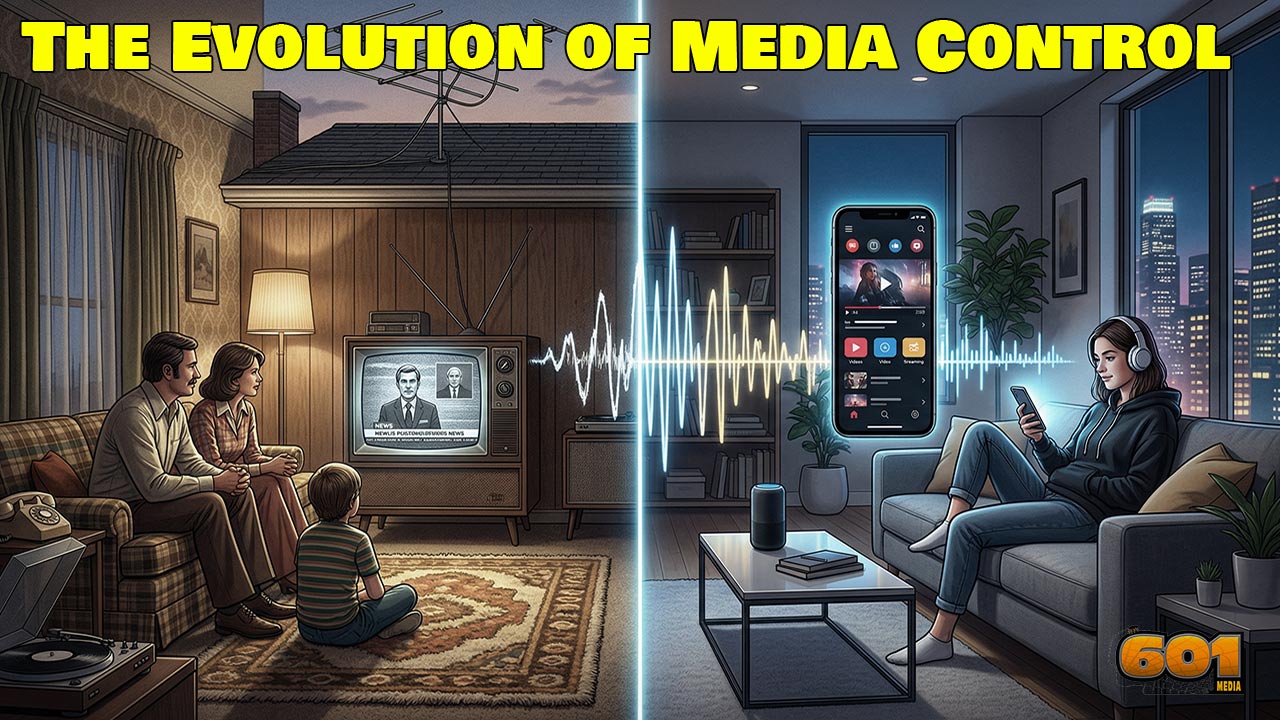
The Evolution of Media Control: Broadcast TV vs. the Internet Era
For most of the 20th century, media control was largely visible: a small number of broadcasters decided what went on air, when it aired, and which voices were amplified. In the internet era, control didn’t disappear—it changed shape. Power moved from schedules to feeds, from licenses to platforms, and from editors to algorithms. This article explains how that transition happened, why it matters for democracy and markets, and what “control” looks like now.
Table of Contents
- What “Media Control” Really Means
- Broadcast TV’s Control Architecture: Scarcity, Licensing, and Schedules
- Who Held Power in Broadcast TV?
- Broadcast Regulation as a Control System
- The Broadcast Business Model: Mass Reach and Limited Inventory
- The Internet Era’s Control Architecture: Abundance, Platforms, and Feeds
- The Evolution of Media Control Infographic
- From Editors to Product Teams: The New Gatekeepers
- Algorithmic Distribution: Control by Ranking, Not Blocking
- Data, Targeting, and the New Advertising Power Center
- Trust, Misinformation, and the Speed Problem
- How Regulation Shifted: From Spectrum to Liability and Platform Duties
- The Hybrid Future: Streaming, Connected TV, and Cross-Platform Control
- Innovation and Technology Management Playbook: Competing in a Controlled Attention Market
- What to Watch Next
- Top 5 Frequently Asked Questions
- Final Thoughts
- Resources
What “Media Control” Really Means
Media control is often described as censorship, ownership, or propaganda, but in practice it’s broader and more operational. It is the set of mechanisms that determine:
- Who gets reach (distribution power)
- What gets monetized (economic power)
- Which norms govern speech and behavior (rule-setting power)
- How quickly content spreads and how long it persists (temporal power)
In broadcast TV, distribution power came from scarce spectrum and channel access. In the internet era, scarcity moved from channels to attention, and control moved into ranking systems, platform policies, ad-tech, and device ecosystems.
Broadcast TV’s Control Architecture: Scarcity, Licensing, and Schedules
Broadcast TV was built on an engineering constraint with political consequences: spectrum scarcity. Only so many stations could operate in a market without interference. That scarcity created a permissioned system. If you wanted mass reach, you needed access to licensed broadcast infrastructure, and access was limited.
Control flowed through three design choices:
- Limited entry: licenses, capital intensity, and geographic coverage constraints.
- Fixed distribution: programming ran on a schedule and viewers had to show up at the appointed time.
- One-to-many communication: a small number of senders, a very large number of receivers.
These constraints shaped culture. Broadcast TV didn’t just deliver content; it synchronized attention. The same shows, the same anchors, the same “shared moments,” on the same evening.
Who Held Power in Broadcast TV?
Broadcast-era power concentrated in institutions with privileged access to distribution and production. The key gatekeepers were:
- Network executives and station owners deciding what got financed and aired.
- Program directors controlling schedules, lead-ins, and what audiences were trained to watch.
- Advertisers and agencies influencing what was “safe” to place next to brand messaging.
- Regulators shaping license terms and content obligations tied to public-interest frameworks.
This is why “control” felt legible. Decisions were made by identifiable organizations, with public reputations, and often with geographic accountability because stations served specific communities.
Broadcast Regulation as a Control System
Broadcast control was never purely private. It was a public-private arrangement: private companies operated stations, but did so under rules justified by spectrum scarcity and public interest.
A well-known example is the Fairness Doctrine, which historically required broadcasters to cover controversial issues of public importance and to present contrasting viewpoints. The FCC repealed it in 1987, a decision often cited as a major inflection point in U.S. broadcast policy.
Another foundational moment is the U.S. Supreme Court’s Red Lion decision (1969), which upheld fairness doctrine-related rules, relying on scarcity-based logic about broadcast frequencies and emphasizing the public’s interest in receiving information.
From an innovation and technology management perspective, this matters because broadcast control was embedded in the system’s governance. The architecture (scarce spectrum) and the rules (licensing, public interest duties) reinforced each other. Control had a “hard boundary”: you were either on air, or you weren’t.
The Broadcast Business Model: Mass Reach and Limited Inventory
Broadcast TV monetized a scarcity of ad slots paired with mass audience reach. Prime-time inventory, sports, and major events commanded high prices because:
- Audiences were aggregated in time (scheduling).
- Measurement, while imperfect, was standardized enough for market-making.
- There were fewer substitutes for real-time mass reach.
Control showed up economically as well. If a network decided to cancel a show, it vanished. If a station refused an ad, the buyer had fewer alternatives. The market structure supported negotiation power for broadcasters.
But that same structure contained a built-in vulnerability: once distribution scarcity weakened, the entire control stack could be disrupted.
The Internet Era’s Control Architecture: Abundance, Platforms, and Feeds
The internet removed the old bottleneck (channels) and created a new one (attention). In theory, anyone can publish. In practice, most people experience the internet through a small number of intermediaries: search engines, social platforms, app stores, messaging apps, and increasingly streaming aggregators.
The new architecture has four defining traits:
- Abundant content supply: the marginal cost of publishing approaches zero.
- Two-way, many-to-many communication: audiences produce, remix, and distribute.
- Personalized distribution: feeds and recommendations decide what rises.
- Continuous measurement and experimentation: ranking systems A/B test behavior at scale.
Instead of “what time is the show on,” the dominant question became “what will the feed surface right now?”
The Evolution of Media Control Infographic
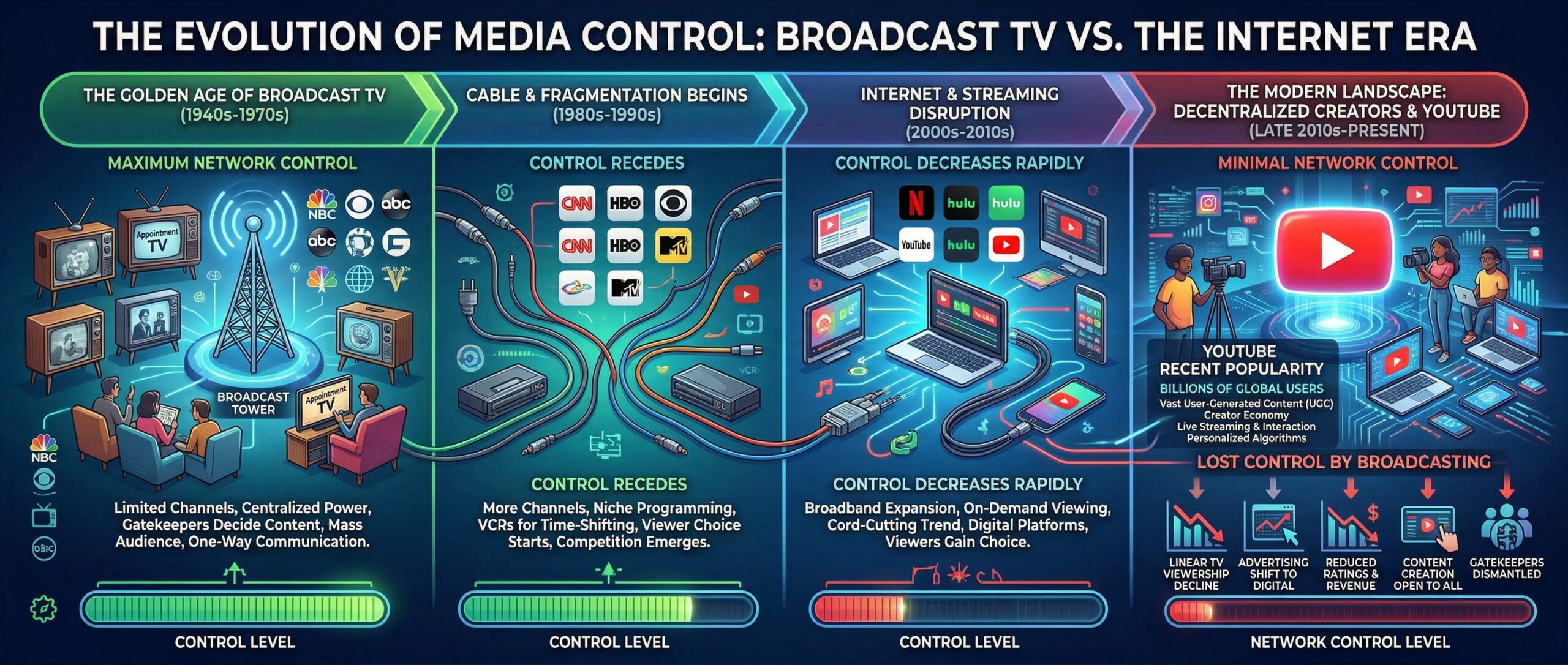
The preceeding infographic visualizes how media control shifted over time—from the tightly centralized power of broadcast TV to the distributed, platform-driven ecosystem of today. It moves chronologically through four eras (Golden Age broadcast, cable fragmentation, internet/streaming disruption, and the creator/platform economy), showing how each technological wave expanded viewer choice while steadily weakening traditional network gatekeeping. The “control level” bars at the bottom reinforce the core message: control didn’t disappear—it migrated from a few broadcasters and schedules to digital platforms, algorithms, on-demand distribution, and user-generated content, reshaping who decides what gets seen and monetized.
From Editors to Product Teams: The New Gatekeepers
In the broadcast era, gatekeeping happened in editorial rooms and programming meetings. In the internet era, gatekeeping often happens in product roadmaps, policy teams, and machine learning pipelines.
Modern gatekeepers include:
- Recommendation systems teams deciding ranking goals, signals, and constraints.
- Trust and safety teams setting moderation rules and enforcement priorities.
- Advertising systems defining what gets funded and what is demonetized.
- App store and device ecosystem owners controlling distribution access and monetization terms.
The big shift is that control is less about “approve or reject” and more about “amplify, suppress, or ignore.” Most content is not explicitly banned; it simply fails to reach anyone.
Algorithmic Distribution: Control by Ranking, Not Blocking
Algorithmic control is a power multiplier because it scales. In broadcast TV, a human schedule controlled reach in discrete blocks. In algorithmic feeds, reach is continuously recalculated at the level of the individual.
Control emerges through:
- Ranking objectives: what the system optimizes (watch time, shares, satisfaction, retention).
- Feedback loops: content that triggers engagement gets more exposure, which creates more engagement.
- Creator incentives: monetization and analytics steer production toward what performs.
- Friction design: prompts, resharing flows, and notification timing accelerate spread.
This creates a different kind of “editorial line.” It is not a coherent opinion; it is a behavioral optimization outcome. The result can feel neutral (“the algorithm”), even when it reflects value choices embedded in metrics and policy constraints.
From a technology management lens, algorithmic distribution is a core competency and a strategic moat. The firm that controls ranking controls demand formation, not just demand capture.
Data, Targeting, and the New Advertising Power Center
Broadcast advertising sold context (a show, a time slot, a demographic proxy). Internet advertising sells identity and intent signals—often inferred—paired with real-time targeting and measurement.
This is one reason ad power shifted. GroupM has forecast global advertising revenue surpassing $1 trillion in 2024, with digital channels dominating growth in many forecasts and analyses.
What changes with data-driven advertising:
- Precision: advertisers can target behavior, location, interests, and lookalike audiences.
- Attribution pressure: budgets shift to channels that can “prove” performance.
- Market concentration: scale platforms capture more data, which improves targeting, which attracts more spend.
The internet era therefore centralizes control economically around platforms that intermediate identity, attention, and transactions. Control is not merely “what you see,” but “what gets paid for,” which indirectly shapes what gets produced.
Trust, Misinformation, and the Speed Problem
Broadcast TV was not immune to misinformation, but it had throttles:
- Higher production friction and fewer outlets reduced volume.
- Editorial processes created some delay between claim and broadcast.
- Defamation risk and station reputation imposed constraints.
The internet trades those throttles for speed and participation. A rumor can become a trend inside minutes, amplified by resharing mechanics and recommendation systems. Control then becomes reactive: platforms moderate after distribution has already occurred, and harmful narratives can persist in screenshots, reposts, and copycat content.
Pew Research Center’s recent platform fact sheets illustrate how digital devices have become the dominant way Americans get news, while TV remains a major source “at least sometimes,” highlighting a mixed, hybrid information environment rather than a clean replacement.
How Regulation Shifted: From Spectrum to Liability and Platform Duties
Regulation in the broadcast era focused heavily on who could transmit and under what obligations. In the internet era, the questions shift to liability, duty of care, transparency, and systemic risk.
In the U.S., one of the most consequential legal building blocks for online intermediaries is Section 230 of the Communications Decency Act. Its core provision is widely summarized as shielding online service providers from being treated as the publisher or speaker of user-generated content under many circumstances.
In the EU, the policy focus has increasingly moved toward platform responsibilities, especially for large services. The Digital Services Act (DSA) is framed around obligations for online intermediaries, including transparency and risk-related requirements, with major applicability across the EU beginning in February 2024.
These regulatory approaches reflect two different control philosophies:
- Broadcast model: control entry and enforce public-interest obligations on license holders.
- Platform model: allow broad entry, then regulate systemic risks, transparency, and governance of intermediaries.
The managerial implication is that compliance and governance are now core strategic functions for platform-scale organizations. Policy is not an external constraint; it becomes part of product design.
The Hybrid Future: Streaming, Connected TV, and Cross-Platform Control
The story is not “TV died.” It is “TV’s control system changed.” Streaming has absorbed many TV functions while importing internet-era mechanics like personalization, identity, and measurement.
Nielsen’s Gauge reporting highlights how streaming has grown into a dominant share of TV viewing in the U.S., including milestone moments where streaming outpaced broadcast and cable combined in certain periods.
This matters because it creates a hybrid control stack:
- TV screen experience, but internet-style personalization and account-based identity.
- Legacy studios, but platform intermediaries controlling discovery and bundling.
- Old ad formats, but new targeting and programmatic pipes.
In other words, “TV” is increasingly a device category, while “broadcast” is a distribution category in decline. Control concentrates around operating systems, app ecosystems, and streaming aggregators that sit between producers and audiences.
Innovation and Technology Management Playbook: Competing in a Controlled Attention Market
If you lead a media company, a platform team, or a brand, “media control” is not an abstract political topic. It is a competitive environment. Here is a practical playbook grounded in innovation and technology management principles.
1) Treat distribution as a product, not a channel
In broadcast, distribution was purchased (carriage, affiliates, time slots). In the internet era, distribution is engineered:
- Metadata quality, packaging, thumbnails, and titles shape ranking outcomes.
- Retention curves and completion rates become creative constraints.
- Release strategies are tested and iterated like software.
The organizations that win are those that integrate editorial, data science, and product operations rather than treating them as separate silos.
2) Build governance into the innovation pipeline
When control is algorithmic, governance must be operational:
- Define what “success” means beyond engagement (satisfaction, harm reduction, quality signals).
- Use red-team reviews for virality and manipulation risks.
- Instrument policy enforcement for consistency and auditability.
The goal is not perfect neutrality; it is clear accountability.
3) Compete on trust as a durable asset
In attention markets, trust is a form of customer retention. If audiences believe you manipulate them or mislead them, churn rises and platform dependence increases.
- Transparency about sourcing and corrections can be a differentiator.
- Creator partnerships can scale credibility if incentives align.
- Consistency across platforms prevents brand fragmentation.
4) Diversify your dependency stack
Broadcast networks once feared distributor power (affiliates, cable carriage). Today, creators and publishers fear platform power (feeds, search, app stores). Dependency is a strategic risk.
- Develop owned channels: email, membership, direct apps, events.
- Use multiple discovery paths: search, social, syndication, partnerships.
- Negotiate data access and measurement standards in distribution deals.
5) Understand that “control” is often an incentive design problem
A platform can claim it does not “control” speech while still controlling incentives:
- Demonetization changes what creators can afford to produce.
- Recommendation changes what audiences ever encounter.
- Friction changes how often content gets reshared.
The strategic lever is incentive alignment: design monetization, ranking, and policy so that quality is profitable.
What to Watch Next
The next phase of media control will likely be shaped by five converging forces:
- Algorithmic transparency pressure: Regulators, researchers, and users increasingly demand clarity on how ranking works and what choices it embeds.
- Generative AI content volume: Abundant synthetic content can overwhelm attention markets, increasing the value of provenance, verification, and trusted brands.
- Messaging and private distribution: Control shifts from public feeds to closed networks where moderation and measurement look different.
- Streaming bundles and OS gatekeeping: Device ecosystems and aggregators can become the new “channels,” reintroducing a form of scarcity through interface design.
- Global policy divergence: Different regions will impose different platform obligations, fragmenting the governance landscape for multinational services.
The important takeaway is that “media control” does not vanish when technology changes. It relocates to the dominant bottleneck. Broadcast controlled channels; the internet controls ranking; the next era may control identity, provenance, and interface real estate.
Top 5 Frequently Asked Questions
Final Thoughts
The most important takeaway is simple: media control follows the bottleneck. In broadcast TV, the bottleneck was transmission capacity and channel access, so control lived in licensing, schedules, and a small set of institutional gatekeepers. In the internet era, the bottleneck is attention and discovery, so control lives in ranking systems, platform rules, and advertising infrastructure that shapes incentives at scale.
This shift changes how influence works. Broadcast control was centralized and legible; internet-era control is distributed and often invisible, expressed through metrics, interface design, and algorithmic optimization. That makes accountability harder, because power is embedded in systems rather than only in leaders. But it also creates opportunities: new entrants can publish, new voices can build audiences, and innovation can scale faster than in the broadcast world.
For innovation and technology management leaders, the practical lesson is to treat governance, incentives, and distribution engineering as first-class strategic capabilities. If your organization acts as though media is “just content,” it will be controlled by those who treat media as a controllable system—built from data, product design, and policy. The winners in the next era will be the ones who can grow attention responsibly, monetize without eroding trust, and navigate a regulatory landscape that is increasingly shaping the rules of visibility itself.
Resources
- International Telecommunication Union (ITU) – Facts and Figures / internet use updates (2024 revisions; 2025 update).}
- Pew Research Center – News Platform Fact Sheet (U.S. news consumption across TV and digital) and related analysis of preferences.
- Nielsen – The Gauge reports on streaming share of TV viewing (milestones in 2025 and December 2025).
- Reagan Library – Historical summary of Fairness Doctrine repeal in 1987.
- Oyez / Justia – Red Lion Broadcasting Co. v. FCC (1969) case overview and context.
- Cornell Law (LII) and EFF – Text and explanation of 47 U.S.C. § 230 (Section 230).
- European Commission – Digital Services Act policy overview; and commentary on broad applicability from Feb 17, 2024.
- Reuters / GroupM coverage – Global advertising revenue forecast surpassing $1T in 2024.


Leave A Comment