



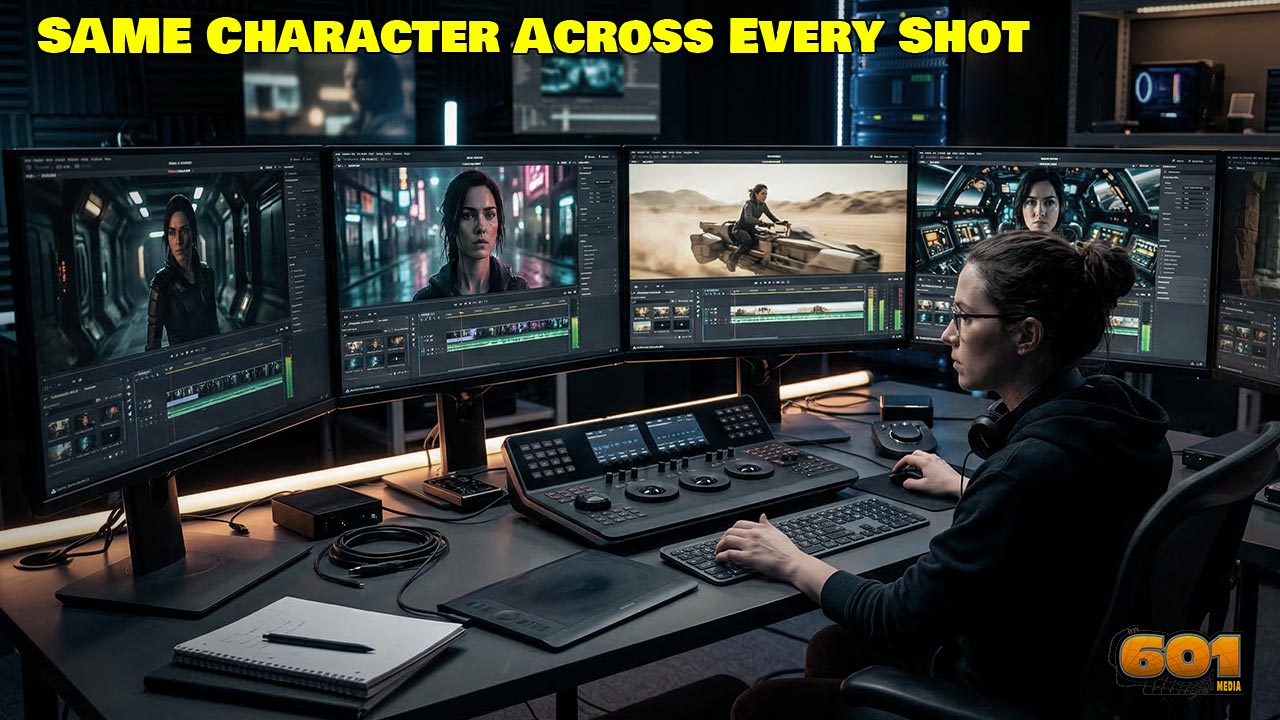
How to Keep the SAME Character Across Every Shot (AI Film Consistency Guide)
Keeping a character visually identical from one scene to the next is the single biggest challenge in AI filmmaking today. As AI image and video models become more powerful, creators are discovering that generating a great single frame is easy—but maintaining the same character across dozens of shots is far harder. Facial structures shift, hairstyles change, wardrobe morphs, and even body proportions drift.
This guide explains how creators, filmmakers, and AI storytellers solve the problem of character consistency in AI video. You will learn the exact techniques used by advanced creators to keep characters visually stable across scenes, including prompt anchoring, character sheets, seed control, reference images, and model-specific tools. By the end of this guide, you will understand how to create believable continuity in AI films and produce professional-quality visual storytelling with modern AI tools.
Table of Contents
- Why Character Consistency Is the Biggest Problem in AI Filmmaking
- How AI Image and Video Models Change Characters Between Shots
- Create a Character Sheet Before Generating Scenes
- Use Prompt Anchoring to Lock Identity
- Reference Images: The Most Reliable Method
- Using Seeds to Maintain Character Continuity
- Maintaining Wardrobe and Costume Consistency
- Handling Different Camera Angles Without Losing Identity
- Best AI Tools for Consistent Characters
- A Professional Workflow for AI Film Character Consistency
- The Future of Character Consistency in AI Video
- Top 5 Frequently Asked Questions
- Final Thoughts
- Resources
Why Character Consistency Is the Biggest Problem in AI Filmmaking
The greatest technical hurdle in AI filmmaking is maintaining character continuity across multiple scenes. Traditional filmmaking solves this problem with actors, costumes, makeup teams, and continuity supervisors. AI filmmaking must solve the same challenge algorithmically. Modern AI models such as diffusion systems generate each image independently. They do not inherently understand that a character in Scene 5 is supposed to be the same person from Scene 1. Every prompt is treated as a fresh request.
Because of this, small differences appear quickly:
- Facial features subtly change
- Hair length and style shift
- Wardrobe colors mutate
- Body proportions drift
- Accessories appear or disappear
These changes break immersion instantly. Viewers subconsciously recognize when a character is not the same individual across scenes. Professional AI filmmakers therefore spend significant time designing systems that lock visual identity across multiple frames.
How AI Image and Video Models Change Characters Between Shots
To solve character consistency in AI video, you first need to understand why the problem exists. AI diffusion models generate images through probability distributions learned from massive datasets.
When you prompt a model with something like:
“young female astronaut in orange spacesuit”
the model produces one of many possible variations matching that description. Even if you reuse the same prompt repeatedly, the output can vary widely because the model explores different visual interpretations.
Small variations may include:
- Eye shape and spacing
- Jawline width
- Nose size
- Hair color tone
- Clothing texture
These differences accumulate over multiple shots. By Scene 10, the character may look like a completely different person. Maintaining consistent characters in AI films therefore requires methods that constrain the model’s randomness.
Create a Character Sheet Before Generating Scenes
Professional AI filmmakers rarely begin with scene generation. Instead, they start by building a detailed character sheet. A character sheet acts as the visual blueprint for the entire film.
It typically includes:
- Front portrait
- Side profile
- Three-quarter angle
- Full body shot
- Emotion variations
- Wardrobe reference
This approach mirrors animation studios. Companies like Pixar and DreamWorks create extensive character sheets before animation begins.
When building a character sheet with AI:
- Generate 20–50 variations
- Select the most consistent identity
- Use that image as the master reference
Once a strong visual identity exists, every new shot references that same base image. This dramatically improves character consistency in AI video.
Use Prompt Anchoring to Lock Identity
Prompt anchoring is one of the most effective techniques for consistent characters in AI films. A prompt anchor is a fixed description of the character that never changes between scenes.
Example anchor:
“Emily Carter, 28-year-old woman, short dark brown hair, green eyes, light freckles, sharp jawline, wearing a red leather jacket and black jeans”
This description appears in every prompt regardless of scene changes.
Example scene prompts:
Scene 1
Emily Carter walking through a futuristic city street at night
Scene 2
Emily Carter sitting in a dimly lit bar
Scene 3
Emily Carter running through a rainy alley
Because the identity description stays constant, the model is more likely to preserve facial features. Prompt anchors function like a character ID for the model.
Reference Images: The Most Reliable Method
Reference images are currently the most powerful solution for maintaining character consistency in AI video. Most modern AI generation tools allow users to upload an image that guides new generations.
This technique is sometimes called:
- Image conditioning
- Reference guidance
- Image prompt
- IP adapters
The reference image acts as a visual constraint. Instead of guessing what the character looks like, the AI model builds upon the provided identity.
This dramatically reduces drift in:
- Facial structure
- Hair style
- Skin tone
- Clothing details
For best results, creators often use multiple references:
- Face reference
- Full body reference
- Wardrobe reference
This multi-reference approach produces significantly stronger continuity.
Using Seeds to Maintain Character Continuity
In diffusion models, a seed controls the starting noise pattern used to generate an image. If you reuse the same seed with the same prompt, the output will remain highly similar. Filmmakers use seeds to preserve identity across shots.
For example:
- Seed 124567 → base character generation
- Same seed reused for alternate angles
- Same seed reused with new environments
Changing only the scene description while keeping the seed constant helps stabilize the character. However, seeds alone rarely guarantee perfect continuity. They work best when combined with reference images and prompt anchors.
Maintaining Wardrobe and Costume Consistency
Wardrobe drift is one of the most common continuity failures in AI films.
A character might start wearing:
“red leather jacket”
but later appear in:
- burgundy jacket
- fabric jacket
- different zipper placement
- completely different clothing
To avoid this, include extremely specific clothing descriptions.
Example:
“red leather biker jacket with silver zippers, black fitted jeans, black combat boots”
Specificity reduces the model’s freedom to reinterpret clothing. Another powerful trick involves generating a wardrobe reference image and using it across all prompts.
Handling Different Camera Angles Without Losing Identity
Changing camera angles is necessary for cinematic storytelling but increases the risk of identity drift.
Common shots include:
- Close-up
- Medium shot
- Wide shot
- Over-the-shoulder
- Profile
When switching angles, the prompt should explicitly state the shot type while preserving the identity anchor.
Example:
“close-up cinematic portrait of Emily Carter”
or
“wide shot of Emily Carter walking through neon city street”
Maintaining the identity description ensures that new perspectives do not generate a new character.
Best AI Tools for Consistent Characters
Several AI platforms are improving character continuity.
Popular tools include:
- Stable Diffusion with IP-Adapter
- ComfyUI workflows
- Midjourney character reference feature
- Runway video generation tools
- Pika AI video generation
Stable Diffusion workflows currently offer the most control because they allow:
- reference image injection
- face embeddings
- control networks
- custom training
This flexibility enables filmmakers to maintain highly consistent characters across long sequences.
A Professional Workflow for AI Film Character Consistency
The most reliable AI filmmaking workflow follows these steps:
Step 1
Design the character visually before generating scenes.
Step 2
Create a master reference image.
Step 3
Write a fixed identity anchor description.
Step 4
Generate multiple reference angles.
Step 5
Use the same references in every shot.
Step 6
Keep wardrobe descriptions constant.
Step 7
Use seeds to stabilize generation.
Step 8
Generate scenes sequentially.
This workflow reduces identity drift dramatically. Many successful AI filmmakers treat their characters like digital actors with defined visual identities.
The Future of Character Consistency in AI Video
Character continuity is improving rapidly as AI video models evolve.
New research areas include:
- identity embeddings
- persistent character tokens
- multi-frame generation
- AI character memory
These systems allow models to remember the same character across hundreds of frames. Major AI labs are actively working on this problem because storytelling requires stable characters. As these technologies mature, AI filmmaking will become dramatically easier. Consistent characters will enable long-form AI movies, episodic series, and complex narrative storytelling.
Top 5 Frequently Asked Questions
Final Thoughts
Maintaining the same character across multiple scenes is the defining challenge of modern AI filmmaking. While generating a single impressive frame is relatively simple, producing a cohesive visual story requires careful control of identity, wardrobe, and facial structure. Successful creators approach AI characters the same way traditional film studios approach actors. They design the character first, establish a visual identity, create reference materials, and reuse those references throughout production. Techniques such as prompt anchoring, reference images, seed control, and wardrobe specificity dramatically improve continuity. When combined into a structured workflow, these methods allow filmmakers to produce visually consistent characters across dozens or even hundreds of shots. As AI video technology continues to evolve, character consistency will become easier and more automated. Until then, creators who master these techniques will have a significant advantage in producing high-quality AI films that feel cohesive, cinematic, and believable.
Resources
- Stanford Artificial Intelligence Lab – Diffusion Model Research
- Runway AI Research Papers
- OpenAI Generative Image Model Documentation
- Stability AI Diffusion Model Documentation
- MIT Technology Review – Generative AI Media Research


Great breakdown of the character consistency problem – the character sheet approach has been the biggest unlock for me too. Before I started building a reference sheet with consistent facial markers, hairstyle, and wardrobe notes, my characters drifted noticeably by scene three no matter how detailed my prompt anchoring was. Reference images are definitely the most reliable method, as you say; seeds help but they’re fragile across different model versions. One thing I’d add for people reading: when you’re iterating on a consistency workflow, it helps to test the same prompt setup across different image models, because each one handles identity differently – I’ve been doing that through pixapi.ai, which lets me compare models and see the credit cost before sending a request. It turned trial-and-error into a reproducible pipeline. Thanks for the guide, the workflow section will save a lot of filmmakers real hours.