



Overview
Marketing in 2026 is moving fast. Customers expect helpful content, quick answers, and proof before they buy. For small businesses, this can feel overwhelming.
The good news is that AI video tools are making promotion easier. You no longer need a big budget, a film crew, or professional editing skills to create useful videos.
In 2026 and beyond, the best small business marketing will blend three things: clear messaging, smart AI tools, and a human touch. Video will sit at the center of that mix.
Why Marketing Is Changing in 2026
Marketing used to be about getting attention.
Now it is about earning trust.
Customers see ads all day. They scroll past polished posts. They ignore generic emails. They also know when content feels fake.
HubSpot’s 2026 marketing research points to a major shift: brands need a clear point of view because AI has made basic content easier to produce and easier to ignore. Businesses that sound the same will struggle to stand out.
For small business owners, this means your story matters more than ever.
You do not need to sound like a huge company. In fact, that can hurt you. You need to sound clear, honest, and useful.
Video Will Keep Leading Small Business Marketing
Video is no longer a “nice to have.”
It is one of the main ways people learn about products and services. Wyzowl’s 2026 video marketing data reports that 91% of businesses use video as a marketing tool, and 93% of video marketers see video as an important part of their strategy.
That matters because video helps people understand quickly.
A short video can show:
- What your product does
- How your service works
- Why your business is different
- What customers can expect
- Who is behind the brand
For example, a local bakery can show how it prepares custom cakes. A plumber can explain how to prevent frozen pipes. A boutique can record a 30-second outfit idea. A consultant can answer one common client question.
These videos do not need to be perfect.
They need to be helpful.
AI Video Tools Make Marketing Easier
In the past, video marketing had a high barrier.
You needed cameras, editing software, lighting, scripts, and time. That stopped many small business owners from even trying.
AI video tools change that.
They can help you:
- Turn a blog post into a video script
- Create captions automatically
- Remove background noise
- Cut long videos into short clips
- Add stock footage
- Create voiceovers
- Generate simple product explainers
- Resize videos for TikTok, Instagram, YouTube, and LinkedIn
Wyzowl’s 2026 data also notes that 63% of video marketers have used AI video tools.
That does not mean AI should replace your voice.
It means AI can handle the hard parts so you can focus on your message.
The Big Marketing Trends for 2026 and Beyond
1. Short-Form Video Will Stay Powerful
Short videos work because people are busy.
They want fast answers. They want quick demos. They want to know if your business can solve their problem.
A strong short video can be as simple as:
- “3 signs your roof needs repair”
- “How to choose the right facial cleanser”
- “What to ask before hiring a bookkeeper”
- “A 20-second tour of our new menu item”
The goal is not to go viral every time.
The goal is to stay visible and useful.
2. AI Search Will Change SEO
People are no longer only searching on Google.
They ask AI tools for answers. They use voice search. They search inside TikTok, YouTube, Instagram, Reddit, and maps.
This means your content must be easy to understand.
Use plain language. Answer real questions. Add examples. Keep your business information consistent across your website, Google Business Profile, social channels, and review sites.
AI search tools often reward clear, trusted, well-structured content.
So your videos should have:
- Clear titles
- Accurate captions
- Simple descriptions
- FAQs
- Location details
- Product or service keywords
For example, instead of naming a video “Watch This,” a dentist should use “How Teeth Whitening Works in One Visit.”
That title tells people and search tools what the video is about.
3. Personalization Will Matter More
Customers want marketing that feels relevant.
AI can help you create different versions of the same message for different audiences.
For example, a fitness coach could create:
- A video for busy parents
- A video for beginners
- A video for people over 50
- A video for former athletes getting back in shape
The core offer may be the same.
But the message changes based on the viewer’s needs.
This is powerful because people pay attention when they feel understood.
4. Social Commerce Will Keep Growing
More people are buying directly from social platforms.
HubSpot’s 2026 marketing statistics report says 26% of marketers plan to explore selling products directly on social media in 2026, including Instagram shops.
For small businesses, this means your videos should not only entertain.
They should guide people toward action.
That action could be:
- Book a call
- Visit the store
- Buy now
- Join an email list
- Request a quote
- Watch a demo
- Send a message
A product video should make the next step obvious.
5. Trust Will Beat Hype
AI can create content quickly.
But speed is not the same as trust.
Customers still want proof. They want reviews. They want to see real people. They want to know your business can deliver.
Use AI to improve your video production, not to fake your brand.
Show real team members. Share real customer stories. Explain your process. Record behind-the-scenes clips.
For example, a home organizer could post a simple before-and-after video. A restaurant could show the chef preparing a popular dish. A landscaper could record a project from start to finish.
These videos build confidence.
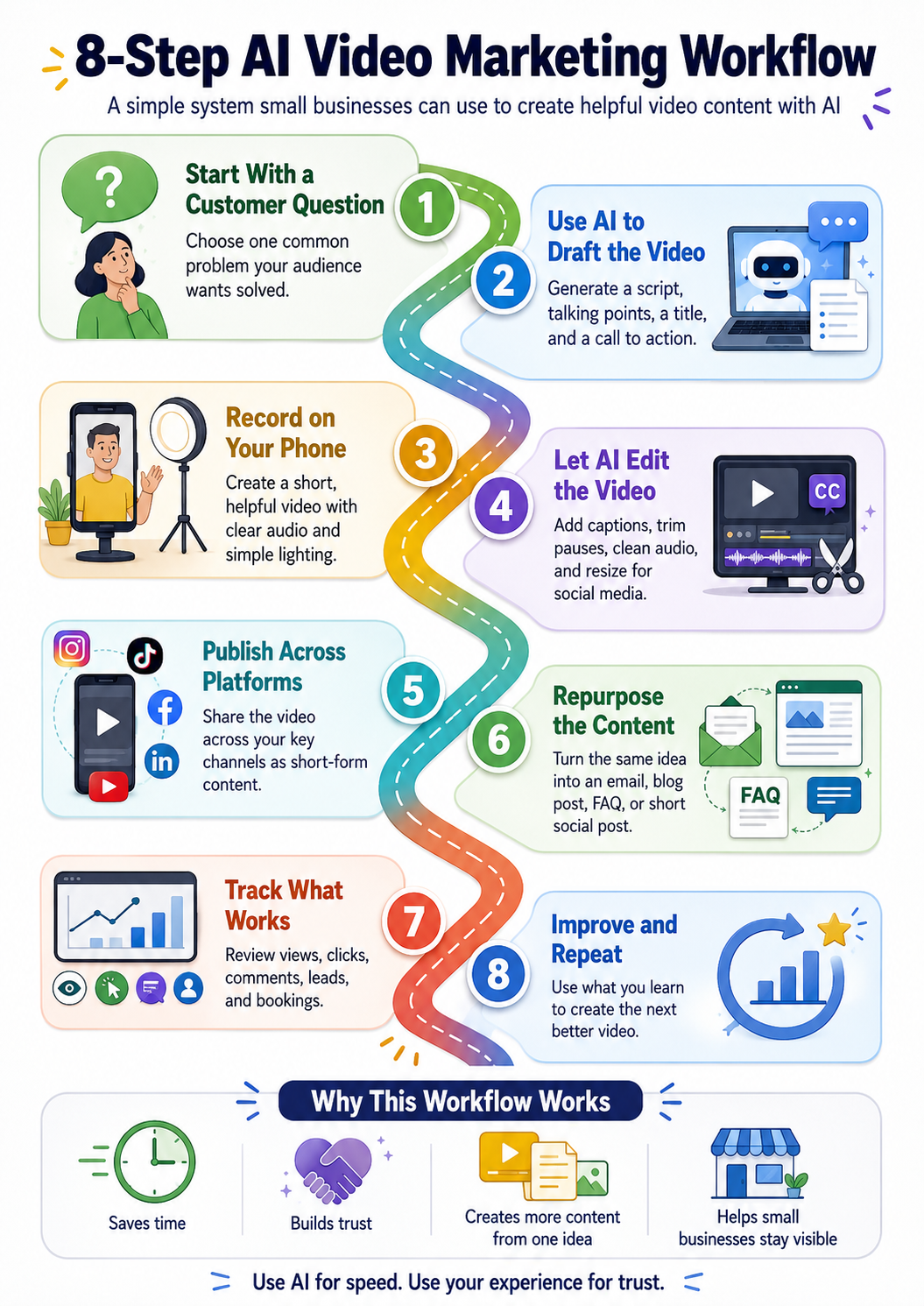
How Small Businesses Can Use AI Video Without Editing Skills
Start With One Simple Video Type
Do not try to do everything at once.
Pick one video format and repeat it.
Good beginner formats include:
- Customer question videos
- Product demos
- Service explainers
- Behind-the-scenes clips
- Customer testimonials
- Before-and-after videos
- “Mistakes to avoid” videos
For example, a tax preparer could record one weekly video answering a common tax question.
That single habit can create content for YouTube Shorts, Instagram Reels, TikTok, Facebook, LinkedIn, and email.
Use AI to Create the First Draft
AI works well when you give it clear direction.
You can ask an AI tool to turn a topic into:
- A short script
- A video outline
- A social media caption
- A title
- A list of talking points
- A call to action
For example:
“Write a 45-second video script for a local dog groomer explaining why regular nail trimming matters. Use simple language. End with a booking call to action.”
That gives you a starting point.
Then you can edit the script so it sounds like you.
Record With Your Phone
You do not need a studio.
Use natural light. Face a window. Keep your phone steady. Speak clearly. Keep the video focused on one point.
A useful 30-second video is better than a perfect video that never gets made.
Let AI Handle the Editing
AI video tools can remove pauses, add subtitles, resize clips, and improve sound.
This saves time.
It also helps your videos look more polished without needing professional editing skills.
Captions are especially important because many people watch videos without sound.
Real-World Examples
Local Coffee Shop
A coffee shop could use AI to create short videos like:
- “How we make our seasonal latte”
- “Meet the barista”
- “Best drink for first-time visitors”
- “Behind the scenes before opening”
These videos make the shop feel familiar before someone walks in.
HVAC Company
An HVAC company could post:
- “How often should you replace your filter?”
- “Why your AC is blowing warm air”
- “What happens during a tune-up?”
- “3 signs your furnace needs service”
These videos answer urgent customer questions.
They also help the business show expertise.
Online Boutique
A boutique could create:
- “3 ways to style this jacket”
- “What to wear to a spring wedding”
- “New arrivals under $50”
- “How this dress fits on different body types”
AI can help turn one product video into several social posts.
A Simple 2026 Marketing Plan for Small Businesses
Start small.
You do not need a large campaign. You need a repeatable system.
Try this weekly plan:
- Create one helpful video
- Post it on two or three platforms
- Add captions and a clear title
- Include one call to action
- Turn the video into an email
- Turn the same idea into a blog post or FAQ
- Track which topics get comments, clicks, or bookings
This approach gives you more value from one idea.
It also keeps your marketing steady.
What to Avoid
AI video tools are helpful, but they can create problems when used the wrong way.
Avoid:
- Posting generic videos with no clear message
- Using fake customer stories
- Overloading videos with effects
- Copying competitors
- Making every video a sales pitch
- Ignoring comments and questions
- Letting AI remove your brand personality
Your goal is not to look perfect.
Your goal is to be trusted.
The Future: Human Brands Using Smart Tools
Marketing in 2026 and beyond will not be won by the business that uses the most AI.
It will be won by the business that uses AI wisely.
Small businesses have an advantage. They are closer to customers. They know real problems. They can move quickly. They can sound human.
AI video tools help turn that advantage into content people can see, hear, and remember.
The best strategy is simple:
Use AI for speed.
Use your experience for trust.
Use video to make your business easier to understand.
That is how small businesses can compete in a crowded market without needing a big team or professional editing skills.


Leave A Comment