



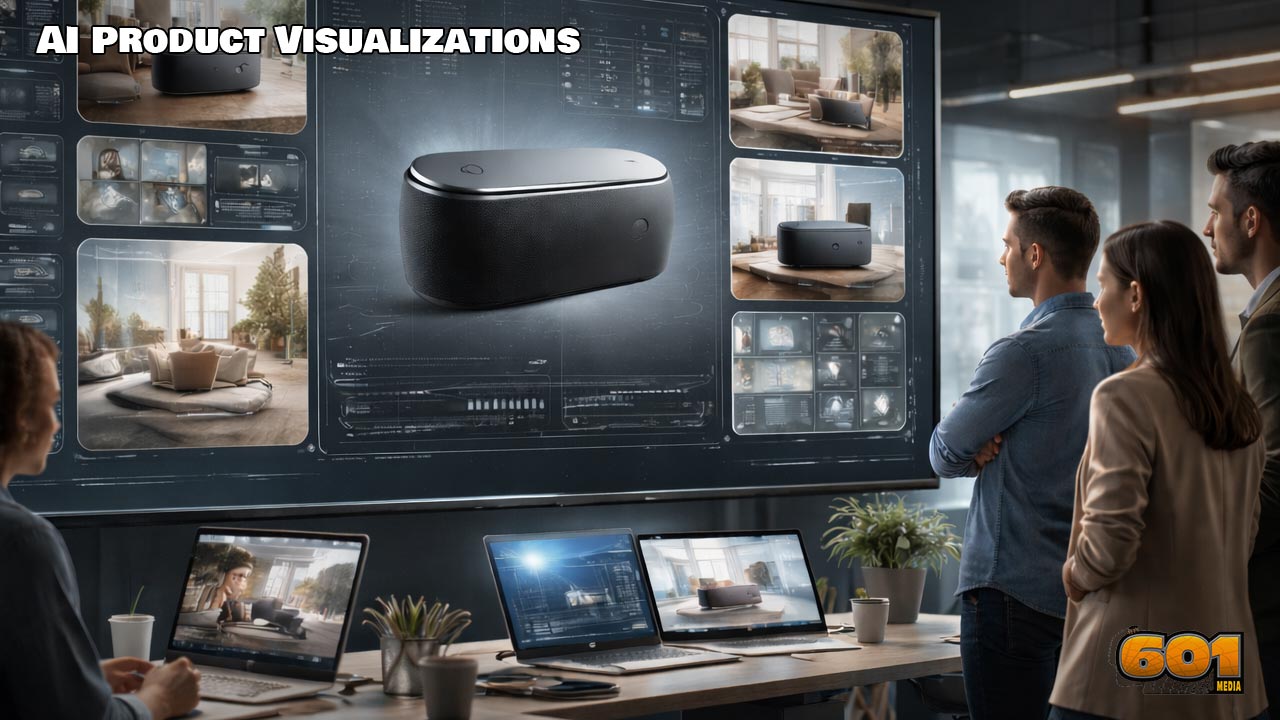
AI Product Visualizations: Creating Stunning Marketing Images Without Photography
Artificial intelligence is transforming product marketing by enabling businesses to generate high-quality product visuals without traditional photography. AI product visualization tools can create photorealistic renders, lifestyle scenes, and dynamic marketing assets using only a product description, CAD file, or basic image. We explore how AI-generated visuals work, why brands are adopting them, the technologies behind the process, and how marketing teams can integrate AI visualization into their workflows to reduce cost, accelerate campaigns, and unlock creative flexibility.
Table of Contents
- Introduction to AI Product Visualizations
- The Limitations of Traditional Product Photography
- How AI Generates Product Marketing Images
- AI Visualization Workflow for Marketing Teams
- Real-World Applications Across Industries
- Benefits of AI Product Visualization
- Challenges and Limitations
- Future of AI-Generated Product Imagery
- Top 5 Frequently Asked Questions
- Final Thoughts
- Resources
Introduction to AI Product Visualizations
Product visuals drive modern digital commerce. Research from Shopify and BigCommerce consistently shows that high-quality imagery significantly increases conversion rates, improves consumer trust, and reduces product return rates. For decades, brands relied on studio photography to create these visuals. The process involved photographers, lighting technicians, studio space, product samples, and extensive post-production editing.
Artificial intelligence is reshaping this workflow.
AI product visualization uses machine learning models, generative algorithms, and computer graphics to produce realistic marketing images without physically photographing the product. Instead of setting up a photo shoot, marketers can generate images of a product in multiple environments, lighting conditions, or use scenarios through software platforms. A single product model can instantly produce hundreds of visual variations. For example, a furniture retailer can render the same couch in dozens of living room settings. A cosmetics brand can simulate lighting and skin tones for global markets. An electronics company can generate promotional graphics for launches long before manufacturing finishes. This shift represents more than a cost-saving measure. It changes how marketing teams approach creativity, speed, and scalability. AI visualization enables marketing teams to design visuals on demand.
The Limitations of Traditional Product Photography
Traditional photography remains powerful, but it comes with constraints that slow modern marketing cycles. Studio shoots require extensive planning. Products must be shipped to studios, stylists must prepare environments, and photographers must capture multiple shots. Editing teams then refine images to meet brand standards. The process can take weeks. Costs also accumulate quickly. Professional photographers charge day rates, studio rentals increase expenses, and retouching adds additional labor. Large product catalogs amplify these costs dramatically.
Another limitation is inflexibility.
Once photos are captured, making changes becomes difficult. Adjusting a background, changing a color variant, or creating new seasonal imagery often requires a completely new shoot. This creates friction in industries where product lines change rapidly. E-commerce brands frequently release new models, colors, and packaging. Marketing teams must update product pages, social media visuals, advertising creatives, and marketplace listings across multiple channels. Traditional photography cannot always keep up with this demand for visual content. AI visualization tools solve this problem by turning imagery into a flexible digital asset rather than a static photograph.
How AI Generates Product Marketing Images
AI product visualization relies on several technologies working together. The most influential innovations come from computer vision, generative AI, and 3D rendering systems.
First, generative models create images from data inputs. Diffusion models and generative adversarial networks (GANs) can synthesize realistic imagery from text prompts or training data. These models learn visual patterns such as lighting, materials, reflections, and spatial composition.
Second, 3D modeling enables accurate representation of product geometry. Many companies already maintain CAD models of their products for manufacturing. These files can be imported into visualization software to create accurate digital twins.
Third, rendering engines simulate lighting and materials. Rendering technology replicates real-world physics such as shadows, reflections, and surface textures. Combined with AI, these systems produce photorealistic results.
Fourth, AI scene generation creates contextual environments. Instead of photographing a product on a real table or shelf, the system generates a digital environment that matches the desired marketing aesthetic.
For example, a coffee mug can appear on a rustic wooden table, in a modern office setting, or in a cozy kitchen environment. All of these components combine into modern AI visualization platforms that marketers can operate with simple prompts or drag-and-drop interfaces.
AI Visualization Workflow for Marketing Teams
Adopting AI visualization requires a structured workflow that integrates technology with marketing strategy.
The process typically begins with product digitization.
Companies create a digital representation of the product using CAD files, 3D scanning, or high-resolution base images. This digital asset becomes the foundation for generating visual content.
Next comes scene design.
Marketing teams define the context in which the product should appear. For example, a fashion brand may generate lifestyle imagery showing clothing in urban settings. A kitchen appliance company might place products in modern kitchens.
AI platforms allow teams to generate multiple variations instantly.
After generating visuals, creative teams refine and curate the images. Even with AI, human oversight remains essential. Designers ensure that images align with brand guidelines, color accuracy, and marketing objectives.
Finally, assets are distributed across marketing channels.
Generated visuals can power website product pages, online ads, social media campaigns, marketplace listings, and digital catalogs.
This workflow dramatically accelerates production timelines.
Campaign visuals that once required weeks can now be created within hours.
Real-World Applications Across Industries
AI product visualization is rapidly expanding across industries.
In e-commerce, retailers use AI-generated imagery to showcase products in different environments. Furniture companies allow customers to visualize products in realistic room layouts.
The fashion industry benefits from AI by generating lookbooks, promotional imagery, and seasonal campaigns without scheduling complex photoshoots.
Consumer electronics brands use AI visualization to create product launch graphics months before physical prototypes exist.
Automotive companies generate marketing images for concept vehicles and upcoming models during early design stages.
Cosmetics companies use AI to simulate packaging variations and lighting scenarios that highlight product textures.
Real estate developers also benefit by rendering interior furnishings, allowing buyers to visualize properties before construction finishes.
Across these sectors, the common advantage is speed.
AI visualization dramatically reduces the time required to produce marketing visuals.
Benefits of AI Product Visualization
The advantages extend far beyond cost reduction.
First, AI visualization increases marketing agility. Campaigns can launch faster because visual assets no longer depend on physical photography schedules.
Second, scalability improves dramatically. Brands can generate thousands of product images covering multiple environments, demographics, and seasonal themes.
Third, creative experimentation becomes easier. Marketing teams can test multiple visual concepts without committing to expensive photo shoots.
Fourth, sustainability improves. Traditional photography often involves shipping products, constructing sets, and transporting crews. AI visualization reduces these environmental impacts by replacing physical production with digital processes.
Finally, global localization becomes easier.
Brands can generate visuals tailored to regional markets without reshooting products. A product can appear in different cultural settings, lighting conditions, or interior styles depending on the target audience.
Challenges and Limitations
Despite its advantages, AI visualization still faces several challenges.
Accuracy remains a key concern.
Generated visuals must match the real product precisely. Any visual discrepancy between marketing imagery and the delivered product can damage customer trust.
Another limitation is brand consistency.
AI-generated visuals require strict oversight to maintain consistent lighting, color grading, and composition across campaigns.
There is also a learning curve.
Marketing teams must develop new skills to effectively use AI tools. Prompt design, scene composition, and digital asset management become essential capabilities.
Finally, some consumers still value authentic photography.
In certain product categories such as luxury goods or handmade crafts, real photography may continue to play an important role in conveying authenticity.
The most effective strategy often combines both approaches.
Future of AI-Generated Product Imagery
The future of AI product visualization looks extremely promising.
Advances in generative AI models are rapidly improving image realism. New systems can simulate complex materials such as glass, metal, and fabric with remarkable accuracy.
Real-time rendering will also play a major role.
Interactive product visualization will allow customers to customize colors, materials, and configurations directly on e-commerce platforms.
Augmented reality integration will further expand possibilities.
Consumers will be able to place AI-generated product models into their own environments using mobile devices.
Marketing will also become increasingly automated.
AI systems will generate optimized visuals for specific audience segments, advertising channels, and campaign objectives.
In this future, marketing imagery becomes dynamic, data-driven, and personalized.
Top 5 Frequently Asked Questions
Final Thoughts
AI product visualization represents a fundamental shift in how marketing imagery is created. Instead of relying solely on physical photography, brands can now generate high-quality visual assets through digital workflows powered by artificial intelligence. This transformation improves speed, scalability, and creative flexibility. Marketing teams can produce campaign visuals faster, experiment with new ideas, and localize imagery for global markets. However, successful adoption requires thoughtful implementation. Businesses must ensure accuracy, maintain brand standards, and combine AI tools with human creative oversight. The most powerful strategy is not replacing photographers entirely but augmenting marketing capabilities with intelligent visualization technologies. Organizations that integrate AI visualization into their marketing operations will gain a significant competitive advantage in the rapidly evolving digital commerce landscape.
Resources
- McKinsey Digital — The State of AI in Business
- MIT Technology Review — Generative AI and Visual Content Creation
- Shopify Research — Impact of Product Images on Conversion Rates
- NVIDIA — AI Rendering and Digital Twin Technology
- Stanford AI Lab — Generative Adversarial Networks Research


Leave A Comment