



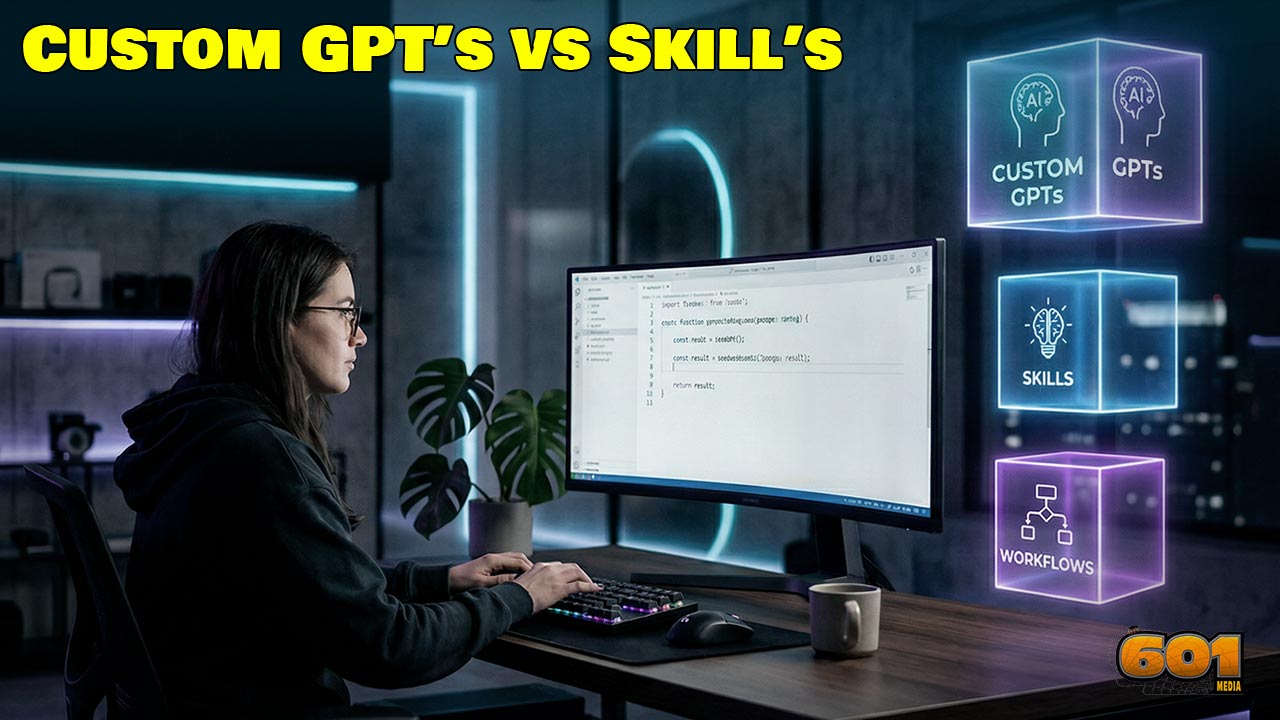
Custom GPT’s vs Skill’s: What Actually Matters When You’re Building AI Workflows in 2026
In 2026, “AI customization” is no longer a novelty feature—it’s the operating system for modern work. Two ideas dominate the conversation: OpenAI’s Custom GPTs (tailored versions of ChatGPT) and Claude Code Skill’s (reusable capability modules built from a SKILL.md file). They sound similar, but they solve different problems. If you’re leading innovation, shipping software, or designing AI-enabled operations, the real question isn’t “Which is better?” It’s “Which tool architecture matches the way we need to scale, govern, and reuse AI work?”
Table of Contents
- Definitions: What Custom GPT’s and Skill’s Really Are
- The Core Differences That Matter in Practice
- Custom GPT’s vs Skill’s: Pros and Cons Table
- Best-Fit Use Cases: When to Choose Which
- Governance, Risk, and Operational Control
- Innovation and Technology Management Lens
- Implementation Playbook for 2026 Teams
- Top 5 Frequently Asked Questions
- Final Thoughts
- Resources
Definitions: What Custom GPT’s and Skill’s Really Are
Custom GPT’s are tailored versions of ChatGPT you can configure for a specific purpose by combining instructions, optional knowledge, and available capabilities. In plain terms: a Custom GPT is a “packaged chat experience” that aims to behave consistently for a defined audience and job. It’s often used as a repeatable assistant for tasks like drafting, customer support triage, onboarding, or internal Q&A—where the interface is conversational and the value comes from packaging a role.
Skill’s in Claude Code are a different unit of value. A Claude Code skill is a reusable module that extends what Claude can do inside the Claude Code environment. The core mechanism is simple: you create a SKILL.md file containing structured instructions, and Claude can use the skill when relevant—or you can call it directly with a slash command. In plain terms: a skill is closer to a repeatable “capability primitive” than a standalone assistant persona.
This difference sounds subtle until you feel it in daily work.
Custom GPT’s tend to be product-like: a front door for users.
Skill’s tend to be system-like: a building block inside workflows.
If you manage innovation and technology adoption, this distinction maps to two classic patterns:
- Productization: packaging a consistent user-facing experience (Custom GPT’s).
- Capability engineering: building reusable, composable operational modules (Skill’s).
Both can be strategically important. But they push teams toward different operating models: one optimizes for distribution and user experience, the other optimizes for repeatability and internal leverage.
The Core Differences That Matter in Practice
To make the comparison concrete, evaluate Custom GPT’s and Skill’s across six practical dimensions that determine whether an AI initiative scales or stalls.
1) Unit of reuse: “assistant” vs “capability”
Custom GPT’s reuse a configured assistant. The reusable asset is the assistant’s behavior: tone, scope, guardrails, and knowledge context.
Skill’s reuse a defined capability. The reusable asset is the task logic: steps, constraints, triggers, and outputs.
If your organization keeps repeating the same task (for example, “convert raw notes into a structured engineering ticket”), skills often feel more natural. If your organization needs a stable role interface (“helpdesk assistant”), Custom GPT’s fit.
2) How teams adopt it: end-users vs builders
Custom GPT’s are typically adopted by end-users who want immediate value with minimal setup. Their success is often driven by usability, discoverability, and trust.
Skill’s are typically adopted by builders (developers, automation engineers, technical operators) who want reliable execution inside a workflow. Their success is driven by clarity, testability, and composability.
This matters in 2026 because “AI adoption” is no longer one audience. It’s at least two:
- Business users who want outcomes now.
- Technical teams who need repeatability, governance, and predictable behavior.
3) Control surface: prompt packaging vs workflow packaging
Custom GPT’s package instruction sets and (optionally) knowledge to influence how a conversation behaves.
Skill’s package procedure: a repeatable method that can be invoked like a tool.
When operational teams complain that “AI is inconsistent,” they’re usually pointing at missing procedure. That’s where skills shine: you don’t just ask for an outcome; you define the steps.
4) Maintainability: versioning the experience vs versioning the procedure
Custom GPT’s maintenance often looks like “tune instructions” and “update reference knowledge.”
Skill’s maintenance often looks like “revise the workflow contract”: inputs, outputs, failure modes, edge cases, and quality gates.
From a technology management perspective, procedures are easier to quality-control than vibes. If you need stable output formats, compliance constraints, or production-like behavior, skills typically provide a cleaner artifact to maintain.
5) Scale mechanism: distribution vs compounding
Custom GPT’s scale when more users adopt the same assistant. The growth lever is distribution.
Skill’s scale when more workflows reuse the same capability. The growth lever is compounding reuse.
In innovation strategy terms:
- Distribution scale is about reach.
- Compounding scale is about leverage.
Both are powerful. But they compound differently. A skill reused across ten workflows can create system-level productivity gains even if only a few people know it exists. A Custom GPT can create high value if it becomes the default front door for an entire function.
6) Measurement: satisfaction metrics vs throughput metrics
Custom GPT success is often measured with user satisfaction, resolution rate, and adoption.
Skill success is often measured with cycle time reduction, error rate reduction, and throughput.
If you can’t measure the value, you can’t defend the program in budget season. Skills often map more cleanly to operational metrics because they are closer to process automation.
Custom GPT’s vs Skill’s: Pros and Cons Table
| Approach | Pros | Cons | Best For |
|---|---|---|---|
| Custom GPT’s |
|
|
|
| Skill’s (Claude Code) |
|
|
|
Best-Fit Use Cases: When to Choose Which
The fastest way to choose is to look at the “shape” of the work.
Choose Custom GPT’s when the work is role-shaped.
Role-shaped work has fuzzy edges. The user wants a helpful assistant that can flex with context:
- “Help me write a project brief with the right tone for leadership.”
- “Answer questions from our internal policy docs.”
- “Coach me through a difficult stakeholder email.”
- “Act like a product strategist and challenge my assumptions.”
These are inherently conversational tasks. The “best” answer depends on context, audience, and intent. Custom GPT’s thrive here because they can maintain a consistent persona and policy frame.
Choose Skill’s when the work is procedure-shaped.
Procedure-shaped work has repeatable steps and a definition of done:
- “Convert bug reports into standardized Jira tickets with required fields.”
- “Run a code review checklist and output findings in a fixed template.”
- “Generate a changelog from commits using our release conventions.”
- “Refactor this module and ensure tests pass with our constraints.”
Here, the value is consistency. Skill’s are built to capture and rerun procedure.
In 2026, many organizations need both. But the sequencing matters. A common failure pattern is launching a “universal AI assistant” before building the underlying capability modules. The assistant becomes a bottleneck because it can’t execute reliably.
A stronger pattern is:
- Build a small library of high-impact skill modules for repeatable tasks.
- Wrap those capabilities with a user-friendly assistant interface for broader adoption.
In innovation terms, you build the capability layer first, then you productize it.
Governance, Risk, and Operational Control
As soon as AI touches customer interactions, regulated workflows, or production code, governance stops being theoretical.
The key governance question is: Can we control how the system behaves under stress?
Custom GPT’s governance typically focuses on:
- Scope control: what topics it should and shouldn’t handle
- Policy alignment: what it must refuse, how it handles sensitive content
- Knowledge boundaries: what reference material it can use
Skill’s governance typically focuses on:
- Process compliance: required steps that must happen every time
- Output contracts: exact formats that downstream systems depend on
- Quality gates: validations, checklists, and failure behaviors
This is why skill-like artifacts often show up first in high-stakes environments. When your downstream system expects a specific schema, “mostly right” is still broken. Teams need enforceable contracts.
From a technology management lens, Skill’s behave like operational assets:
- They can be versioned.
- They can be reviewed like code.
- They can be shared across teams.
- They can encode best practices.
Custom GPT’s behave more like products:
- They can be adopted widely.
- They can be branded for a function.
- They can deliver value quickly to non-technical users.
If you need to reduce operational risk, consider using skills as “approved procedures,” and treat any Custom GPT interface as a thin interaction layer that routes work into those procedures.
Innovation and Technology Management Lens
In innovation portfolios, most AI initiatives fail for one of three reasons:
- They don’t compound: each use is a one-off prompt that never becomes reusable capability.
- They don’t operationalize: they remain a pilot because teams can’t trust outputs at scale.
- They don’t govern: risk teams block deployment because controls are unclear.
“Skill’s” directly address the compounding and operationalization problems because they turn know-how into a reusable artifact.
There is also a talent implication. The Future of Jobs research emphasizes reskilling and the rising importance of skills as a workforce strategy, driven by structural change and technology adoption. The managerial takeaway is straightforward: organizations must treat capability development as a first-class strategy, not a side project.
In 2026, the most durable advantage often comes from building a “capability factory”:
- Capture repeatable workflows as skill modules.
- Test them against real scenarios.
- Version them as processes change.
- Distribute them across teams through simple interfaces.
Custom GPT’s can accelerate adoption and reduce friction, but Skill’s are what make the adoption sustainable.
A practical way to describe the relationship:
- Custom GPT’s improve accessibility.
- Skill’s improve reliability.
If you manage innovation, you care about both:
- Accessibility drives uptake.
- Reliability drives scale.
Implementation Playbook for 2026 Teams
If your goal is to build AI capability as an organizational asset—not a collection of clever prompts—use this playbook.
Step 1: Identify “high-frequency, high-friction” workflows
Look for tasks that happen weekly (or daily) and create drag:
- Ticket creation and triage
- Code review summaries
- Release note drafting
- Incident postmortem structure
- Data pull + analysis + executive summary
High-frequency means reuse will compound. High-friction means people will actually adopt the improvement.
Step 2: Decide whether each workflow is role-shaped or procedure-shaped
If success depends on tone, nuance, and stakeholder context, lean Custom GPT.
If success depends on steps, templates, or strict fields, lean Skill.
Step 3: For procedure-shaped work, define an output contract
Be explicit:
- What inputs are required?
- What format must outputs follow?
- What constraints must be respected?
- What counts as failure, and what should happen then?
This contract becomes the backbone of your skill.
Step 4: Treat skills like code
Even if the artifact is markdown, manage it with code discipline:
- Peer review
- Versioning conventions
- Change logs
- Test cases (golden examples)
Step 5: Productize access with a friendly interface
Once you have stable skill modules, you can expose them through:
- A Custom GPT that routes user requests into approved skill workflows
- Internal documentation with “how to invoke” patterns
- Templates, slash commands, or buttons in your toolchain
This is how you get both reliability and reach.
Step 6: Measure outcomes with operational metrics
Pick metrics tied to the workflow:
- Cycle time reduction (hours saved per week)
- Error rate reduction (fewer rework loops)
- Throughput increases (more tickets, faster releases)
- Quality improvements (review findings, test coverage, incident frequency)
The real goal is not “using AI.” The goal is building a system where improvements compound.
Top 5 Frequently Asked Questions
Final Thoughts
The most important takeaway is this: Custom GPT’s and Skill’s are not competing features; they are different layers of the AI operating model.
Custom GPT’s are best understood as a distribution and usability layer. They help people get value quickly through a role-like assistant experience. They can dramatically reduce friction for non-technical teams and turn AI into something usable day-to-day.
Skill’s are best understood as a capability and reliability layer. They turn repeated work into reusable procedure. They are how organizations capture best practices, reduce variance, and build an internal library of automation assets that compound.
In 2026, the teams that win won’t be the ones with the cleverest prompts. They’ll be the ones that build reusable capability, wrap it in adoptable interfaces, and govern it with engineering discipline. Use Custom GPT’s to accelerate adoption. Use Skill’s to make performance predictable. Combine them to turn AI from a tool into an engine.


Leave A Comment