



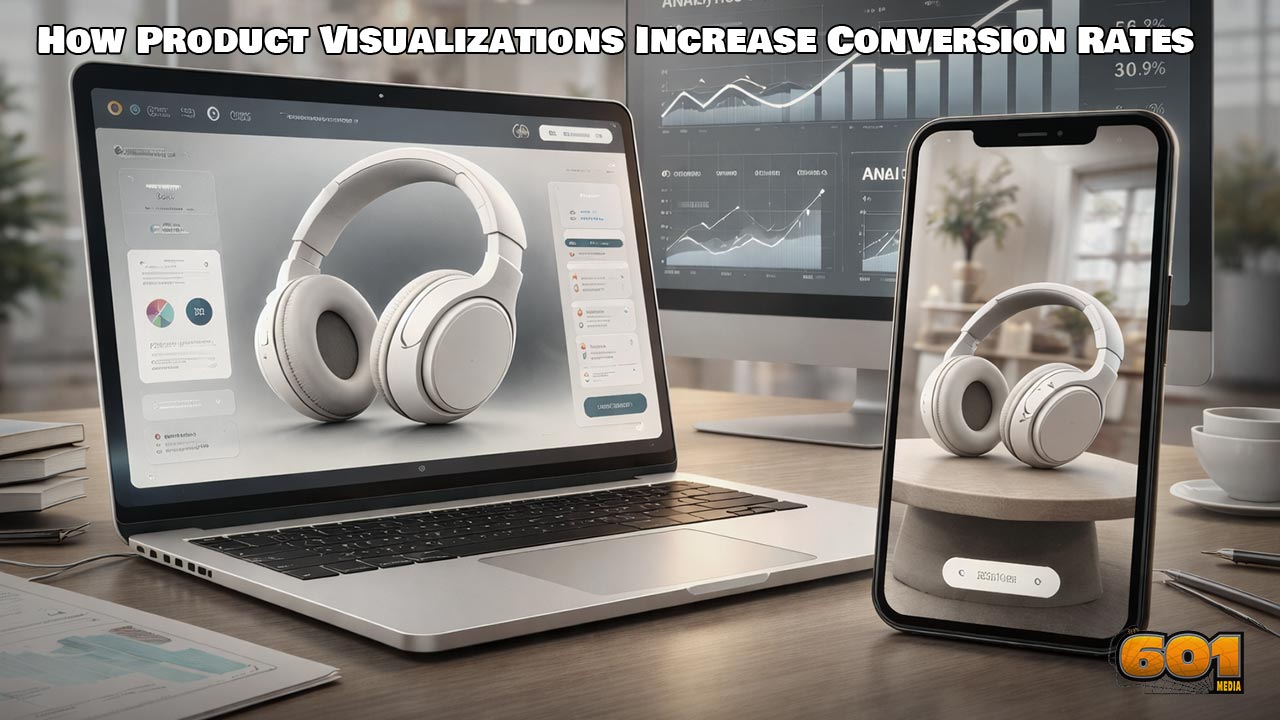
How Product Visualizations Increase Conversion Rates
Product visualization has become one of the most powerful tools in modern digital commerce. As consumers increasingly expect immersive, information-rich online experiences, static product photos are no longer sufficient. Interactive product visualization technologies—such as 3D rendering, augmented reality (AR), virtual product configurators, and dynamic previews—help customers better understand what they are buying before making a purchase decision. Today we’re going to explore how product visualizations influence consumer psychology, reduce uncertainty, and dramatically improve conversion rates. Drawing from research in digital commerce, behavioral science, and innovation management, it explains why visual interaction drives sales and how businesses can implement visualization strategies to gain a competitive advantage.
Table of Contents
- What Is Product Visualization?
- Why Visualization Matters in Digital Commerce
- The Psychology Behind Visual Shopping
- Types of Product Visualization Technologies
- How Visualization Improves Conversion Rates
- Data and Statistics Supporting Visualization
- Implementation Strategies for Businesses
- The Future of Product Visualization
- Top 5 Frequently Asked Questions
- Final Thoughts
- Resources
What Is Product Visualization?
Product visualization refers to digital techniques used to display products in realistic, interactive, or immersive ways that go beyond traditional photography. Instead of static images, product visualization allows users to explore, rotate, customize, or even place products in real-world environments using digital interfaces. These technologies rely on 3D modeling, real-time rendering engines, and interactive user interfaces to simulate the appearance and functionality of products before customers purchase them.
Modern visualization solutions can include:
- Interactive 3D models
- Augmented reality product placement
- Virtual product configurators
- Real-time color and material customization
- 360-degree product exploration
From an innovation and technology management perspective, product visualization represents the convergence of computer graphics, digital commerce platforms, and behavioral analytics. Businesses adopting these tools are essentially redesigning the digital buying experience to replicate—and often exceed—the clarity of in-store product inspection.
Why Visualization Matters in Digital Commerce
Online shopping introduces a fundamental challenge: customers cannot physically interact with products. This limitation creates uncertainty, which directly affects purchasing decisions. In traditional retail environments, consumers rely on tactile feedback, spatial understanding, and visual inspection before buying. Online platforms must recreate these signals digitally. Product visualization bridges this gap. By allowing customers to examine a product from multiple perspectives, zoom into details, and visualize real-world use, visualization technology reduces perceived purchase risk. Research in e-commerce usability consistently shows that product presentation quality is one of the strongest predictors of online conversion rates. For example, studies from Baymard Institute indicate that nearly 56% of online shoppers consider product images the most important factor when deciding to buy. When those images evolve into interactive visualizations, the impact becomes even stronger. Visualization transforms passive browsing into active exploration, which increases engagement, confidence, and ultimately purchase likelihood.
The Psychology Behind Visual Shopping
Human decision-making is heavily influenced by visual cognition. Neuroscience research suggests that the human brain processes visual information approximately 60,000 times faster than text. This cognitive bias toward visual stimuli explains why immersive product presentation strongly influences buying behavior.
Several psychological mechanisms drive this effect.
Mental simulation
When customers interact with product visualizations, they mentally simulate ownership and usage. This phenomenon, known as “mental imagery,” increases emotional attachment to the product.
Perceived ownership
Research in consumer psychology shows that when users configure or manipulate a product digitally, they begin to feel a sense of psychological ownership. This dramatically increases purchase intention.
Reduced uncertainty
The biggest barrier in online shopping is uncertainty about product quality, size, fit, or appearance. Visualization reduces this ambiguity by providing more realistic product information.
Trust and credibility
Highly detailed visualizations signal professionalism and technological sophistication. Consumers interpret this as a marker of brand reliability.
Together, these factors create a powerful influence on purchase decisions.
Types of Product Visualization Technologies
Product visualization can take many forms depending on the complexity of the product and the digital capabilities of the business.
3D Product Visualization
3D visualization allows users to rotate and inspect products from any angle. Unlike traditional images, 3D models provide spatial understanding and depth perception. Customers can zoom into textures, materials, and components, gaining a clearer understanding of the product.
Industries where 3D visualization is especially impactful include:
- furniture and home décor
- consumer electronics
- automotive retail
- fashion accessories
Many major brands now use WebGL-based rendering engines that load 3D models directly within browsers without requiring additional software.
Augmented Reality Product Experiences
Augmented reality enables customers to visualize products in their real-world environment using smartphones or tablets.
For example:
- A shopper can place a virtual sofa in their living room
- A customer can preview a pair of glasses on their face
- A buyer can test furniture layout in their home
AR experiences significantly increase purchase confidence because they simulate actual product usage.
Retailers implementing AR frequently report reductions in product returns because customers better understand the product before purchasing.
Interactive Product Configurators
Product configurators allow customers to customize products in real time.
Common configuration options include:
- color selection
- material changes
- component upgrades
- feature modifications
Luxury automotive companies pioneered this approach, allowing buyers to configure vehicles online. Today, configurators are widely used in furniture, fashion, electronics, and industrial equipment markets.
Configurators also increase average order value because customers are more likely to explore premium upgrades when they can visually preview them.
360-Degree Product Views
360-degree product photography is one of the simplest forms of product visualization. Users can rotate the product to examine every side, similar to holding the product in their hands. Although less immersive than full 3D models, 360-degree views still provide substantial improvements over static imagery. For many businesses, this represents a cost-effective entry point into visualization technology.
How Visualization Improves Conversion Rates
Conversion rate refers to the percentage of website visitors who complete a desired action, typically making a purchase.
Product visualization improves this metric through several mechanisms.
Increased product understanding
When customers clearly understand a product’s features, dimensions, and appearance, they feel more confident completing a purchase.
Higher engagement
Interactive experiences increase time spent on product pages. Higher engagement correlates with stronger purchase intent.
Reduced product returns
Customers who fully understand what they are buying are less likely to return products. This reduces operational costs and increases customer satisfaction.
Improved differentiation
In competitive markets where products are similar, superior visualization can become a decisive advantage.
In other words, visualization acts as both a marketing tool and a decision-support system for customers.
Data and Statistics Supporting Visualization
Several industry studies demonstrate the measurable impact of product visualization on conversion rates. Shopify reports that products featuring 3D content show conversion rate increases of up to 94 percent compared with traditional images. Research from Deloitte suggests that immersive product experiences significantly increase customer engagement and brand perception. AR implementations in retail environments have shown conversion increases ranging from 40 percent to 90 percent depending on product category. Furniture retailer Wayfair reported that customers who interacted with AR visualization were significantly more likely to complete purchases. These findings indicate that visualization technologies are not merely aesthetic improvements, they directly influence business performance.
Implementation Strategies for Businesses
Adopting product visualization requires strategic planning and technological investment.
Several key factors determine successful implementation.
Technology infrastructure
Businesses must ensure their e-commerce platform supports interactive rendering technologies such as WebGL or AR frameworks.
Content creation
High-quality 3D models are essential. Poorly rendered visuals can damage brand credibility.
User experience design
Visualization tools should enhance the shopping journey rather than complicate it. Simple, intuitive interfaces are critical.
Performance optimization
Large 3D files can slow website performance. Efficient rendering and compression techniques are necessary.
Analytics integration
Tracking how users interact with visualization features helps companies refine their strategy and measure ROI.
From an innovation management perspective, visualization technologies should be treated as strategic assets rather than isolated features.
The Future of Product Visualization
Product visualization is evolving rapidly as digital technologies advance. Several emerging trends are shaping the future of this field.
Artificial intelligence generated models
AI systems can automatically generate realistic product renderings, dramatically reducing production costs.
Real-time physics simulation
Future visualizations will simulate real-world behavior such as fabric movement, lighting changes, and mechanical interactions.
Virtual shopping environments
Immersive digital stores may allow customers to browse products in fully simulated environments using VR or mixed reality devices.
Personalized visualization
Machine learning algorithms may generate customized product presentations tailored to individual customer preferences.
As these technologies mature, the line between physical and digital shopping experiences will continue to blur.
Top 5 Frequently Asked Questions
Final Thoughts
Product visualization represents a fundamental shift in how digital commerce communicates value to customers. In traditional retail environments, buyers rely on physical interaction to evaluate products. Online commerce must replicate this experience digitally, and visualization technologies provide the most effective solution. Interactive 3D models, augmented reality previews, and customizable product configurators transform passive product browsing into immersive exploration. This interaction builds confidence, reduces uncertainty, and fosters emotional connection with the product. From a technology management perspective, product visualization should be viewed as a strategic innovation rather than a cosmetic enhancement. Businesses that invest in immersive product presentation gain measurable advantages in engagement, conversion rates, and customer satisfaction. As e-commerce competition intensifies and consumer expectations evolve, the companies that succeed will be those that make digital shopping experiences feel as tangible, informative, and engaging as physical retail.
Resources
- Baymard Institute – Product Page UX Research
- Shopify Commerce Report – 3D and AR Conversion Data
- Deloitte Digital Commerce Insights
- Harvard Business Review – Consumer Decision Making Research
- MIT Sloan Management Review – Technology Innovation in Retail


Leave A Comment