



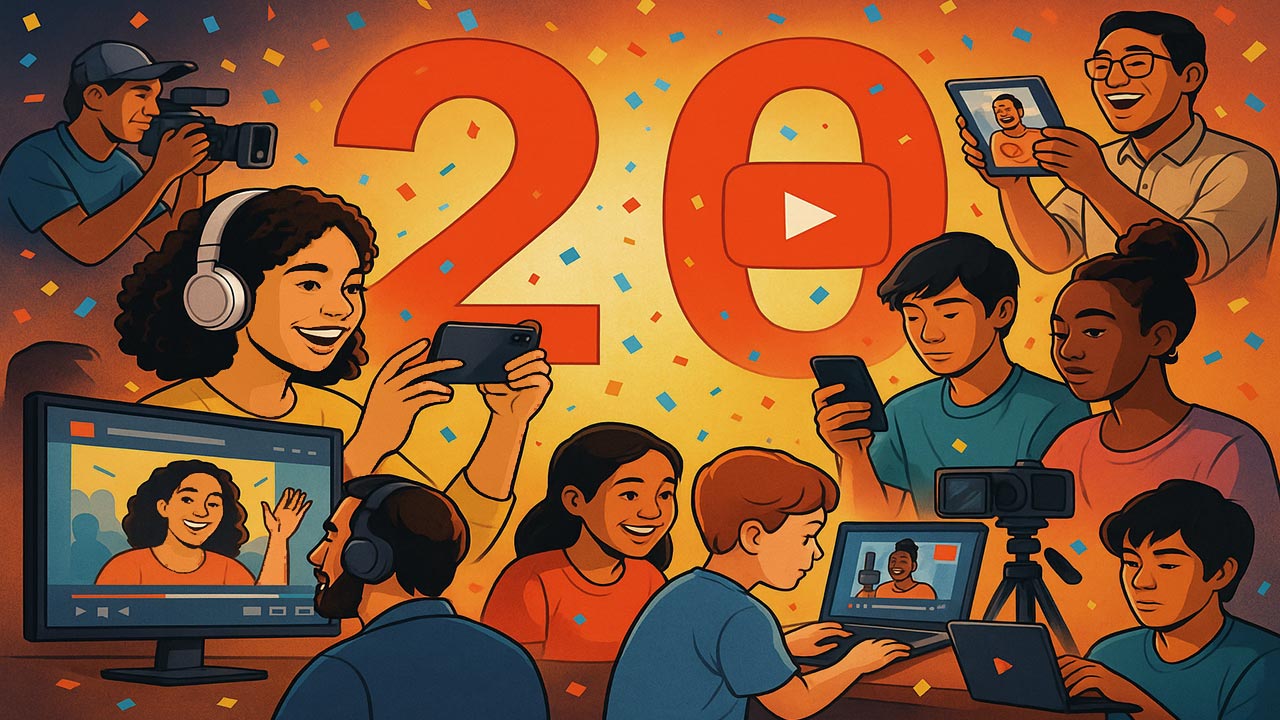
How YouTube Became the World’s TV — 20 Years, 20 Billion Videos, 1 Culture Revolution
YouTube’s 20th Anniversary Culture & Trends Report paints a data-rich picture of how a simple video site turned into a borderless entertainment infrastructure. In two decades, the platform has enabled a global creator class, paid out tens of billions to them, and redefined what “mainstream” even means. This article unpacks the report’s key findings, adds context from 2025 trends, and explains what it all means for innovators, marketers, and media leaders.
Table of Contents
- From Garage Startup to Global Infrastructure: 20 Years of Evolution
- The Economics of the Creator Class: From Hobby to Industry
- How New Formats Emerged: Let’s Plays, ASMR, GRWM and More
- A New Global Mainstream: Borderless Culture by Design
- Scale, Usage and Discovery: How People Actually Use YouTube Today
- What 2025 Looked Like on YouTube: Topics, Creators, Music and Podcasts
- Innovation & Strategy Lessons for Media and Brands
- Top 5 Frequently Asked Questions
- Final Thoughts: Why the 20th Anniversary Report Matters
- Resources
From Garage Startup to Global Infrastructure: 20 Years of Evolution
The 20th Anniversary Culture & Trends Report opens with a simple premise: in 2005 YouTube didn’t invent online video, but it did invent a radically different way for it to work.
In its early years the site looked like a chaotic collection of uploads: pets, pranks, vlogs, and grainy clips. But quietly, structural shifts were underway. By 2007, YouTube launched the Partner Program, giving creators a direct path to advertising revenue. From 2021 to 2023 alone, that program paid out more than $70 billion to creators, artists and media companies — a scale of investment that rivals major entertainment conglomerates.
The report emphasizes that this wasn’t just a UI change or a new feature. It reframed the platform from “place to post videos” to “place where everyday people can build a media business.” That framing created feedback loops:
Creators saw that consistent uploading and audience-building could turn into income.
Fans realized their views, comments and shares had real financial impact.
Advertisers recognized YouTube as a place where they could reach highly engaged, self-sorting communities.
Over time, YouTube evolved from a website into an ecosystem: tools (Studio, analytics, monetization), infrastructure (global delivery, recommendation systems), and adjacent products (YouTube Music, YouTube TV, YouTube Podcasts, Shorts) layered on top of the core video backbone.
Today, according to the report, YouTube draws billions of monthly viewers who collectively watch over a billion hours of video per day, across more than 100 countries and 80 languages. In innovation terms, YouTube has become a critical “cultural utility” — as foundational to attention and discovery as broadcast networks once were.
The Economics of the Creator Class: From Hobby to Industry
The 20th Anniversary report reads like a case study in how a platform can manufacture a new labor market. Two numbers stand out:
The Partner Program launch in 2007.
Over $70B paid to creators between 2021–2023 alone.
This is not a side hustle economy; it’s an industrial-scale value chain.
At the input stage, creators supply content, personality and community leadership. At the output stage, advertisers gain targeted reach, rights-holders gain new distribution, and viewers gain endless choice. YouTube sits in the middle as orchestrator, allocating visibility (via recommendations) and revenue (via ads, memberships, and other tools).
From an innovation and technology management perspective, three levers are critical:
Incentive design
YouTube made attention convertible into income. The clearer the path from view to payout, the more rational it became for individuals to invest serious time, tools and skills into their channels.
Ecosystem enablement
Over time, a surrounding economy of editors, thumbnail designers, analytics tools, talent managers, merch partners and multi-channel networks emerged. The platform didn’t need to build all of this itself; it needed to maintain open APIs, predictable rules and discoverability.
Risk distribution
Traditional media invests heavily in a small slate of bets. YouTube in contrast spreads risk across millions of uploads. Niche videos that never reach 100K views still contribute meaningfully to total watch time — a pattern the report explicitly calls out with its “videos with niche audiences continue to drive viewership” insight.
By solving for creator viability at scale, YouTube effectively turned “creator” from a fringe aspiration into a credible, global career path.
How New Formats Emerged: Let’s Plays, ASMR, GRWM and More
One of the most valuable sections of the 20th Anniversary report walks through how iconic YouTube-native formats emerged not from top-down editorial planning, but from creator–viewer co-creation.
The pattern repeats across multiple genres:
Let’s Play — turning gameplay into performance
“Let’s Play” videos turned gaming from a private hobby into a spectator sport. Beginning around 2008, creators like Slowbeef recorded their gameplay along with live commentary. The report’s data shows a steady rise in uploads and views for videos with “Let’s Play” in the title from 2007–2024 and notes that roughly 60% of YouTube’s 1,000 most-subscribed channels have uploaded at least one gaming-related video.
ASMR — when the audience invents the genre
ASMR (autonomous sensory meridian response) did not arrive as a polished category. Viewers first noticed that certain videos gave them “tingles” and shared them; creators then started designing content to intentionally trigger that sensation. Over time, the community iterated on microphones, soundscapes, and visual triggers, turning ASMR into an established format with global reach.
“Get Ready With Me” (GRWM) — storytelling as beauty infrastructure
GRWM videos combine everyday routines with narrative: creators do their makeup or skincare while telling stories about relationships, mental health, or daily life. What sounds niche on paper became an enduring global format because it matched two things viewers consistently value: intimacy and authenticity.
For innovation leaders, the lesson is straightforward: YouTube’s breakthrough formats didn’t begin as strategic bets. They were emergent behaviors the platform learned to see, support and scale using:
Data (detecting growth in search and watch time)
Product tweaks (playlists, recommendations, Shorts, monetization)
Cultural amplification (highlighting formats in trend reports and events)
Rather than dictating what “content” should be, YouTube built an adaptive system where the most resonant behaviors got oxygen.
A New Global Mainstream: Borderless Culture by Design
Historically, global hits required heavy backing from labels, studios or broadcasters. The report argues that YouTube fundamentally rewired that logic.
One striking statistic: in 2025, over 85% of views for the ten most-watched K-pop artists came from outside South Korea. K-pop’s rise — from “Gangnam Style” holding the most-viewed video title for five years to newer acts dominating charts — would have been slower and narrower without borderless distribution.
The report also highlights:
Mukbang’s expansion from a Korean subculture to a global food-entertainment format, with view growth far beyond its region of origin.
Anime music’s surge: eight anime songs charting on YouTube’s global rankings, with six reaching the top 40 and two hitting #1.
Regional artists achieving global lift, like Mexican artist Peso Pluma becoming the most-viewed artist in the U.S. on YouTube in 2023.
These examples show how YouTube’s recommendation and search systems act as a kind of “cultural routing layer.” Once a creator or scene finds product–market fit in one country, the algorithms can surface it across borders where similar audience interests exist.
For policymakers, brands and rights-holders, the implication is that “local vs global” is no longer a clean distinction. Local scenes can become global franchises when communities, not corporate release schedules, drive distribution.
Scale, Usage and Discovery: How People Actually Use YouTube Today
The 20th Anniversary report and companion blog post both stress the same headline: YouTube has “billions of monthly viewers” who watch over a billion hours every day.
Three structural shifts stand out in the data:
YouTube is leading streaming watch time
Since February 2023, YouTube has led in streaming watch time every single month, according to Nielsen’s U.S. Total TV & Streaming Report. That means that among the universe of streaming options — subscription video services, FAST channels, live platforms — YouTube captures the largest chunk of aggregated viewing minutes.
TV screens are now a primary device
The report notes significant growth in viewing on connected TVs. YouTube is no longer confined to laptops and phones; it’s occupying the literal “living room screen” once dominated by broadcast and cable.
The “barbell” of attention: very short and very long
One of the report’s most intriguing charts shows that “the videos we watch are getting shorter and longer.” Short-form content (like Shorts) satisfies quick, habitual engagement, while long-form and podcast-style videos absorb deep focus. For platform managers, this means the product must simultaneously support swipeable, lightweight interactions and extended, lean-back sessions.
Another important insight: videos with niche audiences — content that never crosses 100K views — still account for a substantial share of total watch time. YouTube isn’t just about blockbusters; it’s about infinite mid-tail and long-tail content serving specific interests, languages and subcultures.
What 2025 Looked Like on YouTube: Topics, Creators, Music and Podcasts
The 20th Anniversary year isn’t only about a 20-year lookback. The 2025 end-of-year trends report shows how creators and fans used YouTube in the anniversary year itself.
Trending topics
The U.S. Trending Topics list for 2025 reflects how fan communities expand existing IP into “digital franchises”:
Fan-driven interpretations of Squid Game that reframed the show through challenges, skits and analysis videos.
User-generated Roblox games like Grow a Garden and Steal a Brainrot, showing how creator-built game experiences and video culture reinforce each other.
The KPop Demon Hunters universe, where fans treated the fictional girl group HUNTR/X as if it were a real K-pop act, fueling fancams, lore videos and edits.
Top creators
In the U.S., MrBeast held the #1 creator spot for the sixth consecutive year, underscoring the durability of large-scale, philanthropy-meets-spectacle content. He was joined by creators like IShowSpeed, whose 24/7 IRL streams pushed the limits of live formats, and CoryxKenshin, who converted fandom into hundreds of thousands of copies sold of his self-published manga.
Across the broader 2025 lists, creators specialized in gaming, commentary, law explainers, family content and outdoor survival also surged — further evidence that “creator” is not a single job type but an umbrella for many content-business models.
Music and Shorts
On the music side, the ROSÉ and Bruno Mars track “APT.” became the fastest K-pop music video to reach one billion views, finally dethroning “Gangnam Style” as the speed benchmark. Bruno Mars and Lady Gaga’s “Die With A Smile” topped several lists, while multiple songs associated with the KPop Demon Hunters cast — such as “Golden,” “Soda Pop,” “Your Idol” and “How It’s Done” — showed how fictional or hybrid IP can generate real-world chart impact.
Shorts, meanwhile, kept resurfacing older catalog songs like “Pretty Little Baby” and “Rock That Body,” proving that short-form remix culture can generate new life (and revenue) for back catalog content.
Podcasts and long-form talk
2025 also confirmed YouTube’s role as a podcast destination. Shows like The Joe Rogan Experience, KILL TONY, Good Mythical Morning, Rotten Mango and The Diary Of A CEO ranked among the top podcasts in the U.S. on YouTube, blending dedicated podcast-first productions with video-forward talk shows.
The through-line: the same platform now houses micro-entertainment (Shorts), cinematic events (MrBeast-scale projects), narrative fandoms (KPop Demon Hunters, Roblox universes) and multi-hour talk shows — all driven by independent creators and their teams.
Innovation & Strategy Lessons for Media and Brands
For executives building products, media companies, or marketing strategies, the 20th Anniversary report is less a nostalgia piece and more an operating manual. Several lessons stand out.
Design for co-creation, not broadcast
The report repeatedly emphasizes the “cultural symbiosis” between creators and viewers: audiences comment, remix, and feed back ideas; creators iterate formats, adjust cadence, and build lore based on that input. In practice, this means successful content feels like an ongoing conversation, not a one-way transmission.
Treat niche as a strategic asset
Because niche videos collectively drive significant watch time, YouTube’s success is tightly coupled to its ability to support micro-communities at scale. For brands, the parallel is clear: investing only in mass-reach content leaves attention on the table. Micro-vertical series, language-specific channels, and community collaborations can outperform generic campaigns when measured on depth of engagement.
Leverage the “barbell” of formats
The “shorter and longer” dynamic suggests that a resilient content strategy will often mix:
Instant, low-friction clips that travel via Shorts, recommendations and social embeds.
Deep-dive formats — essays, investigations, live events, multi-part series — that build authority and watch-time.
Organizations that optimize for only one end of the spectrum risk missing half the opportunity.
Build for global from day one
The K-pop, anime, mukbang and Latin music examples show that global upside is no longer an afterthought — it is baked into how YouTube routes attention. Creators and companies that design with multilingual captions, regionally aware references and collabs across markets put themselves in position to ride those cross-border currents.
Understand YouTube as infrastructure
Perhaps the biggest mindset shift: stop thinking of YouTube as “another channel” in a media mix. With leading streaming watch time since 2023 and a growing role on TV screens, YouTube increasingly functions as an operating system for modern video culture. Strategy built on that assumption looks very different from a strategy built on the idea that YouTube is just a marketing placement.
Top 5 Frequently Asked Questions
Final Thoughts: Why the 20th Anniversary Report Matters
The 20th Anniversary Culture & Trends Report is not just a birthday card for a famous website. It is a snapshot of how entertainment now works — and a forecast of where it is heading.
In 20 years, YouTube:
Enabled a creator class that can earn a living without traditional gatekeepers.
Turned experimental formats like Let’s Plays, ASMR and GRWM into global genres.
Shifted pop culture from national silos to a fluid, borderless “global mainstream.”
Became the leading streaming destination by watch time, including on the living-room TV.
Proved that niche content and mega-hits can coexist inside the same discovery system.
For innovators and technology leaders, the key takeaway is structural: when you combine creator-friendly incentives, massive distribution, data-driven recommendations and active fan participation, you don’t just change what people watch — you change who gets to make culture in the first place.
As YouTube enters its third decade, the report suggests that the platform’s future will be jointly authored by creators and viewers. Product teams will ship new tools; algorithms will keep optimizing; but the real innovation will continue to emerge from countless experiments in front of webcams, game consoles, cameras and microphones around the world.
If you want to understand the future of entertainment, the 20th Anniversary report makes a strong case that you should watch not just the biggest shows, but the evolving relationship between creators, their communities and the technologies that connect them.
Resources
- YouTube Culture & Trends Team, “Culture & Trends Report: 20th Anniversary – An Entertainment Revolution 20 Years in the Making” (PDF).
- YouTube Official Blog, “An entertainment revolution 20 years in the making – YouTube 20th Anniversary Culture & Trends Report.”
- YouTube / Google Blog, “The year on YouTube: The topics, creators, music, and podcasts that defined 2025.”
- Google Blog, “YouTube’s 2025 trends and your Recap.”
- Press coverage of YouTube’s 20th anniversary year and Recap feature.
- Reddit discussion summarizing key datapoints from the 20th Anniversary report (watch-time leadership, niche viewership, format shifts).


Leave A Comment