



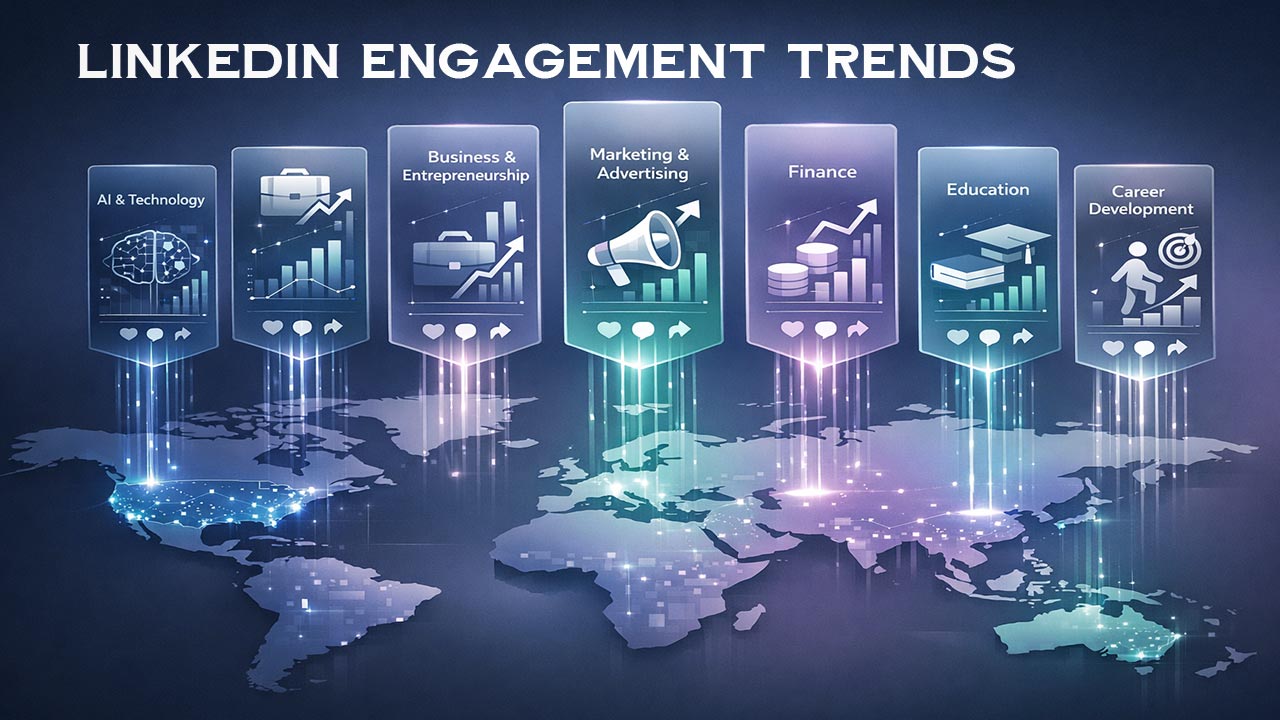
LinkedIn Engagement Trends: Top Categories in Key Countries (2025)
Overview: LinkedIn’s global user base exceeds 1.2 billion members (with ~310 million monthly actives). Engagement on the platform is driven by professional content that resonates with its predominantly young, career-focused audience – about half of users globally are ages 25–34 (and in the U.S. ~40% are Millennials and 31% Gen Z). There is also a strong presence of decision-makers (over 180 million senior-level members) across major industries (especially professional services, tech, manufacturing, finance, and healthcare). Below we identify the top 10 countries by LinkedIn user base and, for each, outline the top 10 content categories driving engagement – including optimal posting times, hot topics, and audience demographics for both individual profiles and company pages. General trends show that mid-week work hours yield the highest engagement across regions, and that content offering professional insight or career value (e.g. leadership tips, industry trends, job advice) performs best. Moreover, LinkedIn’s feed favors posts from individuals (over 60% of feed content) far more than organic company page posts (~2% of feed), so personal profiles often see higher organic reach. Still, the following categories apply to both individual and company content, reflecting what topics garner the most attention in each country’s LinkedIn community.
Top 10 Countries by LinkedIn Members (Jan 2025)
(Based on LinkedIn’s advertising reach data )
| Country | Members (millions) |
|---|---|
| United States | 250 |
| India | 150 |
| Brazil | 81 |
| China | 57 |
| United Kingdom | 45 |
| France | 34 |
| Indonesia | 33 |
| Canada | 27 |
| Mexico | 26 |
| Italy | 23 |
Posting Time (General): Across these markets, Tuesday, Wednesday, and Thursday are the best days to post, with activity peaking in mid-morning through early afternoon (roughly 10:00–14:00 local time). Professionals often check LinkedIn during work breaks and around lunch. Posting during these “golden hours” mid-week maximizes visibility, whereas engagement dips on Mondays (slow start) and Fridays (winding down), and is lowest on weekends. For example, one broad study found optimal slots around 10–11 AM and early afternoon on Tue–Thu for everyone from job seekers to executives. Local habits can vary slightly (e.g. in India, evening 5–7 PM also sees activity as professionals go online after work), but the safe rule is to target standard work hours in the audience’s time zone.
Top Content Themes (Global): Despite regional nuances, certain subject areas consistently perform well on LinkedIn worldwide. Trending hashtags on LinkedIn often include #FutureOfWork, #Leadership, #AI, #Web3, #MentalHealth – signaling popular topics like workplace trends, leadership advice, emerging tech, and professional well-being. LinkedIn’s own analysis of most-shared articles shows recurring themes such as remote/hybrid work (e.g. a story on 4-day workweeks drew ~104k engagements), marketing strategy (e.g. a piece on influencer marketing earned 196k engagements), and women in business (e.g. a Fortune article on women’s post-pandemic workplace stance got 44k engagements). Generally, educational and informative content is highly sought: in one survey, LinkedIn users said they want brands to share “educational information” above all. Short videos (which get the most shares on LinkedIn), carousel documents, and concise text posts are effective formats, but the subject matter is what truly drives engagement. Below we break down the top ten content categories for each of the leading countries, along with the best posting times, popular post topics, and typical engaged viewer demographics (job roles, industries, seniority, and age cohorts).
United States (USA) – Top 10 Engagement Categories
The United States is LinkedIn’s largest market (approx. 250 million members). The user base spans all industries, with strong representation from tech, finance, consulting, healthcare, and media. U.S. LinkedIn culture values thought leadership and career development content. Best posting times are mid-week mornings (~8–11 AM) and lunchtime, Eastern or Pacific time, aligning with the workday across time zones.
- Leadership & Management – Best Times: Mid-week (Tue–Thu) during the workday (especially mid-morning), when professionals are seeking inspiration. Top Topics: Effective leadership styles (e.g. empathetic or inclusive leadership), management tips, productivity hacks for teams, and success stories from CEOs. Content tagged #Leadership often trends on U.S. LinkedIn. Audience: Mid-to-senior level professionals (managers, directors, VPs) across industries (notably in professional services and tech). Age 30–50 is most engaged, skewing toward those with established careers and leadership roles. Major business hubs (New York, Silicon Valley, etc.) dominate engagement.
- Future of Work & Workplace Culture – Best Times: Similar mid-week late mornings or early afternoons, often aligning with when workplace news breaks. Top Topics: Remote vs. return-to-office debates, hybrid work policies, four-day workweek trials (e.g. posts about 4-day week success saw viral engagement), work-life balance, employee well-being, and company culture innovations. Trends like #FutureOfWork and #MentalHealth in work are frequently highlighted. Audience: Broad mix of professionals and HR leaders; both younger workers and senior executives tune in. HR managers, executives, and knowledge workers in their 20s–40s engage heavily, often to weigh in with personal experiences.
- Technology & Innovation (Tech Industry Trends) – Best Times: Mid-week mornings/early afternoons; also aligned with major tech news announcements (often mid-day PST for Silicon Valley news). Top Topics: Artificial intelligence and automation (AI/ML is a consistently hot topic on LinkedIn), software development trends, cybersecurity updates, Web3/Blockchain innovations, and product launches. Posts analyzing tech industry moves (e.g. big tech layoffs or startup breakthroughs) also drive discussion. Audience: Predominantly tech professionals (software engineers, product managers, IT consultants) and tech enthusiasts. Many are early-career (25–34) given the youth of the tech workforce, but also include CTOs/CIOs and seasoned engineers. Concentrated in tech hubs (SF Bay Area, Seattle, Austin).
- Marketing & Social Media – Best Times: During business hours mid-week (marketers often scroll around lunch or between meetings). Top Topics: Digital marketing strategies, personal branding tips, social media trends, content marketing case studies, and sales enablement. For example, B2B marketing insights and stories about marketing ROI often get high engagement (a LinkedIn article on blending brand and performance marketing got 28k+ engagements). Influencer marketing and social selling tips are also popular (one Vogue Business piece on niche influencer marketing earned ~196k engagements). Audience: Marketing professionals (social media managers, CMOs, sales and business development folks). Many are in mid-level roles at agencies or tech companies. Age 25–45 range; skewed slightly toward women in marketing roles. Major cities (New York, Chicago, LA) show high activity.
- Career Development & Job Advice – Best Times: Lunchtime and early evening on weekdays, when individuals carve out time for personal growth. Top Topics: Resume and interview tips, networking advice, LinkedIn profile hacks, stories of career transitions or promotions, and guidance on in-demand skills or certifications. Educational content does especially well – LinkedIn users highly value posts that teach them something new for their career. Also, motivational “career journey” stories (e.g. overcoming job loss or landing a dream job) tend to go viral via personal profiles. Audience: A large base of early and mid-career professionals (including recent grads and young professionals in their 20s and 30s). Also recruiters and HR personnel often chime in (since ~72% of recruiters use LinkedIn for hiring, they engage with hiring-related posts). Viewers span industries, united by an interest in professional advancement; many are junior employees up to mid-level managers.
- Entrepreneurship & Startups – Best Times: Morning hours mid-week (startup founders and investors often browse early). Top Topics: Startup success stories and failure lessons, fundraising announcements, product innovation at new companies, entrepreneurial leadership tips, and small business marketing ideas. Content about scaling businesses or founder experiences (both wins and struggles) generates high engagement as others in the ecosystem relate. Audience: Startup founders, entrepreneurs, venture capitalists, and small business owners are prime viewers – typically ages 25–45. Many hold titles like “Founder”, “CEO”, or “Business Owner”. They span tech (especially in startup scenes like Silicon Valley or New York) and other industries (e.g. D2C product entrepreneurs). Corporate professionals interested in entrepreneurship also follow these posts for inspiration.
- Industry News & Economic Insights – Best Times: Just after major news is released (which often coincides with mornings/market hours during weekdays). Top Topics: Macroeconomic updates (market trends, inflation’s impact on jobs), industry-specific news (e.g. healthcare innovations, finance regulations, manufacturing advances), and thought leadership on business strategy. Posts summarizing reports from sources like the World Economic Forum or industry journals can prompt discussion. For instance, a trending HBR or Forbes article about a business strategy or economic trend can garner tens of thousands of reactions on LinkedIn. Audience: Varies by sub-topic: finance posts draw finance professionals and executives; engineering/manufacturing news draws engineers and project managers, etc. Overall, mid-career to senior professionals (30s, 40s, 50s) who are leaders in their industry are highly represented. Many viewers have titles like analysts, economists, industry consultants, or directors, ensuring the conversation is rich with expertise.
- Workplace Diversity, Equity & Inclusion (DEI) – Best Times: Mid-week midday, often around events or awareness days. Top Topics: Women in leadership (e.g. closing gender gaps – a UN report on bias against women garnered ~36k engagements), racial diversity in hiring, inclusive workplace practices, disability inclusion, and LGBTQ+ inclusion at work. Passionate posts about overcoming bias or championing diversity frequently circulate widely. Audience: HR professionals, diversity & inclusion officers, and employees from underrepresented groups engage strongly. Senior leaders also pay attention to DEI content to align with corporate values. Age is broad (from Gen Z new entrants to Boomers in leadership) but most vocal are in the 25–45 range. Gender-balanced participation; often the LinkedIn Top Voices in this category are women and minority professionals leading the conversation.
- Human Resources & Recruiting – Best Times: Mid-week during office hours (recruiters often active in mornings). Top Topics: Talent acquisition trends, employer branding, tips for hiring managers, discussions on effective onboarding or employee retention, and posts about organizational development. Content around hiring best practices or new workplace policies (like unlimited PTO, remote hiring processes) sees high engagement, especially with the tight labor market. Job-seeker focused posts overlap with the Career category above. Audience: Recruiters, HR managers, and talent acquisition specialists are key contributors – they make up a notable segment of LinkedIn’s user base engaged daily in hiring discussions. Additionally, line managers and job seekers follow HR topics to understand hiring perspectives. Many viewers are in their 30s-40s (experienced HR professionals), and industries like tech, finance, and healthcare (which do heavy recruiting) are heavily represented.
- Personal Branding & Success Stories – Best Times: Evenings mid-week (many users scroll personal stories after work) and also morning commutes. Top Topics: Personal success narratives (e.g. “How I went from X to Y in my career”), lessons learned from failures, posts celebrating promotions or awards (often tagged #Congrats or similar), and advice on building one’s professional brand on LinkedIn. These posts often have a relatable, motivational tone and encourage others to engage (for example, sharing a story of overcoming adversity in one’s career can prompt thousands of reactions and comments). Audience: Very broad – anyone on LinkedIn can be a reader or author of these stories. However, they particularly resonate with aspiring professionals in their 20s and 30s who are building careers and looking for role models. Industries are varied, but tech and corporate professionals are frequent participants. Senior leaders also pay attention when the story ties into leadership or company culture. This category blurs personal and professional, appealing to the human side of LinkedIn’s audience.
(Note: In the U.S., individual LinkedIn profiles often get far higher organic reach than company pages for similar content, due to LinkedIn’s feed algorithms. Companies are still active in these categories – e.g. posting leadership insights or industry reports on their LinkedIn Pages – but typically see best results by having their executives or employees share the content. Many businesses supplement with LinkedIn ads or employee advocacy to boost reach. Overall engagement trends above apply to both individuals and brands; the difference is mainly in reach, not in which topics matter.)
India – Top 10 Engagement Categories
India is LinkedIn’s second-largest market (~150 million members), with a rapidly growing base of young professionals, especially in IT, engineering, and business services. Indian users are highly active in skill development and networking. Engaging content often centers on career advancement and technological innovation. Posting during the workday in India (9 AM–5 PM IST) on Tuesdays through Thursdays works best, with additional spikes in engagement seen in the evening (around 6–8 PM) as users continue networking after office hours.
- Career Development & Job Advice – Best Times: Mid-week mornings (around 9–11 AM) and early evenings (~5–7 PM) IST, catching professionals during and after work. Top Topics: Tips for cracking interviews at top companies, guidance on CV/resume improvement, advice on overseas education or job opportunities, and personal career milestone stories (e.g. “I went from a small town to Google – here’s how”). Skill development posts (IT certifications, MBA experiences, etc.) are especially popular, reflecting India’s upskilling trend. Audience: Huge participation from early-career professionals and students (ages 20–30) looking to grow – India’s LinkedIn audience skews young and ambitious. HR managers and career coaches also chime in with advice. Many viewers are in IT, engineering, finance, and consulting – sectors that employ large numbers of India’s youth.
- Technology & IT Industry Trends – Best Times: Lunch hours and late afternoon on weekdays (roughly 12–4 PM). Top Topics: The latest in software development, coding languages, artificial intelligence and machine learning applications (AI is an especially hot topic in India’s tech circles, mirroring global trends), startup tech innovations (India’s startup scene is vibrant), and discussions on tech career paths. Content about major tech project launches or innovations from Indian IT giants (TCS, Infosys, etc.) also draws engagement. Audience: Primarily tech professionals – software engineers, developers, data scientists, IT project managers – often early to mid career (25–35). Many are based in tech hubs like Bengaluru, Hyderabad, or Pune. Given India’s large IT services industry, posts often see engagement from both practitioners and tech leaders (CTOs, product heads) interested in talent and trends.
- Leadership & Management – Best Times: Mid-week, late morning (around 10–11 AM) when work discussions thrive. Top Topics: Leadership lessons from top Indian CEOs/founders (e.g. quotes from Infosys founders or Tata group leaders), management best practices in the Indian corporate context, mentorship and coaching advice, and posts about managing teams in a fast-growing economy. Culturally resonant themes – like empathetic leadership balancing tradition and modern business – get attention. Audience: Middle and senior management professionals across sectors (IT, banking, manufacturing, etc.). Many are in their 30s and 40s, with job titles like Team Lead, Manager, Director. There’s a notable interest among India’s burgeoning startup founders and corporate managers alike. Engagement often comes from metro areas (Delhi NCR, Mumbai, Bangalore) where many corporate offices are located.
- Entrepreneurship & Startups – Best Times: Afternoon and early evening mid-week (as founders often network post-lunch or post-work). Top Topics: Startup success stories (especially “unicorn” club news), entrepreneurship journey narratives, funding announcements, and tips on starting a business in India. Content on overcoming challenges unique to Indian startups (regulation, infrastructure, etc.) also sparks conversation. There is high interest in tech entrepreneurship (e.g. fintech, edtech startups) as well as social entrepreneurship. Audience: Startup founders, aspiring entrepreneurs, and investors (VCs, angel investors) are key participants. Many are young (late 20s to 40) and often have titles like Founder, Co-founder, CEO of a startup, or are professionals looking to start their own venture. They hail largely from India’s startup hubs (Bangalore, Mumbai, Gurgaon) but also smaller cities thanks to India’s widespread entrepreneurial spirit.
- Marketing, Branding & Social Media – Best Times: Mid-week during work breaks (1–3 PM) when marketers browse social feeds. Top Topics: Digital marketing tactics (SEO/SEM tips, social media trends), personal branding success on LinkedIn (which is a hot meta-topic on LinkedIn India as many try to build an audience), case studies of successful Indian marketing campaigns, and insights on consumer behavior in India’s diverse market. Content in Hindi or regional languages occasionally trends in marketing circles, reflecting local outreach strategies. Audience: Marketing and sales professionals (marketing managers, brand strategists, social media executives) mostly in their 20s and 30s. Also a sizable group of entrepreneurs and freelancers who follow marketing content to promote their own businesses. They represent industries like advertising, media, retail, and tech. Engagement often comes from metros like Mumbai (advertising hub) and Bangalore (tech marketing).
- Future of Work & Workplace Culture – Best Times: Similar to leadership – mid-week late mornings/early afternoons. Top Topics: Discussions about remote work adoption in India (e.g. balancing work-from-home with traditional office culture), the rise of co-working spaces, improving work-life balance in the context of India’s often long working hours, and workplace mental health (stress management, burnout prevention). Also, topics like women returning to work after a career break or adapting to Gen Z workforce habits generate interest. Audience: HR professionals, corporate executives, and employees across the board participate. Given India’s younger workforce, many engaged are 25–40, but HR leaders and execs (40+) also weigh in on policy discussions. The audience spans IT/BPO sectors (where remote work is prominent) to traditional industries navigating change.
- Education & Skill Building – Best Times: Evening hours on weekdays and even weekends (as many engage in learning during off-hours). Top Topics: Posts about professional courses (e.g. “Is an MBA worth it?”, data science certifications, online course reviews), advice on higher education (both in India and opportunities abroad), and learning new skills (like programming, soft skills, language proficiency). Success stories of those who leveraged education to advance careers (scholarship winners, first-generation graduates in a family) are very inspiring and shared widely. Audience: Students, recent graduates, and early-career professionals form the core (ages 18–30). Additionally, educators, career counselors, and ed-tech company pages share content here. Given India’s massive youth population and emphasis on education, this category sees enthusiastic engagement from across the country – not just metros but also smaller cities where learners seek guidance.
- Finance & Economy – Best Times: Morning hours on weekdays (aligning with financial market hours and news cycles). Top Topics: Insights on the Indian economy (GDP growth, inflation, job market trends), personal finance tips for professionals (investments, mutual funds, tax planning), and industry-specific financial news (banking reforms, stock market movements). Discussions around government economic policies or budget announcements also trend on LinkedIn India given their impact on jobs and businesses. Audience: Finance professionals (financial analysts, accountants, banking professionals) and economically savvy professionals across industries. Many are mid-career (30s-50s). Also, a lot of entrepreneurs and managers follow economic content to gauge the business environment. Geographically, engagement is strong in financial hubs like Mumbai as well as among Indian diaspora professionals abroad who stay tuned to India’s economy.
- Human Resources & Workplace Advice – Best Times: Mid-week work hours, especially afternoons. Top Topics: Recruitment trends in India’s job market, strategies to retain talent (addressing high attrition in IT/BPO sectors), discussions on fair compensation and employee rights, and advice for navigating workplace issues (from dealing with difficult bosses to understanding labor laws). Given India’s large workforce, content about government HR regulations or changes (like labor codes, remote work guidelines) also garners attention. Audience: HR managers, recruiters, and talent acquisition specialists (who often post about their hiring experiences or advice for candidates). Also, employees across sectors engage when the topic is universally relatable (e.g. “moonlighting” debate in IT or mass layoffs news). The age range tilts to 25–45. Many active participants are from IT services, manufacturing, and large conglomerates which employ thousands (hence keen on HR best practices).
- Motivation & Personal Success Stories – Best Times: Evening and night-time scrolling periods (8–10 PM) when professionals reflect on personal development. Top Topics: Uplifting stories of individuals overcoming challenges – e.g. someone from a small town landing a big corporate job, entrepreneurs who failed then succeeded, or professionals who battled odds (illness, family responsibilities) to achieve goals. Motivational quotes and lessons (“what I learned from…”) are common. These human-interest posts often go viral due to their relatability and emotional impact. Audience: A very broad swath of Indian LinkedIn users, especially young professionals and students seeking inspiration. The audience isn’t limited by industry – it ranges from engineers to sales reps to civil servants – anyone looking for motivation. These posts often get engagement from across India, including Tier 2/3 cities, as they resonate on a personal level beyond just professional circles.
(Note: Indian LinkedIn pages for companies often localize their content to these themes – e.g. IT companies sharing leadership insights or hiring tips, ed-tech startups posting skill guides. Engagement patterns are similar to individual posts, though personal stories from individuals frequently outperform company posts in organic reach. Companies that leverage employee advocates (having staff post on these topics) often see better engagement, aligning with the fact that people-centric posts dominate the feed.)
Brazil – Top 10 Engagement Categories
Brazil is LinkedIn’s third-largest user base (~81 million members) and the leading market in Latin America. Brazilian LinkedIn users are very engaged with content around business growth, professional networking, and economic trends. Optimal posting times are mid-week (Tue–Thu) during the late morning and lunch hours (approximately 11 AM–2 PM BRT), when professionals break from work, as well as early evening (5–7 PM) as people reflect on the day. Brazilian culture values personal connections, so LinkedIn content that is relatable and conversational often performs well.
- Leadership & Entrepreneurship – Best Times: Mid-week around lunch (12–1 PM) and early evening, to catch both active work discussions and after-hours networking. Top Topics: Leadership lessons often blended with entrepreneurial insight – e.g. Brazilian founders/CEOs sharing their experiences, tips on managing teams in a dynamic economy, and guidance on innovating within businesses. Given Brazil’s vibrant startup and small business scene, posts that combine leadership and entrepreneurship (such as scaling a company, or a CEO’s advice to new entrepreneurs) get strong engagement. Audience: Business leaders, startup founders, and managers across Brazil. Many are in their 30s–50s with roles like CEO, Director, or Business Owner. There’s high engagement from sectors like finance, tech startups, and retail. São Paulo, as a major business hub, contributes a large share of views and comments, but professionals from across the country (Rio de Janeiro, Belo Horizonte, etc.) participate as well.
- Career Growth & Job Opportunities – Best Times: Mid-week workday, especially late morning. Top Topics: Content helping professionals advance or transition – job openings and referrals (LinkedIn Brazil sees many posts “#OP – job opportunity” shared in-network), advice on improving resumes and LinkedIn profiles, success stories of career change or promotion, and discussions about the job market in Brazil (which roles/skills are in demand). Educational tips (like learning English or tech skills for career advancement) also fall here. Audience: Early to mid-career professionals hungry for growth (ages ~22–40). Sectors like finance, IT, and engineering – which are strong in Brazil – have many candidates engaging. HR recruiters also engage, often posting or amplifying job-related content (since LinkedIn is a key hiring channel in Brazil). The audience spans major cities where jobs are concentrated (São Paulo, Rio, Brasília) and beyond, including many young professionals from growing urban areas.
- Marketing & Social Media Trends – Best Times: Mid-week during lunch or mid-afternoon lull (1–3 PM). Top Topics: Insights into digital marketing, branding, and social commerce, which are hot given Brazil’s huge social media usage. Popular posts include case studies of creative marketing campaigns (both global and local Brazilian examples), tips for leveraging platforms (like WhatsApp or Instagram which are big in Brazil) for business, and personal branding advice (how professionals can market themselves). Also, content about consumer trends in Brazil’s market (e.g. the rise of e-commerce, influencer marketing) garners interest. Audience: Marketing professionals, advertisers, and small business owners form the core audience. Many are in their 20s and 30s, with job titles such as Marketing Manager, Social Media Strategist, or Sales Executive. They often hail from media/advertising agencies, retail companies, or tech startups. Creative industries in São Paulo and Rio contribute many viewers, but given Brazil’s widespread consumer market, interest is nationwide.
- Technology & Innovation – Best Times: Late morning on weekdays (when tech news often breaks) and early evening for post-work tech reading. Top Topics: Discussion of new technologies – AI and machine learning adoption in Brazil, fintech innovations (Brazil has a strong fintech scene), agritech and other tech relevant to Brazil’s industries, and coverage of big moves by global tech players in the Brazilian market. Also, software development topics (popular among Brazil’s developer community) and IT career tips fall here. Audience: IT professionals, engineers, and tech entrepreneurs. Many Brazilian software developers (a growing community) engage, often ages 25–40. Also product managers and tech executives follow innovation content. Tech hubs like São Paulo and Curitiba see high engagement, but tech content draws nationwide interest as Brazil’s IT sector is dispersed. Often bilingual professionals (Portuguese/English) lead these discussions, connecting Brazil’s tech scene with global trends.
- Industry News & Economy – Best Times: Morning hours mid-week (7–10 AM) as professionals check news feeds. Top Topics: Brazil’s economic climate and industry-specific news: posts about interest rate changes, inflation or GDP updates, and how those affect businesses and jobs get attention. Industry news such as developments in oil & gas, agriculture (agronomy is big in Brazil), or manufacturing (e.g. auto industry news) also trends. Content summarizing government economic policies or major corporate news (mergers, acquisitions in Brazil) sparks commentary. Audience: Broad professional audience including economists, financial analysts, industry specialists, and business executives. Many are experienced professionals (35+). For example, banking and finance folks in São Paulo engage heavily on economy posts; agribusiness managers from rural states might engage on agriculture news. This category often brings diverse regions and sectors into the conversation because economic trends affect everyone.
- Workplace Culture & HR – Best Times: Mid-week afternoons, when HR professionals and employees alike are active. Top Topics: How Brazilian companies are handling workplace issues – e.g. flexible work hours, diversity and inclusion initiatives, employee engagement strategies, and labor law changes. Cultural topics like maintaining work-life balance in Brazil’s work culture, or dealing with high turnover (“rotatividade”) in certain industries, are discussed. There’s also interest in employee well-being and mental health at work, especially post-pandemic. Audience: HR managers, recruiters, and team leaders are key contributors. They often share their experiences or policies and ask questions. Also, general employees join in when topics are relatable (like coping with burnout or improving workplace communication). Ages range from mid-20s (HR coordinators, younger employees) to 50s (HR directors, seasoned managers). Engagement is strong from sectors that employ large workforces (retail, call centers, manufacturing) as well as corporate offices.
- Personal Success & Motivational Stories – Best Times: Evening hours (7–9 PM) and occasionally weekends, as people browse more inspirational content during personal time. Top Topics: Heartfelt personal narratives – for instance, someone from a humble background achieving professional success, overcoming a professional failure, or stories of persistence (these resonate strongly in Brazil’s supportive LinkedIn culture). Brazilians often celebrate accomplishments on LinkedIn (new degree, promotion, business anniversary), and those posts receive many “Parabéns!” (congratulations) comments. Audience: Very broad – professionals of all stripes who appreciate an inspiring story. However, it’s especially engaging for young professionals and students who look up to those role models (so lots of 20–35 year-old engagement). These stories also invite engagement from mentors, senior professionals, and even non-traditional LinkedIn users, since they’re human-interest focused. Regions aren’t a factor – such posts can go viral nationally, from São Paulo to smaller cities, due to their universal appeal.
- Sales & Business Development – Best Times: Weekdays, end of day (4–6 PM) when salespeople update CRM and check LinkedIn. Top Topics: Techniques for effective selling (popular in Brazil’s large sales community), networking tips, client relationship management, and success stories about closing big deals or growing accounts. Many Brazilian professionals use LinkedIn to find clients, so content about leveraging LinkedIn for social selling or tips on approaching prospects gets attention. Also, discussions around customer service excellence and negotiation strategies fall here. Audience: Sales representatives, account managers, business development managers – typically outgoing professionals in their 20s, 30s, and 40s. They come from industries like SaaS, finance (e.g. insurance agents), real estate, and consumer goods. Given Brazil’s relationship-driven business style, many senior sales leaders (Sales Directors, Heads of Sales) also engage, often sharing wisdom or commenting. This category sees a lot of practical, tip-oriented posts with wide appeal in the business community.
- Education & Professional Training – Best Times: Post-work evenings and weekends (when many consider courses or training). Top Topics: Posts about obtaining certifications or degrees (MBA, language courses, IT certifications) – e.g. someone sharing how a certain course helped their career. Advice on studying abroad (many Brazilian professionals aspire for international education), learning English or Spanish for work, and highlights of free training resources or events. Additionally, thought leadership from educators or ed-tech companies on improving professional education in Brazil gets traction. Audience: Young professionals and recent grads (early 20s to early 30s) seeking to boost their qualifications. Also, HR and managers interested in upskilling their teams follow these posts. The geographic spread is broad, with engagement both in major cities and from smaller cities where online learning opportunities are valued to bridge gaps. Many Brazilian LinkedIn “Top Voices” in education (if any) would be active here.
- Diversity & Social Impact in Business – Best Times: Mid-week around midday. Top Topics: Discussions on diversidade e inclusão (diversity and inclusion) in Brazilian workplaces – e.g. promoting racial diversity (given Brazil’s multi-ethnic society), gender equality in leadership, and inclusion of people with disabilities. Also, companies’ social responsibility initiatives, sustainability efforts, and any content where business intersects with social causes (like encouraging corporate social impact projects) are included. These topics gain visibility as Brazil grapples with social issues and companies increasingly emphasize ESG (Environmental, Social, Governance). Audience: HR professionals, diversity officers, and socially conscious employees and leaders. Many are mid-career (30s-50s) who have influence in company culture. There is notable engagement from multinational company employees in Brazil who often drive these conversations, as well as NGO professionals and activists bringing perspectives. The tone is often constructive and community-oriented, aligning with Brazil’s collaborative culture.
(Note: Brazilian companies on LinkedIn often adopt a friendly, community-centric tone in their posts. Company pages that share employee stories, community initiatives, or thought leadership in these popular categories tend to get better engagement (sometimes approaching that of individual posts). However, like elsewhere, individual influencers and industry experts in Brazil frequently outshine company pages in reach, unless the companies leverage employee advocacy or sponsored posts. In all categories above, both individual professionals and companies (e.g. via LinkedIn Page articles or posts) contribute content – the trends highlight what topics draw the Brazilian audience in general.)
China – Top 10 Engagement Categories
China has an estimated 57 million LinkedIn members (LinkedIn operates under a localized brand for professional networking due to Chinese internet regulations). The user base is primarily urban professionals, many in tech, finance, and international business roles. Content on LinkedIn China skews toward career and global industry insights, as domestic social networks cover other niches. Best posting times align with the workday in China (roughly 9 AM–6 PM CST), especially mid-week mid-morning and late afternoon. Note that LinkedIn’s reach in China is limited compared to other networks, but among those who are active, the following categories perform well:
- Technology & Innovation – Best Times: Mid-week mornings (10–11 AM) when tech professionals check industry news. Top Topics: Developments in AI, cloud computing, and hardware – especially how global tech trends apply in China. Since many Chinese LinkedIn users work in tech or in multinational companies, posts about Silicon Valley innovations, AI breakthroughs, or comparisons between Chinese and Western tech (e.g. Alibaba vs Amazon cloud services) attract interest. Also, content about China’s own tech advances (e.g. Shenzhen startup news, new mobile apps, AI research from Baidu/Alibaba/Tencent) is popular. Audience: Largely tech professionals – software engineers, product managers, IT consultants – typically younger (mid-20s to late 30s). Many have international experience or collaborate with global teams. They’re concentrated in tech hubs like Beijing, Shanghai, and Shenzhen. Bilingual (English-Chinese) posts or summaries often do well, given the internationally oriented readership on LinkedIn in China.
- Career Development & Global Opportunities – Best Times: Evenings on weekdays (7–9 PM) when people contemplate career moves, and mid-week lunch breaks. Top Topics: Advice on working for multinational companies, tips for studying or working abroad, English-language skill improvement for career growth, and general career advancement strategies (interview tips, networking in a global context). Given some limitations on LinkedIn’s features in China, users often leverage the platform for international job hunting – so content about resume writing in English or landing jobs overseas gets engagement. Audience: Young professionals and recent graduates (20s to early 30s) aspiring to global careers. Many are in Tier-1 cities and have strong educational backgrounds. HR professionals who place candidates abroad or in foreign firms in China also engage. There’s a significant student/young alumni presence looking for guidance on international opportunities.
- Leadership & Management – Best Times: Mid-week work hours, especially late afternoon when managers reflect and share. Top Topics: Thought leadership pieces from global business figures (e.g. summaries of a Jack Ma or Satya Nadella talk), management philosophy bridging Eastern and Western styles, and productivity or team management tips in a Chinese corporate context. Content about mentoring, lifelong learning as a leader, or managing cross-cultural teams resonates due to the international nature of LinkedIn China’s crowd. Audience: Managers and aspiring managers in multinational corporations or China’s large firms that engage globally. Titles like Team Lead, Project Manager, Director are common among those interacting. They tend to be in their 30s and 40s. Many have MBAs or international education, and they use LinkedIn to stay current with global management trends. They’re largely based in major economic centers (Shanghai, Beijing, Guangzhou).
- International Business & Trade – Best Times: Weekdays mid-morning. Top Topics: Discussions on global trade developments, import-export industry news, supply chain insights (especially relevant given China’s manufacturing base), and content about navigating international markets. For example, posts analyzing how a new trade policy or tariff affects business can spark conversation. Also, tips for Chinese businesses expanding overseas or foreign businesses entering China draw interest. Audience: Professionals in export/import, supply chain managers, trade analysts, and consultants. Many are mid-career (30s–50s) and have roles in manufacturing companies or trade organizations. Their LinkedIn network is often international, so these posts sometimes get engagement from contacts abroad as well. Coastal cities with big ports and trade activity (e.g. Shanghai, Shenzhen, Guangzhou) see many active users in this category.
- Marketing & E-Commerce – Best Times: Mid-week afternoons. Top Topics: Digital marketing strategies especially focusing on Chinese platforms vs. global ones (e.g. how LinkedIn or Facebook marketing compares to WeChat or Weibo marketing), branding trends, and China’s booming e-commerce innovations (like live-stream shopping insights). Content about consumer behavior in China, UI/UX trends for Chinese apps, or case studies of successful campaigns (for example, a viral Alibaba Singles’ Day marketing tactic) engages marketers on LinkedIn. Audience: Marketing and e-commerce professionals at international agencies or export-oriented companies. Many are in their late 20s to 40s. They include digital marketers, brand managers, and entrepreneurs who sell online. Given that domestic Chinese social media is separate, these LinkedIn discussions often involve those looking outward or comparing with global practices. The audience is concentrated in tech-savvy cities and often overlaps with those who have studied or worked abroad.
- Finance & Investment – Best Times: Weekday mornings (before markets open or around that time). Top Topics: Global finance news as it pertains to China – e.g. stock market trends, foreign investment flows, fintech developments. Discussions about career tips in finance (CFA exam, working at an international bank) also appear. Additionally, content on personal finance/wealth management for professionals (though more limited on LinkedIn vs other platforms) can get traction, especially if tied to global perspectives. Audience: Finance professionals in banking, investment, and fintech – analysts, finance managers, venture capitalists. Many are in Shanghai and Hong Kong (where LinkedIn usage is higher and finance is big), as well as Beijing. They are often mid-career (30s) and globally minded (maybe educated abroad). They value LinkedIn for keeping up with international financial developments, so they engage with content that provides that insight.
- Manufacturing & Engineering – Best Times: Mid-week, midday. Top Topics: Insights into manufacturing trends (Industry 4.0, automation, IoT in factories) which are highly relevant to China’s economy. Engineering best practices, quality control, and case studies of innovation in sectors like automotive or electronics manufacturing. Also, discussions on moving up the value chain – e.g. Chinese manufacturing firms building global brands – can appear. Audience: Engineers, project managers, and operations managers in manufacturing companies (especially those with export focus or foreign clients). Many are based in industrial regions and are experienced professionals (30s-50s). They use LinkedIn to connect internationally, so they engage with technical content that has a global angle. There’s likely a mix of Chinese nationals and foreign professionals in China interacting in this category.
- Human Resources & Talent – Best Times: Mid-week late afternoon. Top Topics: Talent development and retention in China’s competitive job market, cross-cultural workplace tips (since LinkedIn China users often work with foreigners), and hiring trends especially for those aiming to hire bilingual or globally experienced talent. Content discussing the challenge of “brain drain” or attracting overseas Chinese talent back home, for example, could spark interest. Also, any LinkedIn feature updates or networking tips are sometimes shared by HR folks to help others use the platform effectively. Audience: HR managers, recruiters, and career coaches focusing on professional talent. They often represent multinational firms in China or agencies that place candidates internationally. Age range tends to be 30s and 40s. Engagement might not be as high as other categories (since many HR discussions happen on WeChat groups in China), but on LinkedIn the focus is on internationally relevant HR topics, drawing those specific professionals who operate in that sphere.
- Academic & Research Insights – Best Times: Weekdays, early evening. Top Topics: Share of research findings or industry reports by Chinese professionals (often those in scientific or academic fields who maintain a LinkedIn for global collaboration). This can include posts about new publications, technology research coming out of Chinese universities, or even highlights of Chinese professionals featured in international conferences. It’s a niche category, but given LinkedIn is used by scholars for networking internationally, such content does circulate. Audience: Academics, researchers, and R&D engineers – often those with international exposure or collaborations. They engage to discuss findings or connect with peers. This audience is smaller and highly specialized (many have advanced degrees, PhDs). They are usually in their 30s-60s. Locations cluster around top universities and research institutes in China (Beijing, Shanghai, Nanjing, etc.), and the content often appears in both English and Chinese to reach a wide audience.
- Personal Development & Motivation – Best Times: Evenings and weekends. Top Topics: Personal success stories (e.g. a professional sharing how they overcame challenges in their career or tips on productivity/self-discipline), often with an international or educational twist – such as succeeding in a cross-border project or balancing Eastern vs Western work expectations. Motivational posts on LinkedIn China are fewer than on Weibo/WeChat, but those that do well often involve someone sharing their journey of growth or lessons from working abroad. Audience: Younger professionals and students (20s) who are using LinkedIn to build a career path and looking for role models. Also some mid-career folks (30s) share and engage if the stories resonate. Given LinkedIn’s niche in China, the audience here is still largely the internationally minded crowd, so even motivational content tends to be tied to professional development rather than just generic inspiration.
(Note: LinkedIn’s reach in China is limited, and the platform announced changes to its China strategy in recent years. As a result, engagement tends to revolve around internationally oriented content – users on LinkedIn China are often those in multinational firms or seeking global connections. Company pages of multinational companies operating in China do share content in these categories (in Chinese and English) to engage this community. However, purely local Chinese companies may not rely on LinkedIn as much for content marketing. The trends above therefore highlight engagement among the active LinkedIn subset in China, which is a professionally elite group. They interact heavily around content that has global context or helps them connect with worldwide opportunities.)
United Kingdom (UK) – Top 10 Engagement Categories
The UK has about 45 million LinkedIn members, making it one of Europe’s largest LinkedIn communities. British professionals on LinkedIn are very active in sharing industry insights and thought leadership. London’s role as a global business and finance center influences content trends, and there’s strong representation from sectors like finance, consulting, technology, and media. Peak posting times mirror the workday: mid-week mornings (8–10 AM GMT, including commuters checking LinkedIn) and lunchtime/early afternoons (12–2 PM). Engagement also spikes mid-week around 5–6 PM as professionals wrap up and engage online.
- Leadership & Management – Best Times: Mid-week mornings (particularly Tue–Thu around 9 AM) as professionals start their day with industry reading. Top Topics: Strategic leadership advice, often informed by the UK’s strong business press (e.g. Economist, Financial Times articles on leadership get shared). Topics like leading through uncertainty (Brexit and economic changes have made this pertinent), building company culture, and mentorship are popular. UK LinkedIn users also discuss thought leadership pieces – for example, a CEO’s LinkedIn article on kind leadership or new management models can generate robust discussion. Audience: Managers and executives across Britain, especially in London’s corporate environment. Many are mid-career to senior (30s, 40s, 50s), holding titles from Team Manager up to C-suite. Engagement comes from sectors like finance, consulting, and tech – reflecting the UK’s industry mix. British professionals often network internationally, so global leadership topics resonate as well.
- Finance & Economy – Best Times: Weekday mornings (7–9 AM) and around market close (4–5 PM) when financial news is top of mind. Top Topics: Content about the financial markets, economic policy, and banking industry trends. London being a financial hub means posts about the Bank of England updates, fintech innovations, or global economic outlooks get strong engagement. For instance, discussions on inflation’s impact or the latest fintech startup in London’s Silicon Roundabout attract interest. Audience: Finance professionals (bankers, analysts, accountants) and economically savvy executives. Many are based in London’s financial district or in finance roles across the UK. They tend to be experienced (30s and up). Also, economists and policymakers might share content here. The demographic skews slightly male given finance, but is diverse in age, and these posts often draw international readers within the UK network as well (expats in London, etc.).
- Technology & Digital Innovation – Best Times: Mid-week lunch hours (12–2 PM) when tech folks might browse, and also evenings for longer reads. Top Topics: UK’s tech scene content: AI and machine learning applications (AI is a trending topic in UK as globally), fintech and digital banking tech (very hot in London), cybersecurity (given major companies and government interest), and startup innovation stories (London and Cambridge startups news). Also, IT career discussions – e.g. the demand for developers, tech skills shortage in UK – appear frequently. Audience: IT professionals, software engineers, tech startup founders, and digital consultants. Many are in their 20s–40s. London’s tech workforce is a big part of the audience, but also tech clusters around Cambridge, Manchester, etc. A good portion are international professionals in the UK tech scene. They engage with both local tech developments and global tech news shared by UK voices.
- Career Development & Workplace Advice – Best Times: Evenings (6–8 PM) mid-week, when professionals reflect on career moves, plus mid-day breaks. Top Topics: Guidance on progressing in one’s career (e.g. how to move from mid-level to senior positions), CV and interview tips (especially for popular fields like consulting or finance), and navigating workplace challenges (like discussions on work-life balance or remote work policies in the UK context). With a multicultural workforce, advice on working in diverse teams or succeeding as an international professional in the UK also comes up. Posts about job market trends in the UK (skills in demand, effects of economic change on hiring) gain traction. Audience: A wide range – from young professionals and graduates to mid-career individuals. Many are 20s and 30s looking to climb the ladder. HR professionals and career coaches from the UK also contribute advice. Geographic spread covers all of UK – London strongly, but also regional hubs (Birmingham, Edinburgh, etc.) as people across the country seek career tips.
- Marketing, Media & Creative – Best Times: Mid-week around lunchtime. Top Topics: Insights from the UK’s world-renowned marketing and creative industries: social media campaign case studies, branding tips (often referencing British brands’ campaigns), advertising trends (many top ad agencies are London-based), and discussions on content marketing and PR. The UK also has a significant media sector, so LinkedIn sees posts about digital publishing trends or even the business of entertainment (when relevant to marketing). Additionally, with many LinkedIn users in creative roles, topics like how to harness LinkedIn for personal branding, or how agencies are adapting to digital-first strategies, get engagement. Audience: Marketing professionals, advertisers, PR consultants, and creatives (writers, designers) form the core audience. They’re typically in their 20s-40s, with a strong presence in London but also other cities like Manchester (media) or Edinburgh. The demographic is mixed gender. They often engage in a witty or analytical tone (fitting UK marketing culture), sharing both local and global examples.
- Entrepreneurship & Startups – Best Times: Morning hours mid-week, and slightly after work (5–7 PM) when founders might browse. Top Topics: Content about the UK startup ecosystem – fundraising announcements (London has a big VC scene), entrepreneurial lessons from UK founders, and advice on scaling businesses internationally from the UK. Government initiatives or tech incubators news (e.g. what Tech Nation is doing) sometimes feature. Also, since many UK startups have global reach, posts about expanding into US/EU markets or managing distributed teams get attention. Audience: Startup founders, small business owners, and investors (VCs, angel investors) in the UK. Many are in their 30s and 40s (though young fintech founders in their 20s also active). They cluster around London’s startup scene (Shoreditch, etc.), but also hubs like Cambridge (tech/biotech) and Manchester. Often highly educated, they engage deeply with practical advice and network-building posts.
- Consulting & Professional Services – Best Times: Weekdays, mid-morning. Top Topics: Given the UK’s strong consulting sector (Big Four accounting firms, major consultancies), LinkedIn content about consulting frameworks, case study insights, and client success stories get traction. Posts discussing emerging business strategy trends, operations improvements, or client management advice are common – often authored by consultants or analysts sharing knowledge. Knowledge-sharing from law firms or accountancies (without breaching client confidentiality) also falls here, like explaining a new regulation’s impact on businesses. Audience: Consultants, business analysts, accountants, and lawyers – many of whom are LinkedIn power-users for networking. They are usually early to mid-career (20s-40s). London is central (City of London firms, Canary Wharf, etc.), but professionals across the UK (including lots in regional offices or smaller firms) engage as well. Senior partners might post thought leadership which younger consultants amplify. The tone is often professional and data-driven.
- Diversity & Inclusion (Workplace) – Best Times: Mid-week around midday. Top Topics: Workplace diversity and inclusion is a prominent theme in the UK. Topics include gender equality (e.g. women in FTSE 100 leadership discussions), ethnic diversity in hiring (important in multi-ethnic UK cities), LGBTQ+ inclusion at work, and supporting neurodiversity or disability in the workplace. LinkedIn UK often highlights events like International Women’s Day with content, and posts about closing the gender pay gap or implementing inclusive policies get notable engagement. Audience: HR professionals, D&I officers, and employees passionate about inclusion. Many active voices are in their 30s-50s (HR managers, network leads). These discussions attract a wide range of professionals who support inclusion values. Geographically, London has many D&I professionals and diverse workforce, so a lot of content originates there, but it’s a nationwide conversation with input from all corners of the UK corporate world (and often ties into global D&I narratives).
- Human Resources & People Management – Best Times: Mid-week, late morning to early afternoon. Top Topics: HR trends in the UK: e.g. how companies are handling hybrid work (post-COVID, many UK firms have flexible policies – a hot topic), talent retention strategies amid skills shortages, employment law changes (like updates on UK labor regulations or visa rules affecting hiring), and employee wellbeing initiatives. There’s also content about performance management and leadership development from an HR perspective (for instance, how to coach employees or manage mental health issues at work, which is increasingly discussed). Audience: HR professionals (recruiters, HR business partners, talent development managers) and line managers interested in people management. Ages often 30s and 40s. They come from various industries – finance, healthcare, education, etc., since HR is everywhere. CIPD (Chartered Institute of Personnel and Development) members, for example, might share research or advice. Engagement shows a mix of HR veterans and newer HR practitioners discussing both policy and practical tips.
- Personal Branding & Influencer Content – Best Times: Evenings (when professionals might work on their personal posts) and weekends. Top Topics: This is about the LinkedIn influencer style content popular in the UK: posts giving personal narratives with a professional lesson (e.g. a failure turned learning experience), advice on how to build one’s profile or network (some UK LinkedIn coaches/”Top Voices” share tips), and content about authenticity at work. UK professionals often respond well to self-deprecating or humble-toned success stories (“I was anxious about public speaking, but here’s how I overcame it at work…”). Also, there’s a subset of content where UK LinkedIn users discuss LinkedIn itself – best practices on the platform. Audience: A wide range, especially individual contributors and mid-level professionals (20s-40s) who are actively trying to grow their network or thought leadership. Marketing and sales folks are often heavily represented (since they benefit from personal branding), but also tech and freelance professionals. The audience spans the UK, and often these posts have a broad appeal – they might not get industry leaders commenting, but they get high impressions and reactions from everyday professionals who relate to the human angle.
(Note: UK companies maintain active LinkedIn pages and often contribute to these categories, especially Leadership (through their executives’ posts), Diversity (sharing their D&I initiatives), and Industry News (posting reports). Company page content sees decent engagement in the UK, but still generally lags behind individual posts unless the company post is part of a big campaign. The UK’s LinkedIn culture encourages personal thought leadership, so employees or industry experts often drive conversations more than official company announcements. Smart companies tap their employees to share and add personal commentary on corporate content to increase reach.)
France – Top 10 Engagement Categories
France has roughly 34 million LinkedIn members. The French LinkedIn community is active in discussing management philosophies, innovations (with a uniquely French perspective), and workplace culture – often with an eye on work-life balance. Paris is the central hub, but professionals across France (Lyon, Marseille, Toulouse, etc.) use LinkedIn for networking. Optimal posting times are mid-week around late morning (10–11 AM CET) and mid-afternoon (2–4 PM), aligning with typical French work schedules (and perhaps the post-lunch window). Content in French is predominant, though many also engage with English content, especially in international industries.
- Leadership & Management – Best Times: Mid-week late morning (before the standard 2-hour lunch break) and mid-afternoon when meetings slow down. Top Topics: French professionals enjoy discussing management philosophy and methodologies – e.g. empowering leadership (leadership bienveillant), management in flat hierarchies, and how to motivate teams. There’s often a focus on quality of life at work as part of leadership (a reflection of French workplace values). Posts by French CEOs or thought leaders (perhaps referencing authors like Simon Sinek or French management thinkers) garner interest, especially if they tie in recent events or cultural aspects. Audience: Managers and aspiring leaders, typically in their 30s-50s. Many are from sectors like industrial companies, luxury brands, tech startups, and consulting. A lot of engagement comes from Paris region executives, but also managers in regional industries (e.g. aerospace in Toulouse, manufacturing in Lille, etc.). The tone in comments can be intellectual and debate-oriented, reflecting France’s discussion culture.
- Workplace Culture & Work-Life Balance – Best Times: Mid-week afternoons. Top Topics: France is known for valuing work-life balance (e.g. 35-hour work week laws, right to disconnect). So LinkedIn content around workplace culture gets traction – discussions on flexible hours, remote work acceptance in France, combating burnout (burn-out, a term widely used in French now), and creating a positive office culture. Also, topics like “manager vs leader” or improving employee well-being (perhaps referencing French labor policies or social benefits) are popular. Audience: A broad range from HR professionals to employees at all levels who are passionate about workplace improvements. Ages 25–50. Many are in white-collar sectors but also public sector employees sometimes engage on these debates. There’s a nationwide interest, but Paris leads in volume. These conversations often involve referencing French labor laws or cultural norms, so local context is strong.
- Technology & Innovation – Best Times: Mid-week around lunch (1–2 PM) and early evenings. Top Topics: France’s tech scene (la French Tech) topics: artificial intelligence (France has national AI initiatives, so posts about AI research or French AI startups trend), cybersecurity (with Europe’s GDPR and data focus, often discussed), and innovations in industries like automotive (e.g. electric vehicles, where French companies like Renault/Peugeot are key players). Also, content about software engineering, fintech in Paris, and digital transformation of traditional French industries appears regularly. Audience: Engineers, tech entrepreneurs, and digital consultants. Many are younger (20s-40s) and often part of France’s growing startup ecosystem (Paris Station F, etc.) or R&D centers of big firms. They may engage in both French and English. There’s representation from across France’s tech hubs (Paris, Sophia Antipolis, etc.). Highly educated, often with engineering degrees (France’s Grandes Écoles grads). They look for both technical insights and opportunities for France to shine in global tech.
- Marketing & Luxury Brand Strategy – Best Times: Mid-week, early afternoon. Top Topics: France being a capital of luxury and fashion, LinkedIn content often features marketing and branding insights, especially in those sectors. Case studies of successful luxury brand campaigns, discussions on customer experience (CX) and retail innovation, and digital marketing trends (how French brands use social media, for instance) are common. Additionally, general marketing topics – content strategy, advertising creativity (sometimes referencing Cannes Lions winners or local campaigns) – get attention. Audience: Marketing professionals, brand managers, advertising creatives, particularly those in consumer goods, fashion, and luxury sectors. Many are in Paris (a global fashion/brand hub), in their 20s-40s. They often have international exposure and might post bilingually. Engagement is high when content touches on iconic French industries (like a champagne brand’s marketing or a tech twist to a fashion show), drawing pride and professional interest.
- Entrepreneurship & Startup Culture – Best Times: Morning to mid-day mid-week (10 AM – 12 PM). Top Topics: Posts about the French startup ecosystem (startups are flourishing with government support in recent years). Topics include funding news of French startups, entrepreneurial lessons (often founders sharing challenges in raising capital in France, navigating regulations, etc.), and scaling startups internationally from France. Also, content about French entrepreneurial hubs (like Paris’s Station F, or incubators in Lyon) and tech innovation competitions. Audience: Startup founders, VC investors, and aspiring entrepreneurs. Many are younger (late 20s to 40). There’s a strong Parisian startup crowd, but also activity in other cities. They often compare with Silicon Valley or London, so they engage with content that has an international context. Bilingual capability is common, but a lot of sharing is in French to rally local support. These users are keen on networking and often use LinkedIn to gain visibility, so they’re very interactive.
- Industry & Economic News – Best Times: Weekday mornings (7–9 AM) as professionals catch up on news, and early afternoon when news from the EU/US overlaps. Top Topics: Key developments in France’s major industries (like aerospace, energy, automotive): e.g. Airbus announcements (Toulouse-based), renewable energy projects, or agribusiness trends. Also, discussion of the French economy, unemployment trends, and policies (posts about changes in economic policy by the government, EU regulations affecting France). Articles from Les Échos or Le Monde business section often get shared and discussed. Audience: A mix of industry professionals and executives, economists, and policy wonks. Many are 30s-60s. For example, an aerospace engineer might post about a new aircraft order; a finance exec might share analysis of a budget. Engagement comes from those in related fields, often clustering by industry. This category sees more formal discussion, sometimes even union or worker representatives chiming in (as LinkedIn is increasingly used by a broad professional base in France).
- Human Resources & Management Practices – Best Times: Mid-week mid-morning. Top Topics: HR topics in a French context: effective management practices (often referencing both Anglo-Saxon and French styles), training and development (formation continue), dealing with labor law (the famed Code du travail is complex; HR folks discuss compliance and innovations within its scope). Also, recruitment trends (skills shortage in tech, how to attract talent in France) and employee engagement initiatives are common. Often, HR leaders share their approach to performance reviews or team motivation in a way that aligns with French cultural expectations (perhaps a bit more formal than in the US). Audience: HR professionals, recruiters, and managers interested in people management. Many are in their 30s-50s. They span many industries and regions. French HR consultants or authors might have significant influence and followers on LinkedIn, and their posts spark dialogue. This audience values exchanges of best practices, often referencing frameworks from conferences or French HR organizations.
- Diversity & Inclusion – Best Times: Mid-week around lunchtime. Top Topics: Diversity in the French workplace is a growing topic – covering gender equality (e.g. women in STEM, addressing the still-low numbers of women executives in CAC40 companies), inclusion of immigrants or minorities in corporate France, and disability inclusion (French companies have quotas for employing people with disabilities, often discussed). Additionally, given France’s secular workplace norms, inclusion discussions sometimes touch on cultural/religious accommodation at work. Posts highlighting successful D&I initiatives (like companies achieving parity in leadership, or public figures advocating diversity) get engagement. Audience: HR and D&I officers, as well as many rank-and-file professionals who are passionate (including women’s network members, etc.). Ages typically 30s-50s spearhead these talks. Geographically mostly larger companies and progressive sectors (tech, multinational firms in Paris) drive the conversation, but awareness is nationwide with many chiming in about their experiences.
- Workplace Rights & Labor Discussions – Best Times: Weekdays, late afternoon/early evening. Top Topics: In France, labor issues are often openly discussed. Content about employee rights, the impact of unions or strikes on industries (France has a strong labor movement), fair wages, and recent labor reforms (like pension age changes or remote work regulations) surfaces on LinkedIn. Professionals might share perspectives on these socio-professional issues or how their companies handle them. While this overlaps with general news, on LinkedIn it’s discussed in a professional context – e.g. managers talking about how they maintained operations during a strike, or employees debating the merit of certain labor policies. Audience: A mix of professionals including managers, HR, and regular employees, as well as consultants/policy people. Because labor topics can be universal, engagement ranges widely in age and level. It’s one of the categories where you might see more French-language debate, reflecting broader societal discourse, but framed around workplace impact.
- Personal Development & Success Stories – Best Times: Evenings and Fridays (when people are winding down and reflective). Top Topics: Personal success stories with a professional angle – e.g. someone sharing their journey of starting at a small school and ending up at a big firm, or overcoming a professional challenge like public speaking fear. Also, posts about productivity hacks, work habits, or lessons from failure attract French professionals who are increasingly open to self-improvement ideas (though often delivered with a bit of French skepticism or humor). Inspirational content is a bit more subdued in tone compared to the US (grandiose “hustle” posts are rarer), but genuine, relatable stories do well. Audience: Broad professional audience, especially younger professionals and those looking for motivation or a sense of community. Age 20s-40s mostly. They come from various fields; these posts cross industry lines. Engagement includes a lot of “bravo” or thoughtful commentary. Sometimes, well-known French LinkedIn influencers (Top Voices) in coaching or motivation spark these discussions by sharing personal anecdotes.
(Note: French companies actively produce LinkedIn content but often with a formal tone. They share in categories like Industry News (press releases, innovations) and sometimes Workplace Culture (showcasing their work environment). However, truly high engagement usually comes when individuals – whether a CEO or an employee – post in a more personal voice. The above trends reflect that individual voice style which French LinkedIn users increasingly appreciate, complementing traditional corporate communications.)
Indonesia – Top 10 Engagement Categories
Indonesia’s LinkedIn community (~33 million members) is one of the largest in Asia. It’s a young and fast-growing audience, heavily concentrated in urban centers like Jakarta. Professionals in Indonesia are keen on content that helps them advance in a developing economy – including tech, entrepreneurship, and skills training. Best times to post tend to be the standard mid-week work hours, with peaks around late morning (10–11 AM) and mid-afternoon (2–4 PM) WIB, aligned with breaks and after lunch.
- Career Development & Education – Best Times: Mid-week late morning, and also after office hours (7–9 PM) when many pursue learning. Top Topics: Tips on career advancement, scholarship or study opportunities (many Indonesians aspire to study abroad or take professional courses), English and soft-skill improvement, and motivational career stories. Given Indonesia’s young workforce, posts like “how I landed a job at a multinational” or advice on transitioning from college to corporate life are very popular. Also, any content about government job openings or civil service exam tips can trend due to high interest. Audience: A huge base of students, fresh graduates, and early-career professionals (ages ~18–30). University students and young alumni use LinkedIn for guidance. HR and senior folks sometimes weigh in with advice, but the vibe is very much peer-to-peer encouragement. Engagement is nationwide, though Jakarta, Bandung, and other big cities dominate in volume.
- Entrepreneurship & Small Business – Best Times: Weekdays around lunchtime. Top Topics: Indonesia has a thriving entrepreneurial scene including many SMEs. Content includes success stories of local entrepreneurs (often highlighting modest startups that grew, or family businesses modernizing), practical advice on starting and running SMEs (dealing with challenges like funding, navigating bureaucracy), and digital entrepreneurship (many utilize social commerce, so tips on selling via Instagram/WhatsApp). Also, there’s interest in the creative economy – startup apps, e-commerce ventures (Tokopedia, Gojek success stories). Audience: Small business owners, startup founders, and those aspiring to start a side business. Many are young (20s-40s). Outside of big startups, a lot are spread across Indonesia running local enterprises, but they come to LinkedIn to learn and network. Content in Bahasa Indonesia is common here, making it very accessible and widely shared.
- Technology & IT – Best Times: Mid-week afternoons (tech professionals often browse after coding or meetings). Top Topics: Discussions on programming, app development (Indonesia has many mobile developers), startup tech breakthroughs, and adoption of global tech trends like AI or blockchain in Indonesia. Also, content around major tech employers in Indonesia (e.g. roles at big firms like Telkom, or regional offices of Google/Microsoft) and how to get into tech careers. With the country’s active digital economy, posts on fintech, ride-hailing tech (Gojek case studies), and e-commerce platform engineering get engagement. Audience: Software engineers, IT professionals, and tech enthusiasts – largely under 35. Many are self-taught or bootcamp-trained, eager to learn from others. The audience is concentrated in Jakarta’s tech scene, but also present in Bandung, Yogyakarta (tech education hubs). Some content is in English (to engage with global tech community), but Bahasa posts that explain complex tech simply get huge reach domestically.
- Marketing & Social Media – Best Times: Weekdays around 1–3 PM. Top Topics: Social media marketing is big in Indonesia (given high social media usage). Posts cover how to grow a brand on Instagram/TikTok, case studies of viral marketing campaigns in Indonesia, and digital marketing career tips. Influencer marketing trends, content creation tips (since many aspire to be content creators or manage them), and e-commerce marketing (since social commerce is common) are frequently discussed. Audience: Marketing professionals, digital agency folks, and entrepreneurs who do their own marketing. Many in their 20s and 30s. They hail largely from Jakarta and other major cities, working in retail, FMCG, or startup sectors. This group often mixes languages (Indonesian with a bit of English marketing jargon) in posts and comments. They appreciate practical, example-driven content they can apply to their own social campaigns.
- Leadership & Management – Best Times: Mid-week mornings. Top Topics: As more Indonesian professionals take on leadership roles, they seek guidance on effective management. Popular topics include motivational leadership quotes (often shared from global thought leaders but captioned in Indonesian context), managing teams in a hierarchical culture, and blending traditional values with modern leadership (e.g. leading with humility and community focus, which resonates culturally). Success stories of prominent Indonesian business leaders or lessons from multinational company leaders stationed in Indonesia also circulate. Audience: Middle managers, team leads, and senior professionals aiming to improve their leadership skills. Ages typically 30s-50s. Many are in corporate sectors like finance, telecom, or state-owned enterprises. There is high engagement from those who have risen quickly and share their insights, as well as those looking up to them.
- Finance & Investing – Best Times: Weekday evenings (after market hours) and Monday mornings (start of week planning). Top Topics: Personal finance and investing advice are trending in Indonesia’s emerging middle class on LinkedIn. Posts about how to save and invest salary wisely, basics of mutual funds or stocks, and experiences with new investment platforms get traction. Also, corporate finance and economy content, like discussions on Indonesia’s economic growth, job market statistics, or government financial policies (sometimes simplified by finance professionals for general audience). Audience: Young professionals keen to build wealth, often in 20s-30s. Also finance industry workers (bankers, analysts) who share their knowledge in accessible ways. The engagement is often in Indonesian to reach the broad audience. Many viewers are in Jakarta (financial hub) but as personal finance is universally relevant, it draws people from all regions.
- Human Resources & Workplace Tips – Best Times: Mid-week office hours. Top Topics: Recruitment tips (what HR looks for in Indonesia – often HR reps share common CV mistakes or interview advice in Indonesian), workplace etiquette and communication (important in diverse Indonesian workplaces), and discussions on brain drain vs talent retention in Indonesia. There’s also content on employee rights and labor law updates (if any new regulations). Additionally, LinkedIn itself as a tool – HR folks often guide people on using LinkedIn to job search or network. Audience: HR professionals and recruiters lead many of these discussions. Also, many job seekers and employees follow to better understand HR perspectives. Age range is broad: recruiters could be late 20s to 40s, and job seekers from fresh grad upward. The conversation is inclusive, often with HR answering questions in comments. It’s largely centered on major job markets (Jakarta, Surabaya, etc.), but helpful to all.
- Motivation & Inspirational Stories – Best Times: Weekends and evenings. Top Topics: Uplifting personal stories are very popular in Indonesian LinkedIn. Examples: someone from a remote village who achieved corporate success, an entrepreneur who failed multiple times before succeeding, or overcoming personal hardship and tying it to professional growth. Often these posts have a moral or encourage gratitude and hard work – aligning with cultural values. They might include religious undertones occasionally (as Indonesia is predominantly Muslim, a mention of faith in success isn’t uncommon, but kept professional). Audience: Almost everyone – these posts often go viral beyond one sector. Younger professionals seem especially inspired (20s-30s), but even senior folks appreciate them and sometimes share their own. The engagement often comes in form of supportive comments like “semangat!” (stay spirited) or “terima kasih for sharing”. It fosters a positive community vibe on Indonesian LinkedIn.
- Entrepreneurial Tech (Startup Ecosystem) – Best Times: Mid-week afternoons. Top Topics: There’s a subset of content focusing on Indonesia’s burgeoning startup scene (particularly in Jakarta, a growing SE Asian tech hub). Topics include tech startup funding news, discussions of working at a startup vs corporation, and innovation in sectors like ride-sharing, fintech (with local giants like Gojek, Tokopedia now GoTo). Founders share product updates or thought leadership on Indonesia’s digital economy. Also, events like Hackathons or startup competitions (often promoted on LinkedIn) get traction in this community. Audience: Tech startup employees, founders, and investors. Many are young (20s-30s). They might mix English and Indonesian in posts (English to connect regionally/internationally). The audience includes not just Indonesians but sometimes other Southeast Asian professionals connected to the Indonesian scene, making the conversation somewhat regional on bigger news. They are savvy with LinkedIn and use it for networking and hiring.
- Diversity & Social Impact – Best Times: Mid-week midday. Top Topics: Topics around workplace diversity and social responsibility are emerging in Indonesia’s LinkedIn discussions. Content here includes women’s empowerment (e.g. women in tech or leadership in Indonesia, overcoming stereotypes), inclusivity for people with disabilities at work (there are advocacy groups in Indo that sometimes share stories), and occasionally environmental sustainability efforts by businesses (CSR projects). While not as dominant as in Western countries, these discussions are growing, often led by multinational company employees or NGOs. Audience: HR professionals, NGO workers, and socially conscious employees (often those who’ve worked/studied abroad bring these topics to Indonesian LinkedIn). Many are late 20s to 40s. The audience is still mostly urban and educated, and they respond well to local context – e.g. discussing how cultural norms can be balanced with inclusion.
(Note: Indonesian companies and government organizations use LinkedIn increasingly to share content – for example, big banks or telcos posting leadership insights or job openings, and ministries posting updates or achievements. However, similar to global trends, individual stories and posts often receive greater engagement than formal company announcements. Many Indonesian professionals prefer the more personal, storytelling style content, which aligns with the generally community-oriented culture on social media. As a result, a lot of corporate content is reframed into personal narratives by employees or leaders for better reach.)
Canada – Top 10 Engagement Categories
Canada, with about 27 million LinkedIn members, has one of the highest usage rates per capita. The audience is diverse – spanning industries like natural resources, technology, finance, and a significant small business sector. Canadian LinkedIn culture is somewhat similar to the U.S. but with its own focuses (e.g. higher emphasis on work-life balance, multiculturalism). Best times to post mirror the North American pattern: mid-week (Tue–Thu) during business hours, particularly 9–11 AM and around 1–3 PM in each local time zone (Eastern time for Toronto/Montreal, Pacific for Vancouver, etc.).
- Leadership & Management – Best Times: Mid-week mornings (9–10 AM) across time zones when professionals are gearing up for the day. Top Topics: Collaborative leadership and inclusive management styles are big in Canada. Posts about leading with empathy, success stories of Canadian CEOs (or lessons from failures), and management approaches that emphasize diversity and respect (reflecting Canadian workplace values) resonate. Also, given Canada’s many small-to-medium enterprises, a lot of leadership content comes from owners of growing companies sharing how they lead teams. Audience: Managers and business owners from various sectors. Age mostly 30s-50s. Toronto and Vancouver professionals are very active, but also representation from Calgary, Montreal, etc. It’s common to see both corporate managers and nonprofit/public sector leaders engaging, as leadership discussions cut across industries in Canada’s tight-knit professional communities.
- Technology & Innovation – Best Times: Mid-week lunch hours and early afternoons. Top Topics: Canada’s tech scene is booming (Toronto, Montreal, Vancouver tech hubs). Content includes AI and machine learning research (Montreal is an AI hub – posts about AI developments get attention), startup innovation especially in fintech and SaaS, and discussion of Canada’s brain gain/brain drain (attracting or losing tech talent). Also, with many global tech offices in Canada, posts about experiences at companies like Shopify, Salesforce Toronto, etc., or comparisons between Silicon Valley and Canadian tech culture appear. Audience: IT professionals, engineers, startup founders, and tech investors. Many are younger (20s-40s). Bilingual posts may appear (especially French for Montreal tech), but English dominates national discussions. Engagement often spans borders, as Canadian tech folks are well integrated with US and international peers on LinkedIn.
- Career Development & Immigration – Best Times: Evenings (7–9 PM) mid-week, when people explore career resources, and mid-day. Top Topics: Tips for advancing one’s career in Canada, including advice for immigrants/newcomers on finding jobs (Canada welcomes many immigrants, and LinkedIn has groups and posts aiding them). Resume and interview advice tailored to the Canadian context, networking strategies (some unique Canadian nuances like emphasis on referrals), and guidance on switching careers or industries. Also, discussions on credential recognition or upgrading education (e.g. newcomers getting Canadian certifications) are common. Audience: Early and mid-career professionals, plus a notable subset of newcomers to Canada (who might have significant foreign experience but seek local guidance). Ages 20s-40s. HR professionals and career coaches often contribute advice. Geographically, major immigrant-receiving cities (Toronto, Vancouver, Montreal) see the most, but given LinkedIn’s reach, people in smaller provinces also tap in for advice.
- Marketing & Creative Industries – Best Times: Mid-week around noon. Top Topics: Content from Canada’s marketing and media professionals: digital marketing trends, social media strategy (with examples from Canadian campaigns or global campaigns analyzed by Canadian experts), and the intersection of marketing with culture (Canada’s bilingual marketing, multicultural advertising approaches). The creative industry in Canada (TV, film, design) sometimes pops up in LinkedIn posts discussing the business side of creativity or personal branding for creatives. Audience: Marketing managers, content creators, PR and media professionals – typically 20s-40s. Toronto’s large marketing/media scene leads participation, but agencies and companies across the country join in. They often share case studies (like a successful campaign from a Canadian brand) which get a lot of local applause and analysis.
- Entrepreneurship & Small Business – Best Times: Weekday mornings (8–10 AM) when owners are catching up on news. Top Topics: Stories of Canadian entrepreneurs (from tech startups in Waterloo to family businesses in small towns), practical small business tips (financing, navigating government grants, expanding to the US market), and discussions about the challenges of entrepreneurship in Canada (like accessing venture capital which can be harder than in US, or scaling across a vast geography). There’s pride in Canadian innovation, so posts about startups that make it big (e.g. success of companies like Slack, which was founded in Vancouver) get shared. Audience: Small business owners, startup founders, and folks in entrepreneurial support roles (incubator managers, investors). Ages vary widely (20s to 50s). Participation comes from all provinces – tech hubs and also traditional industries (resource sector entrepreneurs out west, for example). Canadian entrepreneurs often network on LinkedIn for mentorship and opportunities, making this a vibrant category.
- Mining, Energy & Natural Resources – Best Times: Weekdays, early morning (resource sector often starts early). Top Topics: Canada’s economy has big resource sectors, so LinkedIn sees content about mining developments, oil & gas industry trends (especially out of Alberta), and renewable energy projects. Posts might include safety innovations at mines, discussions on sustainable mining, pipeline project updates (with professional analysis, not just political debate), and even job postings or insights from remote project sites. Audience: Engineers, project managers, geologists, and other professionals in mining/oil/gas/energy. Many are mid-career to senior (30s-60s) and often located in Western Canada (Calgary, Edmonton, Saskatchewan) or mining centers (Northern Ontario, etc.). They engage around technical and policy discussions relevant to their work. While this category is somewhat industry-specific, it’s a top engagement driver within those circles on Canadian LinkedIn.
- Workplace Culture & Work-Life Balance – Best Times: Mid-week afternoons. Top Topics: Canadians place high value on work-life balance and respectful workplace culture. Content in this realm includes advocating for mental health at work (Bell Let’s Talk is a known campaign, for example), flexible work arrangements, diversity and inclusion efforts (strong overlap with next category, often discussed together), and how Canadian workplaces compare to others (e.g. a Canadian expat might share how work culture differs in US or Europe). Also, content about the four-day work week trials or parental leave experiences can trend, as these social topics have traction. Audience: A broad mix: HR and managers, as well as employees who engage from personal perspective. Ages 20s-50s. Many come from corporate offices in big cities but also government employees and others weigh in. Given Canada’s generally progressive labor standards, these posts often highlight positive experiences or advocate for further improvements.
- Diversity, Equity & Inclusion – Best Times: Mid-week around noon. Top Topics: Canada’s multicultural society reflects in LinkedIn discussions about diversity and inclusion. Topics include promoting women in leadership (Canada has many initiatives for this), celebrating workforce diversity (ethnic, linguistic – e.g. including French-English dynamics, Indigenous inclusion in business), and ensuring equitable hiring (addressing any bias against visible minorities, immigrants, etc.). Content might also touch on reconciliation efforts (Indigenous peoples and corporate Canada) or accessibility for people with disabilities in workplaces. Audience: D&I professionals, HR leaders, and a wide range of employees who champion these causes. Many leading voices might be in their 30s-50s, often working in large companies or non-profits. Engagement is national – from Bay Street firms in Toronto to government departments in Ottawa – as DEI is a pan-Canadian conversation. The tone is usually supportive and educative, with people sharing best practices and personal experiences of inclusion or exclusion.
- Human Resources & Recruiting – Best Times: Mid-week mornings/early afternoons. Top Topics: HR community in Canada shares about talent acquisition trends (e.g. how to tackle skilled labor shortages, especially in tech and healthcare), retention strategies, and adapting to remote/hybrid work from an HR perspective. There’s also a focus on compliance with Canadian labor laws (which differ by province) and on benefits trends (like extended health benefits, etc.). Recruiters often post about what they look for in candidates, which becomes advice for job seekers by proxy. Audience: HR managers, recruiters, and HR consultants. Many are experienced (30s-50s). They span industries and provinces, but there is a collegial national HR network that interacts on LinkedIn. In comments, you’ll often see HR professionals from different cities agreeing or adding perspectives (like a Vancouver HR person and a Montreal HR person comparing notes).
- Personal Success Stories & Thought Leadership – Best Times: Evenings and Fridays. Top Topics: Canadian professionals also appreciate personal stories that have a lesson – though often delivered in a modest tone in line with Canadian humility. Examples: someone sharing how volunteering led to a job opportunity, or a story of overcoming a setback like a layoff and landing a better role. Additionally, thought leadership pieces from Canadian voices (could be republished LinkedIn articles or long posts) on topics like sustainability, responsible business, or any area of expertise – these sometimes gain traction beyond the author’s industry if they strike a chord with Canadian values (e.g. ethical leadership). Audience: Broad LinkedIn population – especially mid-level professionals who can relate and aspirants looking for inspiration. Engagement can come from anyone, though the initial authors are often managers or seasoned professionals reflecting on their journey (40s+). Canada’s supportive culture means these posts often get positive comments and encouragement, and sometimes get picked up by LinkedIn News editors in Canada for wider distribution.
(Note: In Canada, as in other countries, individual voices often have high credibility on LinkedIn. It’s common to see a well-respected industry expert or a CEO from even a mid-sized company gather a large following by posting regularly. Company pages (especially large banks, telecoms, etc.) do post and get engagement, but typically around more formal announcements or employer branding. The truly engaged discussions usually happen on personal posts or when company news is re-shared by individuals with their commentary. Canadian LinkedIn etiquette is generally polite and constructive, aligning with the country’s cultural norms, which makes for professional yet friendly engagement in all the categories above.)
Mexico – Top 10 Engagement Categories
Mexico has around 26 million LinkedIn members, representing a significant and growing user base in Latin America. Key industries include manufacturing, oil & gas, consumer goods, and an expanding tech/startup scene. Many Mexican LinkedIn users are eager to connect and learn for career advancement, and there’s a blend of Spanish and English content (though Spanish dominates for local topics). Best times to post are mid-week during office hours, especially 10 AM–1 PM CST, and a secondary peak in the evening (7–9 PM) when professionals check in after work.
- Career Advancement & Education – Best Times: Mid-week mornings and evenings (after 7 PM) when professionals have downtime. Top Topics: Content that helps people get ahead: tips for getting a better job, advice on interviewing, stories of promotions, and recommendations for professional courses/certifications. Many posts are in Spanish discussing how to climb the corporate ladder in Mexico or success stories like “Empecé como becario y ahora soy gerente” (I started as an intern and now I’m a manager). Education is also key – posts about obtaining an MBA or learning English for work get high engagement, as many see language and education as keys to growth. Audience: A broad range of professionals in their 20s and 30s primarily. This includes recent graduates, young managers, and also recruiters/HR contributing advice. Active regions include Mexico City (the largest job market), Monterrey, and Guadalajara, but professionals nationwide benefit from these discussions.
- Leadership & Management – Best Times: Mid-week around lunchtime (1–3 PM) when managers might take a break. Top Topics: Posts about effective leadership in Mexican business culture – which often emphasize personal relationships and empathy. Popular themes include motivating teams amid challenges (economic or organizational), leadership lessons from famous CEOs (both global and Latin American), and how to be a young leader (since many up-and-comers seek mentorship). Additionally, family business leadership is a topic, since many Mexican companies are family-run; advice on transitioning leadership to next generation, etc., may appear. Audience: Executives and middle managers across industries. Many are in their 30s-50s. Engagement often comes from across the country’s major industrial and business hubs – Mexico City, Monterrey (known for industry), Guadalajara (tech hub). The tone is respectful and often mixes insights with motivational tone.
- Entrepreneurship & Startups – Best Times: Weekdays mid-morning. Top Topics: Mexico’s startup ecosystem is growing (especially in fintech and e-commerce). Content includes founder stories, startup funding announcements, and tips on launching a business in Mexico (navigating bureaucracy, finding investors, etc.). Entrepreneurs share lessons learned from failures (often encouraging a culture that’s less afraid of failure, which is a shift in mindset). Also, family entrepreneurship (SMEs) experiences – many share how they turned a side business into a full-time venture. Audience: Startup founders, small business owners, and aspiring entrepreneurs. Many are younger (20s-40s). Tech startup folks in CDMX or Guadalajara network heavily on LinkedIn, but also traditional small business owners from various regions are increasingly present. They engage in Spanish mostly, sometimes with English if discussing global expansion.
- Marketing & Social Media – Best Times: Mid-week afternoons. Top Topics: Marketing professionals in Mexico discuss trends like digital marketing strategies targeting Mexican consumers, successful ad campaigns (for example, a clever commercial by a Mexican brand going viral), and social media usage (Instagram/Facebook remain huge in LatAm, and LinkedIn content often covers how to leverage them). Also, given a large youthful population, influencer marketing and brand collaborations are hot topics. Content may highlight bicultural marketing (for US Hispanic vs. domestic market) for companies straddling both. Audience: Marketers, advertisers, and sales professionals, usually in their 20s-40s. Many work in consumer goods, media, or agencies in Mexico City and other metro areas. They use LinkedIn to swap ideas and highlight campaigns. Engagement is lively, with creative professionals often adding their thoughts or sharing their work.
- Industry News (Manufacturing/Energy) – Best Times: Weekday mornings (8–10 AM). Top Topics: Mexico’s economy has big manufacturing (auto, aerospace) and energy sectors. Posts here cover developments like new automotive plants opening, exports milestones, changes in trade policy (NAFTA/USMCA impacts), and the oil & gas industry news (Pemex announcements, renewable energy projects in Mexico). Professionals often share news articles with commentary on what it means for jobs or the economy. Audience: Engineers, operations managers, supply chain professionals, and energy sector workers. Many are experienced (30s-60s). They often come from northern states (Nuevo León, Chihuahua – manufacturing hubs) or the Gulf region (energy sector). Discussions can be technical but also touch on national pride in industrial growth. This is a key engagement area for those sectors, even if not as general-population as career or leadership content.
- Technology & IT – Best Times: Mid-week midday. Top Topics: Discussions on tech developments, especially as Mexico tries to grow its tech sector. Content includes software development tips, news of tech companies investing or opening offices in Mexico, fintech and crypto trends (Mexico has some big fintech startups), and AI/automation as they relate to Mexican industries. Also, with many engineers outsourcing/working remotely for foreign companies, posts about how to get those opportunities or experiences in global tech teams appear. Audience: IT professionals, software developers, and tech entrepreneurs. Many are young (20s-30s) and concentrated in Mexico’s emerging tech hubs like Guadalajara (often called Mexico’s Silicon Valley), Mexico City, and Monterrey. Bilingualism is common in this group, and some posts or at least technical terms might be in English. Engagement often includes questions and knowledge-sharing among peers.
- Human Resources & Workplace Culture – Best Times: Mid-week morning/early afternoon. Top Topics: HR practitioners in Mexico share about effective recruitment in a competitive market, retaining talent (especially as younger workers job-hop), and building a positive workplace culture. Given Mexico’s mix of traditional and modern workplaces, content might address shifting from hierarchical cultures to more inclusive ones. Also, labor law updates or norms (like discussing the recently added vacations or working hours reforms) can be shared as advice. Another topic is bilingual workplaces or dealing with international management, since many companies are multinational. Audience: HR managers, recruiters, and team leads concerned with their team’s culture. Ages 30s-50s mostly. They’re from across industries – manufacturing, services, etc. – and regions. LinkedIn in Mexico has active HR groups, so posts from prominent HR figures (maybe directors from big companies) can get wide engagement.
- Diversity & Inclusion – Best Times: Mid-week around noon. Top Topics: Conversations about diversity in the Mexican workplace are growing. They include gender equality (addressing machismo culture; promoting women in STEM and leadership), inclusion of LGBTQ+ employees (some companies in Mexico have Pride networks, and they share their work), and socioeconomic diversity (opportunities for people from less privileged backgrounds). Also, discussions on disability inclusion or indigenous inclusion in corporate settings show up. These topics are often championed by multinational company employees or younger professionals pushing for change. Audience: HR and D&I professionals, plus many younger corporate employees passionate about social issues. It’s a somewhat niche but expanding audience, usually in big cities and often in sectors like tech, finance, or academia where these conversations are more active. Posts are typically in Spanish and can spark thoughtful comment threads as people share experiences.
- Motivational & Personal Growth – Best Times: Evenings and weekends. Top Topics: Much like elsewhere, Mexican LinkedIn has plenty of motivational content. Often in Spanish, individuals share life lessons or “reflexiones” tied to work (e.g. how overcoming a personal struggle taught them resilience at work). Stories of people who succeeded against odds (first in family to graduate university, etc.) get a lot of “Felicitaciones!” and support. There’s a culturally warm tone to many of these posts, sometimes invoking family or community. Professional coaches or influencers might share quotes or short essays encouraging continuous improvement and positivity in one’s career. Audience: A very broad slice of users, from students to managers, who enjoy uplifting content. It resonates strongly in a culture that values personal relationships – LinkedIn in Mexico can be quite community-oriented. These posts often go viral beyond one specific sector.
- Sales & Customer Relations – Best Times: Weekdays, end of day (5–7 PM) when salespeople wrap up. Top Topics: Tips and stories around sales techniques, building client relationships (key in Mexican business culture), and customer service excellence. Many LinkedIn posts in Mexico revolve around how to better serve clients or how someone closed a deal through perseverance. Also, content about networking effectively (which in sales is crucial) – for example, how to leverage LinkedIn or industry conferences to generate leads. Audience: Sales representatives, business development managers, customer service professionals – often extroverted LinkedIn users who share their experiences. Ages typically 25–45. These users come from various industries: real estate, automotive, software, etc. They frequently engage by tagging colleagues or echoing strategies that worked for them.
(Note: Mexican companies are increasingly using LinkedIn to boost their employer brand and share content (especially larger firms and multinationals). Company pages post job openings, community projects, or industry insights, and these can get decent engagement. Still, as elsewhere, personal posts (in Spanish) by employees or leaders often drive more interactive discussion. A trend in Mexico is leaders of companies posting in a down-to-earth manner to connect with employees and customers – those posts humanize the company and tend to perform well. Overall, LinkedIn engagement in Mexico thrives on a mix of professional knowledge-sharing and warm, personal storytelling, reflecting the blend of professionalism and personalism in Mexican business culture.)
Italy – Top 10 Engagement Categories
Italy’s LinkedIn membership is about 23 million. Italian professionals on LinkedIn come from a mix of traditional industries (manufacturing, fashion, automotive) and growing sectors (technology, consulting). Content tends to be in Italian for local topics, though many Italians speak English in global contexts (often engaging with both Italian and international content). Best posting times mirror the working day with a bit of a late start: mid-week between 10 AM and 1 PM, and then again after the riposo (afternoon break) around 3–5 PM CET. Engagement can also pick up in the evening (8–10 PM) as people check LinkedIn after dinner.
- Leadership & Management – Best Times: Mid-week late morning (around 11 AM) and mid-afternoon (3–4 PM). Top Topics: Italian management culture historically is hierarchical, but LinkedIn content often promotes modern leadership ideas: empowering employees, innovation in family-owned businesses, and balancing a personable approach with efficiency. Posts might feature lessons from famous Italian leaders (e.g. fashion house CEOs, automotive industry heads) or global gurus translated into Italian context. Themes like taking businesses international, or leading through Italy’s economic fluctuations, resonate. Audience: Managers and executives, particularly from family businesses (very common in Italy) as well as corporates. Ages 30s-60s. Many are from industrial north regions (Milan, Turin, Bologna) as well as Rome. They engage in Italian, though some sprinkle English terms, and discussions often involve anecdotes, reflecting Italy’s narrative style even in business.
- Career Development & Young Professionals – Best Times: Evening hours (8–10 PM) when many younger folks are online, and mid-day. Top Topics: Advice for students and new graduates (the Italian job market can be tough, so LinkedIn is used to gain tips), how to combat the high youth unemployment/underemployment – e.g. encouraging internships, international experience, or digital skills. Also, guidance on navigating Italy’s often relationship-driven hiring (networking, employee referrals, etc.). Success stories of young Italians finding opportunities, especially if they overcame obstacles like a slow job market or had to move abroad and came back, are popular. Audience: University students, recent grads, and early-career professionals (20s). Also HR professionals and career coaches who give advice. Universities and polytechnics in Italy increasingly encourage students to use LinkedIn, so engagement often originates around Milan, Rome, and other student-heavy cities, but reaches nationwide as youth seek guidance.
- Technology & Innovation – Best Times: Mid-week afternoons. Top Topics: Italy’s tech scene (startup ecosystem is smaller than some countries, but growing in fintech, IoT, etc.). Content includes digital transformation of traditional Italian industries (like Industry 4.0 in manufacturing, fashion-tech, food-tech), discussion of AI and automation impacting Italian jobs, and promotion of homegrown startups or tech hubs (Milan is a tech hub, also Turin for auto-tech, etc.). Additionally, Italian IT professionals often share knowledge on software development, though some of that happens in niche groups. Audience: IT professionals, engineers, and startup founders. Many are younger (25–45) and likely in urban centers like Milan, Turin, Rome. Bilingual ability is common in tech, but Italian is used when the audience is local. Engagement includes both those excited about pushing Italy’s tech forward and those cautious about tech changes – sometimes leading to debate.
- Marketing & Design – Best Times: Mid-week around lunch. Top Topics: Italy being a design and fashion capital, LinkedIn content often intersects marketing with design/creativity. Posts about successful brand campaigns (especially in fashion, luxury, automotive – think Ferrari or Gucci marketing), the rise of digital marketing in Italy’s retail sector, and using social media for “Made in Italy” branding are common. Also, discussions on Italian consumer behavior and how marketing is evolving (e.g. more e-commerce adoption, influencers in Italy). Audience: Marketing professionals, brand managers, creative directors, and even small business owners handling their own marketing. Many are 20s-40s, located in fashion and media hubs (Milan primarily, but also Florence for luxury, etc.). They engage in lively commentary, often exchanging ideas or praising notable campaigns, reflecting Italy’s pride in good design and aesthetics even in marketing.
- Entrepreneurship & Family Business – Best Times: Weekday mornings. Top Topics: Italy has a huge number of family-owned SMEs (small/medium enterprises). Content covers challenges and triumphs of running these businesses – succession planning (passing the company to next generation is a hot topic), innovation in long-standing firms, accessing global markets for local businesses, and navigating Italy’s bureaucracy or economic hurdles as an entrepreneur. Also, there’s content about startups and entrepreneurship support, but often with an angle of modernizing Italy’s economy. Audience: SME owners, startup founders, and business consultants. Many are mid-career or older (30s-60s, as some running family businesses are older gen, while startups are younger gen). Strong representation from industrial regions (Lombardy, Veneto, Emilia-Romagna) where many businesses are based. Engagement often involves swapping practical advice, sometimes in Italian dialect or informal tone if between peers.
- Manufacturing & Engineering – Best Times: Mid-week early morning (some manufacturing folks start early). Top Topics: Italy’s manufacturing prowess in areas like machinery, automotive (think Fiat/Stellantis), and aerospace (Turin). Posts here include engineering innovations, factory process improvements, lean manufacturing success stories, and export achievements of Italian products. Also, given Italy’s focus on quality and design, content about combining engineering with design (e.g. supercar engineering at Ferrari/Lamborghini) can appear. Audience: Engineers, plant managers, and professionals in manufacturing companies. Many are in their 30s-50s. They’re primarily in northern/central Italy where factories cluster. Engagement might be technical but also patriotic when it comes to Italy’s manufacturing reputation. LinkedIn is increasingly used by this group for sharing best practices (which historically might have been shared at trade associations, now also online).
- Human Resources & Workplace Culture – Best Times: Mid-week around 10–11 AM. Top Topics: HR trends in Italy: tackling relatively high unemployment and brain drain (talented Italians moving abroad) – HR pros discuss how to retain talent domestically, make workplaces attractive (flexible hours, etc., which historically Italy lagged on). Workplace culture topics like reducing hierarchy, encouraging creativity, and improving gender balance appear. Also, interpretation of Italy’s labor laws or recent reforms (like changes in contracts, benefits) are shared in practical terms. Audience: HR managers, recruiters, and enlightened managers who want to modernize their company culture. Ages 30s-50s. Many active voices from Milan/Rome corporate HQs, but also consultants around the country. They often share research or surveys (possibly from sources like HRCI Europe or local studies) and engage in Italian, citing both local and global HR concepts.
- Diversity & Inclusion – Best Times: Mid-week midday. Top Topics: D&I is an emerging focus in Italian companies. Topics include the push for more women in leadership (Italy has relatively fewer women execs; content often supports increasing that), inclusion of younger voices (since many orgs are older at top, giving youth a chance is discussed), and regional diversity (north-south Italy divides in employment, some discussion on bridging that). There’s also talk of including immigrants and second-generation Italians in the workforce (as Italy has become more diverse), and accommodating disability in workplaces. Audience: HR and D&I officers, as well as many professionals who are passionate (often women in business networks, etc.). This audience is mostly in progressive companies or multinationals; ages vary but a lot of 30s-50s professionals. Engagement is growing but still smaller compared to some other countries – however, each year it gains traction as cultural attitudes shift and global companies influence local practices.
- Motivational & Personal Success – Best Times: Evenings and Fridays/Saturdays. Top Topics: Italians on LinkedIn share motivational content too, often flavored with personal anecdotes or even literary/philosophical references (Italy has a rich cultural heritage and sometimes quotes or analogies appear). Posts could be about someone overcoming professional setbacks (failed business, job loss) and finding success, or juggling work with family (work-life balance stories). Achievements like completing a marathon, then tying that discipline back to work life, or someone leaving a corporate job to pursue a passion and succeeding, get attention. Audience: Quite broad, from students to execs, anyone who appreciates an inspiring story. Italians do appreciate storytelling, and such posts often attract many “Complimenti!” and thoughtful comments. The audience may be nationwide; even those outside major cities engage because the themes are relatable universally.
- Finance & Economy – Best Times: Weekday mornings (financial news time). Top Topics: Italy’s economy is often under the microscope (debt, EU relations), so LinkedIn sees content where professionals analyze what macro news means on the ground: budget changes, EU recovery fund usage, etc. Also, personal finance tips for professionals (less prominent than in other countries, but emerging as younger Italians invest), and banking/fintech news (Milan being a finance hub). Posts from economists or finance experts simplifying the impact of a new tax law or offering investment outlooks gain traction. Audience: Finance professionals (analysts, bankers, accountants) and managers who keep an eye on the economy. They range 30s-60s. Many are in Milan (Italy’s financial center) or Rome (policy and banking HQs), plus some in industrial cities who follow economic policy’s impact. Engagement often includes sharing of news articles with commentary, and sometimes debate if it’s a policy issue, though kept professional in tone.
(Note: Italian companies, especially large ones (Enel, Eni, Fiat, Luxottica, etc.), maintain active LinkedIn pages posting in both Italian and English. They get decent engagement, but often it’s when those posts are shared by individuals with their own insight that the discussion ignites. A unique aspect is that LinkedIn in Italy is used not only for business networking but also somewhat for nation-building narratives – highlighting Italian excellence and ingenuity. Posts that tap into “Made in Italy” pride, whether by individuals or companies, tend to rally engagement across categories. As LinkedIn usage grows in Italy, more professionals are embracing open knowledge-sharing (traditionally, networks were more closed), making the platform’s discussions richer and more collaborative.)
Sources: The above analysis draws on LinkedIn’s latest country user statistics datareportal.com and platform insights (e.g. best posting times mid-week socialpilot.co). It incorporates studies from LinkedIn and social analytics firms on engagement trends, which note that educational, informative posts and those providing professional value get the strongest response sproutsocial.com. Trending topics like #FutureOfWork, #Leadership, #AI, etc. frequently appear among top posts globally linkedin.com, and this holds true across the countries profiled. Demographic data shows LinkedIn’s core audience is young professionals (about 50% of users are 25–34 years old globally sprinklr.com), with a significant presence of decision-makers (e.g. ~180 million senior-level members) columncontent.com. This mix is reflected in the viewer profiles mentioned for each category (job titles from entry-level to executives, chiefly in the 25–45 age range for most engaging content). Additionally, LinkedIn’s feed algorithm prioritizes person-to-person content – roughly 60% of feed content is from individual creators vs. only 2% from organic company pages authoredup.com – so individual professionals posting about these high-engagement topics often reach wide audiences. The patterns and examples above are supported by LinkedIn editorial round-ups of top content (which highlight themes like remote work, marketing trends, and inclusive leadership as highly engaging) linkedin.com linkein.com and by region-specific user observations from LinkedIn analytics tools and third-party reports. Each country’s section marries these broad insights with local context, giving a comprehensive view of what works on LinkedIn and why in that market.


Leave A Comment