



New SEO in 2026: Why AI Citations Matter More Than Google Rankings
The SEO playbook that built digital brands over the last decade is quietly expiring. While most companies are still chasing Google rankings, a smaller, faster-moving group is optimizing for something far more valuable: being cited by AI engines. This shift is not theoretical. It is already reshaping how visibility, trust, and demand are created in 2026 and beyond.
Table of Contents
- The End of the Page-One Era
- How AI Search Changes Discovery
- Rankings vs. Citations: The Real Difference
- Why Authority Is the New SEO Currency
- From Keywords to Intent Matching
- Why Traffic Is No Longer Visibility
- The New SEO Framework for 2026
- What This Means for Marketing Teams
- Future-Proofing Your Brand for AI Discovery
- Top 5 Frequently Asked Questions
- Final Thoughts
- Resources
The End of the Page-One Era
For years, SEO success was measured by one question: did you make it to page one of Google? Entire teams, tools, and agencies were built around ranking improvements, keyword positions, and click-through rates. That system worked because search behavior was linear. Users typed a query, scanned links, and clicked.
That world no longer exists.
AI-driven search experiences from Google, OpenAI, Microsoft, and others do not stop at page one. They synthesize information, summarize answers, and surface sources they trust. In many cases, users never see traditional search results at all. The decision of what matters now happens before a click ever occurs.
How AI Search Changes Discovery
AI engines function less like directories and more like analysts. They retrieve content, evaluate credibility, cross-reference sources, and then present a consolidated answer. This fundamentally changes discovery.
Instead of asking “Which page ranks highest?” AI asks:
Which source is most authoritative?
Which explanation best matches intent?
Which brand consistently provides reliable insight?
If your content does not meet those standards, it may still rank, but it will not be cited. And if you are not cited, you are invisible at the moment decisions are formed.
Rankings vs. Citations: The Real Difference
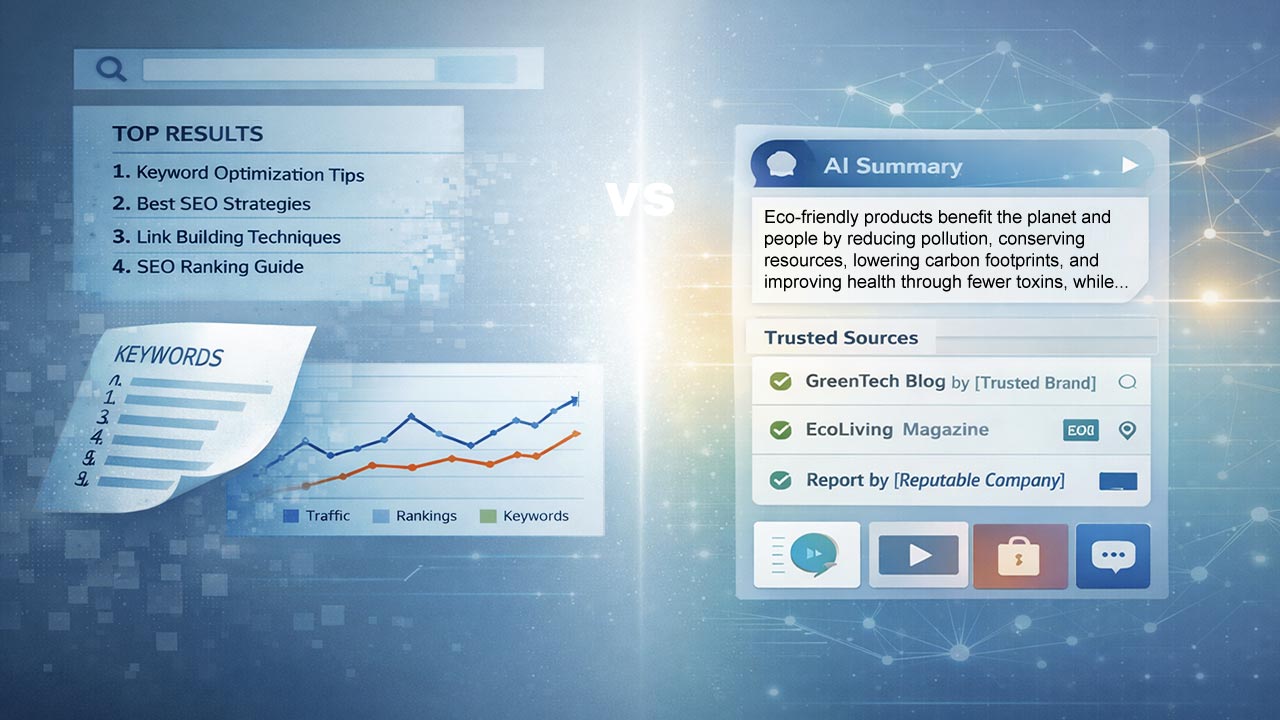
Old SEO optimized for exposure. New SEO optimizes for inclusion.
Rankings place your content in a list. Citations embed your brand inside the answer itself. A ranking is passive. A citation is an endorsement.
When an AI engine cites a brand, it is signaling trust. That signal compounds over time as models learn which sources consistently deliver value. This is why brands that are cited once often continue to appear again and again, while others disappear entirely.
Why Authority Is the New SEO Currency
Authority is no longer inferred from backlinks alone. AI systems evaluate authority holistically, factoring in topical depth, clarity, consistency, and real-world relevance.
Publishing dozens of shallow blog posts no longer builds visibility. In fact, it can dilute it. What matters now is whether your content demonstrates genuine expertise and original insight.
Brands that win citations tend to:
Address complex questions clearly
Provide structured explanations
Reference credible data and frameworks
Align messaging across channels
Authority is not volume. It is precision at scale.
From Keywords to Intent Matching
Keyword stuffing worked when algorithms were literal. AI is contextual. It understands nuance, intent, and semantics far beyond exact-match phrases.
New SEO starts with understanding why a question is being asked. Informational intent, evaluative intent, and buying intent all require different content structures. AI engines favor sources that match the underlying intent, not just the words used in the query.
This is why some lower-traffic pages are now outperforming high-volume content. They answer the right question, not the loudest one.
Why Traffic Is No Longer Visibility
Many teams still confuse traffic with relevance. Dashboards show sessions increasing while brand visibility quietly erodes.
Traffic measures visits. Visibility measures presence in decision-making moments.
If your competitor is being cited in AI-generated answers while your brand is not, they are shaping the narrative before the buyer ever reaches a website. By the time a click happens, trust has already been allocated.
In AI-mediated discovery, being absent is not neutral. It is disqualifying.
The New SEO Framework for 2026
New SEO operates on a different framework:
Retrievability ensures your content can be accessed and parsed by AI systems.
Credibility establishes trust signals through depth, clarity, and consistency.
Cite-worthiness makes your content easy to reference in synthesized answers.
Compounding visibility turns every citation into future authority.
This framework shifts SEO from a tactical channel into a strategic asset. It touches brand, content, product messaging, and thought leadership.
What This Means for Marketing Teams
This transition is uncomfortable because it exposes outdated incentives. Teams rewarded for publishing volume will struggle. Teams optimized for rankings will feel successful right up until they disappear from AI discovery.
Modern marketing teams must collaborate across SEO, content, product, and PR. Authority cannot be outsourced or automated. It must be earned.
The most successful organizations are already reallocating budgets away from low-value content production and toward fewer, higher-impact assets designed to be cited.
Future-Proofing Your Brand for AI Discovery
The uncomfortable truth is simple: if AI engines do not cite you, buyers will not see you.
AI is now the primary distribution layer for knowledge. It decides which brands matter, which ideas persist, and which voices fade out. Visibility belongs to those chosen by AI, not those shouting the loudest.
The brands that win in 2026 will not be the ones chasing rankings. They will be the ones building authority worth citing.
Top 5 Frequently Asked Questions
Final Thoughts
SEO is no longer about winning a position on a results page. It is about earning a place in the answer itself. As AI becomes the dominant interface for discovery, authority replaces traffic as the metric that matters. Brands that understand this shift early will compound visibility. Those that ignore it will slowly disappear, even while their dashboards look healthy. In the age of AI, visibility belongs to the brands that AI chooses to trust.
Resources
- Google Search Generative Experience Documentation
- OpenAI Retrieval and Citation Research
- Gartner: The Future of Search and AI-Driven Discovery
- McKinsey: How AI Is Reshaping Marketing and Growth


Leave A Comment