



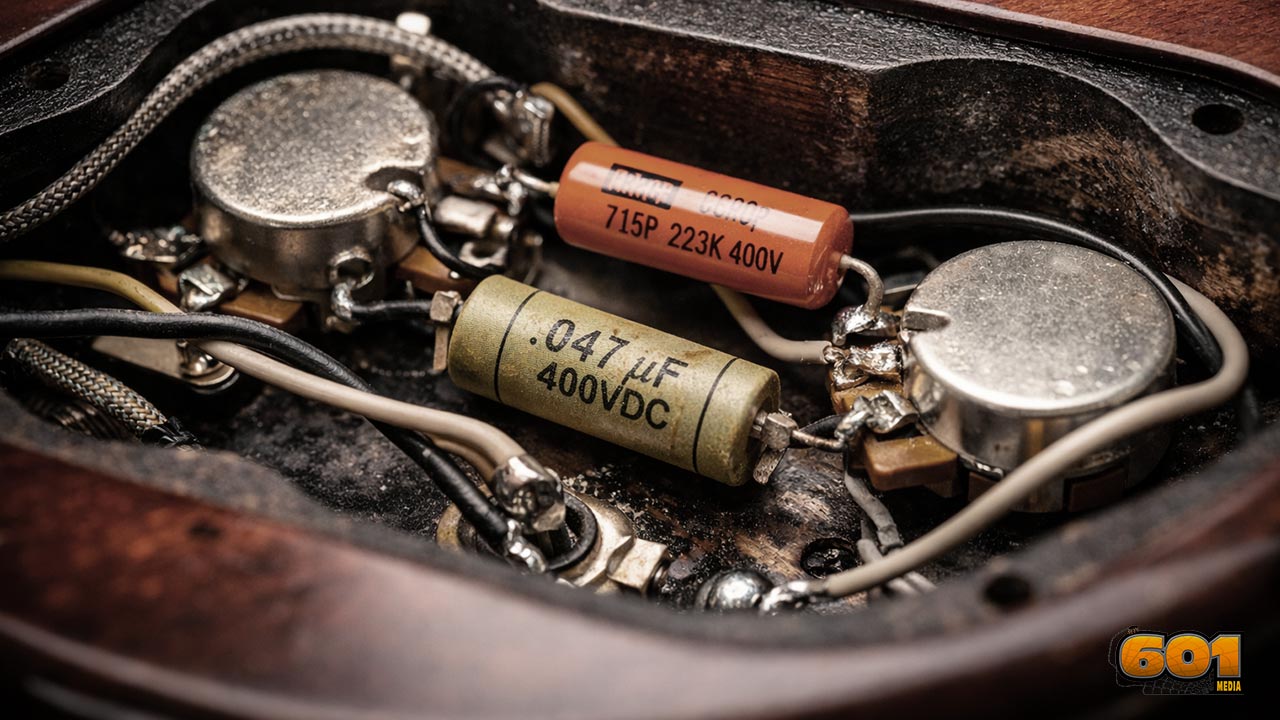
The Truth About Guitar Tone Capacitors: Myths, Science, and Sound
Guitar tone capacitors are among the most misunderstood components in electric guitars. Often credited with dramatic tonal changes or dismissed as irrelevant myths, these tiny electronic parts sit at the center of endless debates among players, builders, and modders. We’ll cut through folklore, marketing hype, and forum noise to explain what tone capacitors actually do, what they cannot do, and how to choose the right one based on sound engineering rather than belief.
Table of Contents
- What a Guitar Tone Capacitor Actually Does
- Capacitor Values and Frequency Roll-Off
- Capacitor Materials and the Myths
- Tolerance, Voltage, and Build Quality
- What Listening Tests Really Reveal
- How to Choose the Right Tone Capacitor
- Top 5 Frequently Asked Questions
- Final Thoughts
- Resources
What a Guitar Tone Capacitor Actually Does
A guitar tone capacitor is part of a passive low-pass filter. Its only job is to route high frequencies to ground as the tone knob is turned down. When the tone knob is fully open, the capacitor is effectively removed from the signal path. No filtering occurs, and the guitar’s pickups feed the output unaltered by the tone circuit.
This point is critical. With the tone knob on 10, the capacitor does not color the sound. Any perceived difference at full tone is almost always caused by component tolerance, wiring layout, or expectation bias rather than the capacitor itself.
The filter cutoff frequency depends on two variables: the capacitor value and the resistance of the tone potentiometer. Together, they determine how aggressively treble frequencies are reduced as the knob is rolled back.
Capacitor Values and Frequency Roll-Off
Capacitor value, measured in microfarads (µF), has a direct and measurable effect on tone. Larger values remove more high frequencies and begin rolling off treble at higher tone-knob positions.
Common values include:
- 0.047 µF – Standard for many single-coil guitars
- 0.022 µF – Common in humbucker-equipped guitars
- 0.015 µF – Retains more clarity when rolling down tone
- 0.1 µF – Heavy treble reduction, often used in vintage circuits
A higher capacitor value does not make the guitar “warmer” by default. It simply lowers the cutoff frequency of the low-pass filter. This distinction matters because warmth is a psychoacoustic perception, not an electrical property.
Choosing a value should depend on pickup inductance, musical style, and how often the tone control is used dynamically rather than left fully open.
Capacitor Materials and the Myths
This is where mythology dominates reality. Ceramic, polyester, polypropylene, paper-in-oil, silver mica, and boutique “vintage correct” capacitors are often claimed to have distinct tonal personalities.
In a passive guitar circuit operating at low voltage and audio frequencies, capacitor material has no audible impact when the values are equal and tolerances are controlled. Electrical engineering literature supports this conclusion consistently.
What players often perceive as tonal differences are typically caused by:
- Wide tolerance ranges in vintage-style capacitors
- Different actual capacitance values than labeled
- Expectation bias reinforced by cost or reputation
- Changes in tone-knob taper behavior
Paper-in-oil capacitors gained legendary status largely due to their use in early electric guitars, not because of superior sonic properties. Modern film capacitors outperform them in stability, consistency, and lifespan.
Tolerance, Voltage, and Build Quality
Tolerance matters more than material. A capacitor rated at ±20% can vary enough to audibly affect the roll-off behavior of the tone control. Two guitars using “the same” capacitor value may behave very differently if one measures 0.018 µF and the other 0.026 µF.
Voltage rating, on the other hand, is largely irrelevant. Guitar circuits operate at fractions of a volt. A 50V capacitor performs identically to a 400V capacitor in this application.
Build quality does matter for reliability. Cheap capacitors can drift over time, become microphonic, or fail outright. However, once basic quality thresholds are met, price has no correlation with sound.
What Listening Tests Really Reveal
Blind listening tests consistently show that players cannot reliably identify capacitor material when values are matched. When differences are detected, measurements usually reveal mismatched capacitance rather than material influence.
Controlled experiments using oscilloscopes and frequency analysis confirm that tone capacitors behave predictably and mathematically. The guitar signal does not contain the voltage, current, or bandwidth conditions required for dielectric coloration to manifest audibly.
This does not mean players are “wrong” to hear differences. It means the cause is often misidentified.
How to Choose the Right Tone Capacitor
A rational approach to tone capacitors prioritizes value, tolerance, and usability over mystique.
Best practices include:
- Select the capacitor value based on pickup type and tonal goals
- Choose ±5% or ±10% tolerance for consistency
- Ignore voltage ratings beyond basic safety margins
- Avoid paying premiums for unverified tonal claims
For players who ride the tone knob constantly, smaller values often provide more usable sweep. For players who treat it as a preset, traditional values work well.
Top 5 Frequently Asked Questions
Final Thoughts
The truth about guitar tone capacitors is refreshingly simple. They are predictable electronic components governed by well-understood physics. Their influence on tone is real, but limited, and often exaggerated by marketing narratives and cognitive bias.
Understanding how capacitance values shape frequency response empowers players to make informed decisions. When mystique is removed, tone control becomes a practical tool rather than a source of endless confusion.
Resources
- R.G. Keen – “The Secret Life of Tone Controls”
- Helmuth Lemme – Electric Guitar Pickup Analysis
- Douglas Self – Audio Electronics Theory
- IEEE Transactions on Audio and Electroacoustics


Leave A Comment