



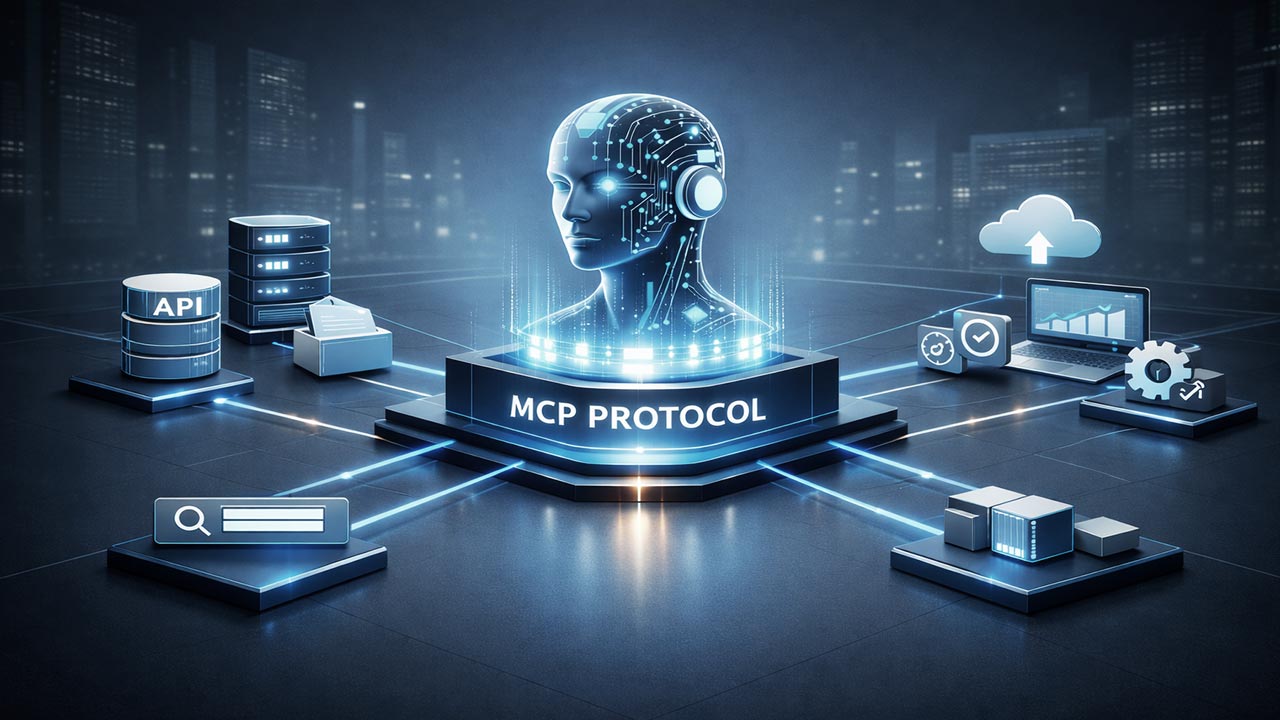
Model Context Protocol (MCP): How AI Finally Connects to Real Systems
The Model Context Protocol (MCP) is an emerging open standard designed to solve one of modern AI’s biggest limitations: reliable, secure, and scalable access to real-world tools, data, and systems. MCP defines a structured way for AI models to understand, request, and use external context such as APIs, databases, files, and enterprise services without brittle custom integrations.
Table of Contents
- What Is the Model Context Protocol (MCP)?
- The Core Problem MCP Is Solving
- What Is Currently in Place Before MCP
- How MCP Works: Architecture and Flow
- How MCP Will Be Used in Practice
- Enterprise and Product Implications
- Security, Governance, and Trust
- Why MCP Matters for the Future of AI
- Top 5 Frequently Asked Questions
- Final Thoughts
- Resources
What Is the Model Context Protocol (MCP)?
The Model Context Protocol (MCP) is a standardized communication layer that allows AI models to interact with external tools and data sources in a predictable, auditable, and reusable way. Instead of hard-coding tool usage into an AI application, MCP defines a shared contract for how context is described, requested, delivered, and used.
At its core, MCP separates three concerns that are often tightly coupled today: the AI model, the tools or data sources it can use, and the application logic that connects them. This separation enables models to dynamically discover and use tools without custom glue code for each integration.
The Core Problem MCP Is Solving
Modern AI systems are powerful at reasoning and language generation, but they are inherently disconnected from live systems. To be useful in real workflows, they need access to files, APIs, databases, SaaS platforms, and internal services.
Today, this access is achieved through bespoke integrations that create several problems:
- Each tool requires custom prompts and function definitions
- Integrations are fragile and break when APIs change
- Security policies are inconsistent across tools
- Context handling is opaque and difficult to audit
- Scaling across teams or products is slow and expensive
MCP addresses these issues by providing a common language for context exchange, allowing tools to be plugged into AI systems the same way USB devices plug into a computer.
What Is Currently in Place Before MCP
Before MCP, AI tool integration relies on a patchwork of approaches.
One common method is prompt-based tool calling, where developers describe available tools directly in the prompt. This approach is simple but brittle, as models may hallucinate tool usage or misuse parameters.
Another approach uses function calling or structured outputs, where developers define schemas the model must follow. While more reliable, this still requires custom implementation per tool and per model provider.
Retrieval-augmented generation (RAG) systems add external knowledge via vector databases, but they are optimized for reading data, not performing actions or managing live context.
Plugins and agents attempt to orchestrate multiple tools, but they lack a shared protocol, leading to vendor lock-in and duplicated effort.
In short, the current ecosystem works, but it does not scale cleanly across organizations, tools, or AI providers.
How MCP Works: Architecture and Flow
MCP introduces a clear, modular architecture made up of three primary components.
The first component is the MCP server. This server exposes tools, data sources, or services in a standardized way. Each capability is described using a structured schema that defines what the tool does, what inputs it accepts, and what outputs it returns.
The second component is the MCP client. This is typically an AI application or agent that knows how to speak MCP. It does not need custom code for each tool; it only needs to understand the protocol.
The third component is the AI model. The model receives structured context describing available tools and decides when and how to use them as part of its reasoning process.
The flow works as follows:
- The client connects to one or more MCP servers
- The servers advertise available tools and context
- The model selects a tool based on its goal
- The client executes the request via MCP
- The result is returned as structured context
- The model incorporates the result into its response
This flow makes tool usage explicit, observable, and repeatable.
How MCP Will Be Used in Practice
MCP enables a new class of AI-powered applications that are deeply integrated with real systems.
In developer tools, an AI assistant can safely read repositories, open pull requests, run tests, and inspect logs without custom integrations for each platform.
In enterprise environments, AI agents can access internal dashboards, query approved databases, and trigger workflows while respecting access controls and audit requirements.
In personal productivity, a single assistant could manage calendars, emails, documents, and task systems through standardized MCP interfaces.
For AI vendors, MCP allows models to work across ecosystems without being tightly coupled to proprietary plugins or APIs.
The key shift is that tools become discoverable services rather than hard-coded features.
Enterprise and Product Implications
From an innovation management perspective, MCP reduces integration friction, which directly lowers time-to-value for AI initiatives.
Teams can expose internal capabilities once and reuse them across multiple AI products. Governance teams gain visibility into what tools are available and how they are used. Product leaders can iterate faster without rebuilding infrastructure.
MCP also encourages modular product design. Tools become independent services with clear contracts, enabling parallel development and easier deprecation.
This aligns with modern platform strategies and composable architecture trends seen in cloud-native systems.
Security, Governance, and Trust
Security is a central design consideration for MCP.
Because tools are exposed via servers with explicit schemas, organizations can enforce authentication, authorization, and logging at the protocol level. Models never receive raw credentials or unrestricted access.
Every tool invocation can be audited. Permissions can be scoped by role, environment, or task. Sensitive operations can require human approval.
This is a significant improvement over prompt-based integrations, where context leakage and unintended actions are common risks.
Trust is built through transparency and control, not blind automation.
Why MCP Matters for the Future of AI
MCP represents a shift from model-centric AI to system-centric AI.
As models become more capable, the limiting factor is no longer reasoning ability but integration quality. The real value of AI lies in how well it connects to the systems where work actually happens.
By standardizing context exchange, MCP enables an ecosystem where tools, models, and applications evolve independently while remaining interoperable.
This mirrors the evolution of the web, where shared protocols unlocked massive innovation without central control.
Top 5 Frequently Asked Questions
Final Thoughts
The Model Context Protocol is not just another AI integration pattern. It is a foundational layer that addresses scalability, security, and interoperability at the same time. By treating context as a first-class, standardized resource, MCP unlocks more reliable, trustworthy, and extensible AI systems.
For organizations investing in AI long-term, understanding MCP is not optional. It is a signal of where the ecosystem is heading and how serious AI systems will be built.
Resources
- Anthropic MCP Specification and Documentation
- Open-source MCP server examples and SDKs
- Research on tool-augmented language models
- Enterprise AI governance best practices


Leave A Comment