



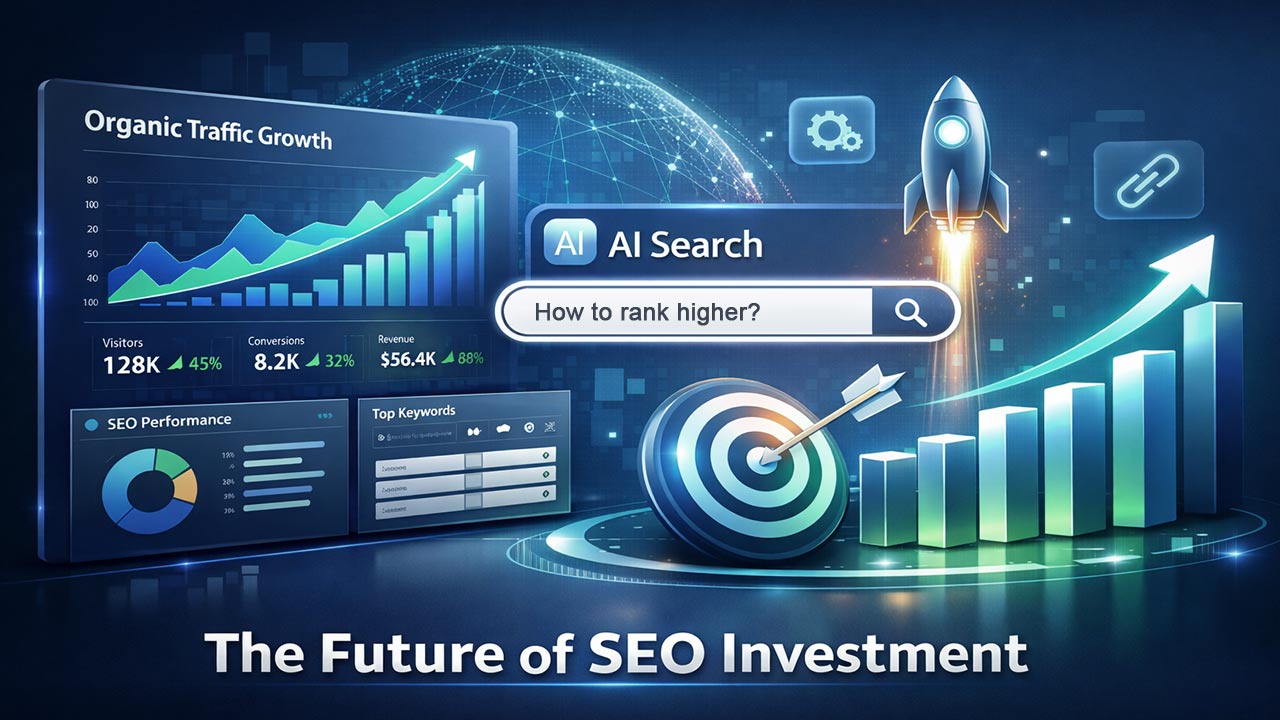
Will Companies Invest More or Less in SEO in 2026?
SEO budgets are no longer a “nice to have.” They are a boardroom discussion tied directly to growth, resilience, and competitive survival. As we approach 2026, companies are reassessing how search fits into a world shaped by AI-driven discovery, zero-click results, privacy regulation, and tightening marketing budgets. The central question is not whether SEO still matters, but how much companies are willing to invest—and where that investment will shift. Todays article explores whether companies will invest more or less in SEO in 2026, what forces are shaping those decisions, and how SEO itself is evolving into a broader digital demand engine.
Table of Contents
- SEO Spending Trends Heading into 2026
- Economic and Budget Pressures on Marketing
- How AI and Search Evolution Are Reshaping SEO Investment
- SEO vs Paid Media: A Cost Efficiency Comparison
- How Investment Will Differ by Company Size
- Where SEO Budgets Will Actually Be Spent
- Why SEO Is Becoming a Long-Term Risk Strategy
- Top 5 Frequently Asked Questions
- Final Thoughts
- Resources
SEO Spending Trends Heading into 2026
Companies are expected to invest more in SEO in 2026—but not in the way they did in the past. The era of heavy spending on keyword stuffing, mass backlink acquisition, and generic blog content is effectively over. Instead, investment is shifting toward fewer, higher-impact initiatives. According to multiple industry surveys conducted between 2023 and 2025, over 70 percent of marketers reported that organic search delivered higher long-term ROI than paid channels. At the same time, more than half of CMOs stated they planned to protect or increase SEO budgets even during cost-cutting cycles. The reason is simple. SEO compounds. While paid media stops the moment spend is paused, organic visibility continues to generate demand, leads, and brand authority over time. In uncertain economic conditions, compounding assets become more attractive, not less. In 2026, SEO investment will likely grow modestly in total dollars, but significantly in strategic importance.
Economic and Budget Pressures on Marketing
Macroeconomic pressure is forcing marketing leaders to justify every dollar. Inflation, higher interest rates, and slower growth forecasts have pushed companies to focus on efficiency rather than expansion.
SEO benefits from this environment because it aligns with three executive priorities:
- Revenue attribution over vanity metrics
- Lower customer acquisition costs
- Sustainable, defensible growth channels
While overall marketing budgets may flatten or grow slowly, SEO is increasingly viewed as infrastructure rather than campaign spend. That framing matters. Infrastructure budgets are protected. Campaign budgets are cut. Companies reducing spend in 2026 are more likely to cut experimental channels, influencer programs, or underperforming paid ads before they reduce SEO investment.
How AI and Search Evolution Are Reshaping SEO Investment
AI-powered search experiences are changing how users discover information, but they are not eliminating the need for SEO. They are raising the bar.
Search engines now prioritize:
- Topical authority instead of isolated keywords
- First-hand experience and expert insight
- Structured data and machine-readable content
- Brand trust signals across the web
This means companies must invest more per piece of content, not less. Thin content strategies fail in AI-assisted search environments because they lack credibility and depth.
SEO investment in 2026 will increasingly fund:
- Subject-matter experts instead of generic writers
- Original research and proprietary data
- Content optimization for AI summaries and featured answers
- Technical SEO for crawlability, speed, and structured data
In effect, SEO is merging with knowledge management and brand authority building.
SEO vs Paid Media: A Cost Efficiency Comparison
One of the strongest drivers of increased SEO investment is the rising cost of paid acquisition. Cost per click across major platforms has increased steadily year over year, especially in competitive B2B, SaaS, finance, and e-commerce sectors. By contrast, the marginal cost of organic traffic decreases over time. Once a page ranks, each additional visitor costs less than the last.
Executives are increasingly modeling SEO as a demand hedge:
- Paid media delivers speed
- SEO delivers durability
In 2026, companies are unlikely to abandon paid media, but they will rebalance. SEO will absorb budget previously allocated to underperforming paid campaigns, particularly in upper-funnel awareness and informational queries.
How Investment Will Differ by Company Size
Investment trends will vary significantly by organization type. Large enterprises will invest more in SEO platforms, automation, and governance. Their focus will be on scaling content quality, managing global search visibility, and integrating SEO into product, PR, and brand teams. Mid-market companies will increase investment selectively, prioritizing high-intent content, technical performance, and conversion-focused optimization. Small businesses may not increase total SEO spend, but they will rely on it more heavily. With limited paid media budgets, organic visibility remains one of the few viable growth levers available. Across all sizes, SEO is becoming less of a silo and more of a shared capability across marketing, product, and communications.
Where SEO Budgets Will Actually Be Spent
SEO spending in 2026 will shift away from volume and toward capability building.
Key investment areas include:
- Advanced SEO and analytics platforms
- Content optimization tools integrated with AI
- Technical SEO and site performance improvements
- In-house SEO talent and training
- Digital PR and authority-building initiatives
Interestingly, many companies will spend less on external agencies and more on internal expertise. This reflects the increasing strategic nature of SEO. Tactical execution can be automated. Strategic judgment cannot.
Why SEO Is Becoming a Long-Term Risk Strategy
Perhaps the most overlooked driver of SEO investment is risk management. Companies that fail to invest in organic visibility become dependent on platforms they do not control. Algorithm changes, ad policy shifts, and rising auction prices expose businesses to sudden demand loss. SEO mitigates that risk by diversifying traffic sources and strengthening brand discoverability. In 2026, SEO will be framed less as a growth hack and more as an insurance policy against volatility in digital markets.
Top 5 Frequently Asked Questions
Final Thoughts
Companies will invest more in SEO in 2026—not because it is trendy, but because it is rational. In an environment defined by uncertainty, rising costs, and AI-driven disruption, SEO offers something few channels can: durable, compounding value. The nature of SEO investment is changing. Success will belong to organizations that treat SEO as a strategic capability, invest in expertise and infrastructure, and align organic visibility with long-term business goals. Those who underinvest risk becoming invisible in the very systems customers rely on to make decisions.
Resources
- Gartner Marketing Budget and Spend Surveys
- Google Search Central Documentation
- HubSpot State of Marketing Reports
- McKinsey Digital Marketing ROI Studies
- Ahrefs and SEMrush Industry Research Reports


Leave A Comment