



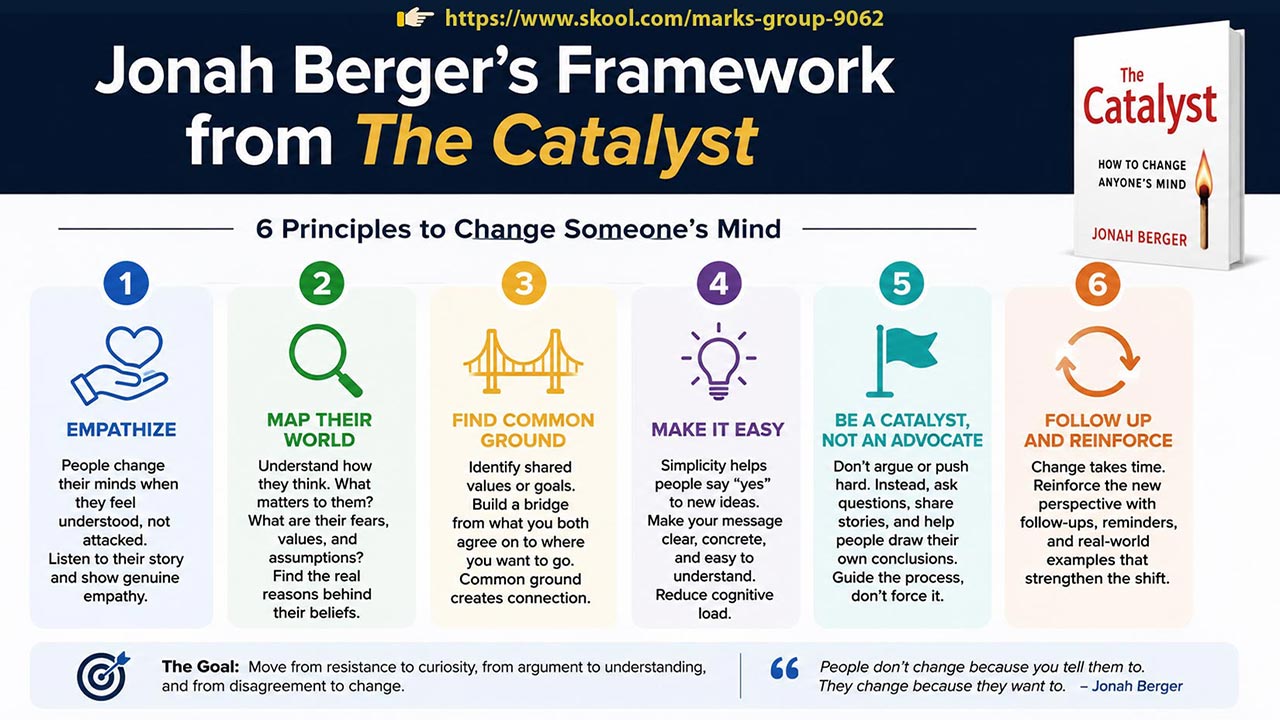
Jonah Berger’s Framework from The Catalyst: How to Change Someone’s Mind
Jonah Berger’s book The Catalyst: How to Change Anyone’s Mind explains a simple but powerful idea: people do not usually change because someone pushes harder. They change when the barriers stopping them are removed. Berger, a Wharton marketing professor, calls this approach being a “catalyst.” Instead of forcing people toward a decision, a catalyst makes change easier. His REDUCE framework includes five barriers: Reactance, Endowment, Distance, Uncertainty, and Corroborating Evidence.
The first barrier is Reactance. This happens when people feel like someone is trying to control them. A teenager may ignore good advice simply because it sounds like an order. Adults do the same thing at work, in politics, and in buying decisions. Berger’s solution is to give people more choice. Ask questions. Let them feel ownership. For innovation leaders, this matters because employees resist new technology when they feel it is being forced on them.
The second barrier is Endowment. People tend to value what they already have. Even if a new tool is better, the old tool feels safe because it is familiar. This is why companies often struggle to replace outdated systems. A good catalyst does not just explain why the new thing is better. They show what the person is losing by staying the same. The goal is to make the cost of inaction visible.
The third barrier is Distance. Sometimes an idea feels too far from what a person already believes. When that happens, facts may not help. They may even make the person dig in deeper. Berger’s advice is to shrink the gap. Start with a smaller step the person can accept. In technology management, this could mean piloting artificial intelligence in one department before asking the whole company to change.
The fourth barrier is Uncertainty. People avoid change when they are unsure what will happen. A customer may like a product but still worry it will not work for them. A manager may support innovation but fear failure. Catalysts reduce uncertainty through free trials, demos, pilots, guarantees, and clear examples. These tools lower risk and make the next step feel safer.
The fifth barrier is Corroborating Evidence. Some decisions need more than one voice. A person may need to hear the same message from several trusted sources before changing their mind. This is especially true for big, risky, or emotional decisions. In business, that means case studies, peer examples, expert reviews, and customer stories can be more persuasive than one sales pitch.
Berger’s framework is useful because it respects human behavior. It does not treat people as stubborn or irrational. It asks: “What is blocking this person from changing?” That question is better than simply asking, “How can I convince them?”
For leaders, marketers, teachers, parents, and innovators, the lesson is clear. Do not push harder. Remove friction. Give people control, make the new option feel valuable, reduce the size of the leap, lower risk, and bring in trusted proof. That is how a catalyst changes minds.
For more content like this join our support community here: https://www.skool.com/marks-group-9062


Leave A Comment